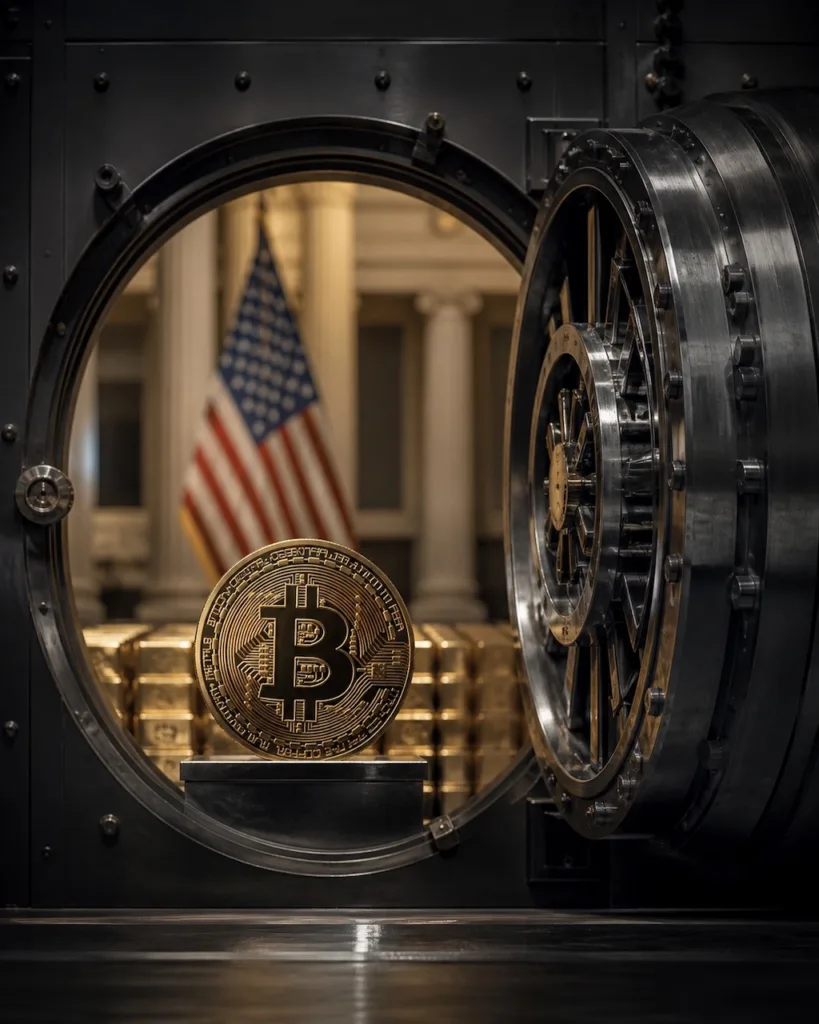
If Bitcoin long carried the label of a “speculative asset,” that framing has now officially changed, at least at the level of the U.S. federal government. On March 6, 2025, President Donald Trump signed an executive order on “Establishment of the Strategic Bitcoin Reserve and United States Digital Asset Stockpile.” With it, Bitcoin became the first crypto asset the U.S. has declared it will hold and manage at the national level. Fourteen months after the signing, the actual build-out of the reserve is still underway, and debate over putting it into law continues.
- What did the executive order specify?
The core of the executive order comes down to two structures: the Strategic Bitcoin Reserve and the U.S. Digital Asset Stockpile.
The Strategic Bitcoin Reserve sets up a separate office under the Treasury and consolidates into it the Bitcoin that federal agencies have acquired through criminal and civil forfeiture. The executive order states in writing that Bitcoin held in the reserve “shall not be sold and shall be maintained as reserve assets of the United States.” The Treasury secretary and the commerce secretary were also given authority to develop budget-neutral strategies for acquiring additional Bitcoin at no cost to taxpayers.
The Digital Asset Stockpile is a separate account for managing other forfeited crypto assets besides Bitcoin, such as Ethereum (ETH), XRP and Solana (SOL). Unlike the Bitcoin reserve, which follows a strict “never sell” principle, the stockpile was designed as a flexible structure in which the Treasury secretary can decide on management strategy depending on circumstances.
The executive order also required every federal agency to fully report its digital asset holdings to the Treasury secretary and the President's Working Group on Digital Asset Markets within 30 days of the signing.
- How much Bitcoin does the U.S. government actually hold?
There is an important caveat. This reserve does not mean “the government bought Bitcoin in bulk on the market.” The roughly 328,372 BTC the federal government currently holds were accumulated through seizures and forfeitures in criminal cases such as Silk Road and the Bitfinex hack. They are worth about $25 billion at market prices and make the U.S. the world's largest national holder of Bitcoin. In other words, the reserve started not as a policy investment decision but as a byproduct of law enforcement. BeInCrypto
According to a White House fact sheet, selling Bitcoin prematurely in the past cost taxpayers more than $17 billion in lost value. Previous administrations disposed of forfeited Bitcoin through public auctions run by the U.S. Marshals Service. The executive order formally ended that policy and switched to a “hold, don't sell” approach. The White House
- Why was Bitcoin singled out?
The order's background section spells out why Bitcoin was treated separately. The text notes that Bitcoin's total supply is permanently capped at 21 million coins and that it has never been hacked, and on that basis calls Bitcoin “digital gold.” The case for Bitcoin as a national reserve asset, based on scarcity and security, is laid out directly in the body of the order. Federal Register
This is not mere rhetoric. It applies to Bitcoin the logic behind strategic goods the U.S. has traditionally managed, such as gold reserves, the Strategic Petroleum Reserve and medical stockpiles, and it formally places Bitcoin in the category of national security assets. It is the first time the U.S. has officially designated a cryptocurrency as a strategic national reserve asset. Lathrop GPM
- Legislation is still unfinished, and the limits are clear
An executive order is a powerful symbol, but because it is not a law, it has structural limits. The Trump administration has concluded that setting up the reserve requires legislative action by Congress, and more than a year after the order was signed, the reserve still has not actually been built. CoinDesk
Legislative efforts to fill the gap are underway. The BITCOIN Act (Boosting Innovation, Technology, and Competitiveness through Optimized Investment Nationwide Act), introduced by Republican Sen. Cynthia Lummis, would require the Treasury to buy a total of 1 million BTC over five years and hold them in trust. But as earlier bills such as the CLARITY Act have struggled in Congress, momentum behind digital asset legislation as a whole is weakening. Blockmedia
People familiar with the legislative strategy point to an amendment to the National Defense Authorization Act (NDAA) at the end of 2026 as a realistic path for including a Bitcoin reserve provision. CoinDesk
The latest developments are also worth noting. At the Bitcoin 2026 conference in Las Vegas in late April 2026, White House crypto adviser Patrick Witt said the Trump administration would announce a major update on the Strategic Bitcoin Reserve within the next few weeks, claiming a breakthrough on the legal framework. The details have not yet been disclosed. BeInCrypto
- Global ripple effects: other countries respond
The U.S. move is spurring similar discussions among other countries and institutions. Bills allowing central banks to hold Bitcoin as a reserve asset have been introduced one after another in the legislatures of Argentina, Brazil, Hong Kong and Japan, and Japan's Government Pension Investment Fund (GPIF) has said it plans to explore diversifying into Bitcoin. Wikipedia
States within the U.S. have also moved quickly. In May 2025, New Hampshire's governor signed a bill allowing investment in digital assets with a market capitalization of more than $500 billion, and Texas's Strategic Bitcoin Reserve law formally took effect on June 22, 2025. Wikipedia
Change in private finance is also striking. In December 2025, Vanguard Group, the world's second-largest asset manager, dropped its longstanding skepticism toward crypto and began selling ETFs and mutual funds that invest in Bitcoin, Ethereum, XRP, Solana and others. The regulatory environment eased as well. On March 7, 2025, the day after the executive order, the Office of the Comptroller of the Currency (OCC) issued an interpretive letter (Interpretive Letter 1183) stating that banks do not need prior supervisory approval to carry out crypto-related activities. HankyungLathrop GPM
BITPRESS Insight
The core significance of this executive order is that it reclassified Bitcoin from something to be disposed of into something to be preserved. The “we won't sell” declaration itself has the structural effect of removing potential selling pressure from the market.
But a sober view is also needed. Fourteen months after the order was signed, the reserve has still not actually been built, and the BITCOIN Act's chances of passing Congress are seen as low. The prediction market Polymarket puts the probability that the U.S. actually establishes a Strategic Bitcoin Reserve before 2027 at 23%. With the White House adviser promising an announcement “within weeks,” progress may come soon, but until the gap between executive order and law is closed, the policy's permanence cannot be guaranteed.
For long-term investors, the more important signal is not the size but the “change in classification.” The fact that Bitcoin has officially joined the list of state-managed assets alongside gold, oil and strategic medicines means that the risk narrative of “an asset that could vanish at any time” has officially ended, at least at the U.S. federal level. Investors should note that this shift may have a bigger impact over a much longer time frame than short-term prices.
Sources
https://www.whitehouse.gov/presidential-actions/2025/03/establishment-of-the-strategic-bitcoin-reserve-and-united-states-digital-asset-stockpile/ https://www.whitehouse.gov/fact-sheets/2025/03/fact-sheet-president-donald-j-trump-establishes-the-strategic-bitcoin-reserve-and-u-s-digital-asset-stockpile/ https://www.federalregister.gov/documents/2025/03/11/2025-03992/establishment-of-the-strategic-bitcoin-reserve-and-united-states-digital-asset-stockpile https://en.wikipedia.org/wiki/U.S._Strategic_Bitcoin_Reserve https://www.lathropgpm.com/insights/white-house-establishes-a-u-s-strategic-bitcoin-reserve-and-digital-asset-stockpile-what-it-is-and-what-it-implies/ https://phemex.com/blogs/us-bitcoin-holdings-and-strategic-reserve https://www.congress.gov/bill/119th-congress/senate-bill/954 https://www.coindesk.com/ko/news-analysis/2026/03/06/those-who-cheered-u-s-bitcoin-reserve-have-spent-year-watching-trump-order-languish https://kr.beincrypto.com/white-house-strategic-bitcoin-reserve-announcement/ https://www.blockmedia.co.kr/archives/1080535