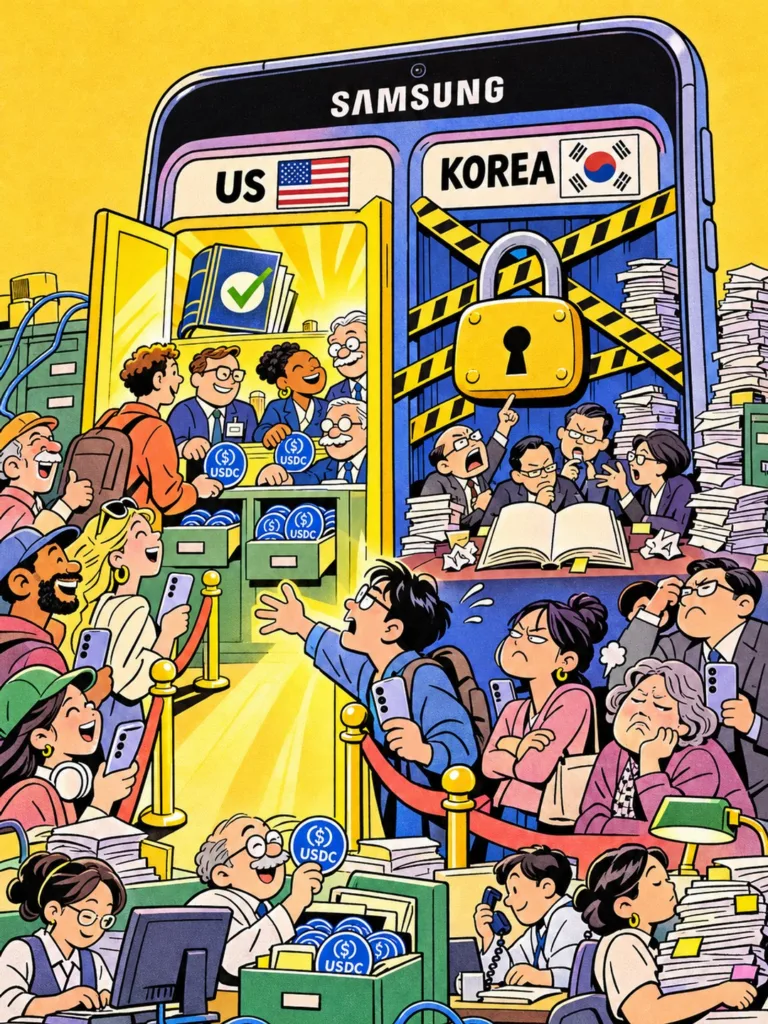
On Nov. 5, a "stablecoin account" opened in Samsung Wallet for US Galaxy users. A stablecoin is a coin built to stay tied 1-to-1 to money such as the dollar, and the account lets users buy, hold and send USDC, a dollar stablecoin. By Samsung's count, about 82 million US Galaxy devices are compatible with the account.
The common assumption is, "Samsung is a Korean company, so this will surely come to Korea soon." But the account is open only to US users, and Galaxy users in Korea cannot use it.
The key looks to be rules, not technology. The US has a federal law setting rules for issuing stablecoins and licensed custody firms, while Korea's bill had not yet been submitted to the National Assembly as of Nov. 2.
- What is the USDC account in Samsung Wallet?
USDC is a stablecoin issued by affiliates of Circle, and each coin is promised to be exchangeable for one dollar. Circle says USDC is 100% backed by cash and near-cash assets.
Think of a department store gift card. Both work like money for a set amount. The difference is that a gift card circulates only inside that store, while USDC moves straight to other wallets on Solana, one of the blockchains USDC runs on.
Samsung Wallet users pay Samsung no transfer fee when sending USDC to another Samsung Wallet or an outside crypto wallet. They can also send money to bank accounts in more than 60 countries, with fees that vary by destination. Users must be 18 or older with a device running Android 13 or later, and New York residents are excluded.
- Why doesn't Samsung hold the coins itself?
Custody means holding a customer's money or coins on their behalf. The account is run by Bastion, a licensed stablecoin custody and infrastructure company. The USDC itself is held by Coinbase through a storage service called Coinbase Prime Vault. When a custodian passes safekeeping on to another firm like this, it is called sub-custody.
Users buy and send USDC on the Samsung Wallet screen, but Bastion appears to process the account and Coinbase keeps the USDC in its vault. Samsung handles the screen users see, in effect the front counter.
Picture a bank branch inside a shopping mall. The sign may hang in the mall, but the bank holds the money. So users do not have to install a separate crypto app or manage a private key, the password-like key to a crypto wallet, themselves.
- How was this kind of front counter possible in the US?
On July 18, 2025, the US president signed the GENIUS Act, the federal stablecoin law. The White House said the law creates the first federal regulatory system for stablecoins.
The law requires issuers to hold 100% reserves in assets such as dollars or short-term Treasuries and to publish the makeup of those reserves every month. If an issuer cannot pay its debts, coin holders' claims come ahead of other creditors.
Put simply, it settled who may issue the coins, what backs them, and whose money is returned first if something goes wrong. With such rules in place, Samsung likely could choose to partner with a licensed firm and leave custody to it.
- What does Korea lack?
Korea's stablecoin law is the Digital Asset Basic Act, which the government is preparing and which covers both crypto and stablecoins. On Nov. 2, a Democratic Party lawmaker on the Political Affairs Committee said, "The Financial Services Commission says it will provide the government bill in November," and "We will try to get it passed by December."
That means the government bill had not yet been submitted to the National Assembly as of Nov. 2. Who should be allowed to issue won stablecoins was also still in dispute as of Nov. 2. The lawmaker was reported to have cited resistance from the traditional financial industry as the reason talks have slowed.
Imagine a place with no taxi licensing system. Even with a car, you cannot start a taxi company. Korea has the car, Samsung Wallet, but it seems to have no licensing system yet that sets what qualifications a coin-custody firm needs.
- What signals a Korean launch?
Samsung said its next steps are to explore online and in-store stablecoin payments and expansion to other markets. It attached a condition, though: "subject to local regulation." In effect, Samsung itself made each country's rules a condition of expansion.
In the US, about 16 months passed between the signing of the GENIUS Act (July 2025) and the launch of the Samsung Wallet account (November 2026). How the two events are connected is unconfirmed. Korea differs in that the bill debate centers on who issues won stablecoins.
Lily Liu, president of the Solana Foundation, said, "For a decade, stablecoins have proved the technology works. What they lacked was a way to reach the mainstream." Samsung Wallet opened that path in the US first.
- BITPRESS Insight
That Galaxy users in Korea cannot use a USDC account looks like a problem of rules rather than technology. The US has a federal stablecoin law and licensed custodians, so Samsung likely could hand off custody and just open the screen, while Korea has no law yet setting qualifications for the firms that would hold the coins.
So a Korean launch of this service likely depends as much on the National Assembly passing a law as on Samsung's decision. Once a law exists, issuers and custodians can qualify, and an app like Samsung's would likely open its front counter after that.
To judge when dollar stablecoin payments might arrive in Korea, watch not Samsung's announcements but whether the National Assembly has passed a law on who may issue and hold stablecoins.
Sources
https://www.theblock.co/news/business/2026-11-05-samsung-wallet-launches-usdc-accounts-solana-us-galaxy-users-434523
https://www.whitehouse.gov/fact-sheets/2025/07/fact-sheet-president-donald-j-trump-signs-genius-act-into-law/
https://www.circle.com/usdc
https://en.bloomingbit.io/feed/news/123421
Glossary
Stablecoin — A coin built so its value stays tied 1-to-1 to a currency such as the dollar.
Custody — Holding a customer's money or coins on their behalf.
Sub-custody — An arrangement in which a custodian passes the assets it holds on to another firm for safekeeping.
Private key — The password-like key that opens a crypto wallet; if it is lost, the coins cannot be withdrawn.
GENIUS Act — The US stablecoin law signed in July 2025, which set reserve and disclosure rules.
BITPRESS articles are information to help your investment decisions, not a recommendation to buy or sell any stock or coin. Investment decisions and their results are your own responsibility.