Intel's stock fell nearly 30% at one point during trading on Oct. 30 (U.S. time). From a previous close of $92.07, it dropped as low as $65.76 intraday (reports measure at different moments, so the decline is cited as anywhere from the 25% to 30% range). That is on the order of the biggest one-day drop in about 50 years, since July 1974 (29.9%). In South Korea's market, which opened earlier the same day, SK hynix fell 7.08%.
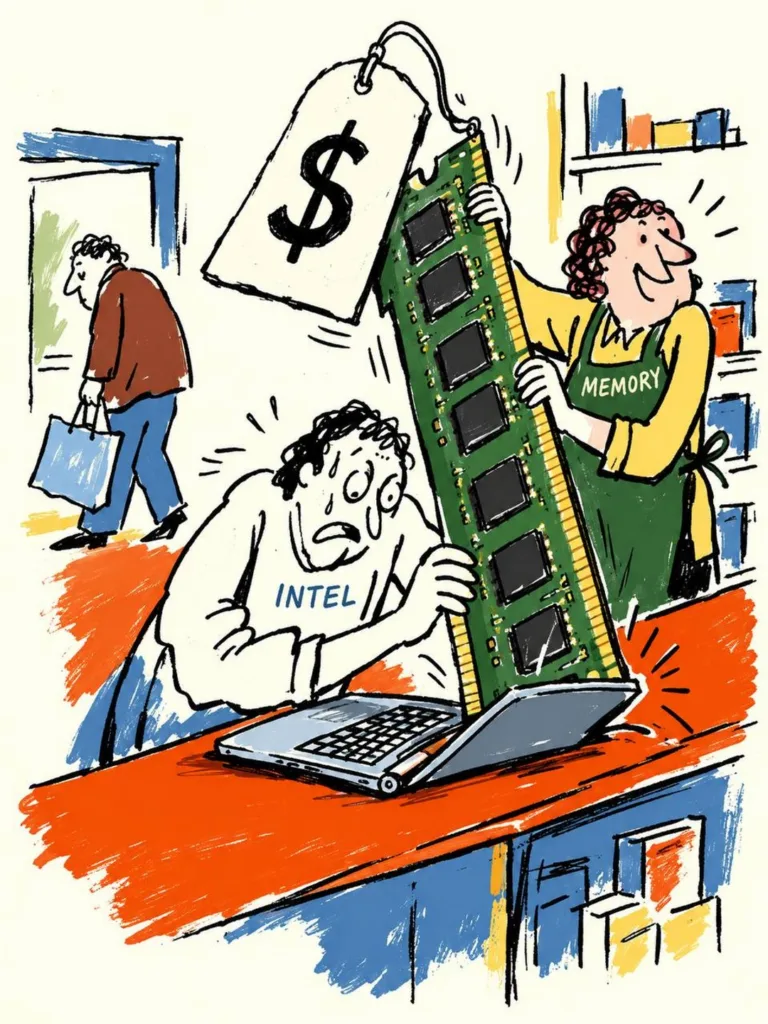
The common reading is that "the chip cycle has turned." But Intel's own explanation tells a different story. Intel pointed to "memory is too expensive" as the reason PCs are not selling. SK hynix is a company that sells memory. The same news sent SK hynix a good signal and a bad signal at once.
- Why did Intel blame memory prices?
Intel forecast fourth-quarter revenue of $15 billion to $16 billion. The market had expected about $17 billion. It said fourth-quarter revenue in its PC chip division would fall by more than 20%. It also expects global PC sales to shrink about 12% this year and by about 10% again next year.
Here is how it works. Memory prices rise and supply runs short → the cost of making and buying PCs goes up → PC makers order fewer Intel chips. As for why memory is scarce, Korean reports say Samsung Electronics and SK hynix have shifted production toward HBM (high-performance memory stacked in layers to move data quickly) and server memory (memory that goes into data center computers), which has cut the supply of PC DRAM (memory that briefly holds the data a device is working on). It is like cabbage prices climbing so high that people make less kimchi, and then less red pepper powder gets sold too. Intel sits in the spot of the red pepper powder shop.
Intel CFO Dave Zinsner said, "We do not expect a sustained recovery until memory availability improves and pricing begins to normalize."
- How high have memory prices climbed?
According to market research firm DRAMeXchange, the October fixed transaction price for general-purpose PC DRAM (DDR4 8Gb) was $27.50, up 5.77% from $26.00 in September, setting a new all-time high again. The fixed transaction price is the price that memory makers and PC makers set in advance when they trade in bulk. TrendForce (a Taiwanese market research firm) maintained its forecast that PC DRAM contract prices in the fourth quarter will rise 13% to 18% from the third quarter.
Put simply, PC makers are paying more than the month before each time they buy memory. That PC DRAM has become scarce, pushing up PC prices and cutting sales, with Intel absorbing the burden, is also evidence that memory makers can still sell their goods even when they raise prices.
- Where does SK hynix make its money?
On Oct. 28, SK hynix announced third-quarter revenue of KRW 104.6155 trillion and operating profit of KRW 83.3338 trillion. Broken down by use, third-quarter DRAM revenue came about 50% to 55% from servers, 20% to 25% from smartphones, and 10% to 15% from graphics, including HBM. PC DRAM falls into the remaining 5% to 20%, together with consumer products such as home appliances.
If DRAM revenue were KRW 10 million, KRW 5 million to KRW 5.5 million would come from servers, and PCs, even combined with consumer products, would account for KRW 500,000 to KRW 2 million. SK hynix CFO Kim Woo-hyun also said, "Shipments of PCs and mobile devices will decline," adding, "The growth in demand for AI infrastructure will more than offset this decline."
The company said its DRAM and HBM supply through 2029, three years out, is effectively sold out, and that more than 50% of its 2027-2028 capacity is covered by long-term agreements (contracts that fix volumes and terms for several years ahead).
- So why call it a warning sign?
The October fixed transaction price for general-purpose NAND flash (used in memory cards and USB drives) was $30.61, unchanged from September. This is the first pause in an upward run that had lasted 21 months since early 2025. Korean memory makers' PC DRAM output next year is estimated to fall by 20% to 40% or more from this year. Prices are holding up because supply is shrinking, but it is not yet clear whether buyers will keep following.
Intel CEO Lip-Bu Tan said, "Memory prices have risen a lot," and "In 2027 it will become a very serious problem for all of us." It is like used car prices climbing too high: at first cars sell at a high price, but in the end the people who wanted to buy give up on the car. However, memory has another big customer in AI servers, so even if PC customers drop out, warehouses do not fill up right away.
- BITPRESS Insight
Intel's crash is not news that the whole chip sector has turned down. According to Korean reporting (ZDNet Korea), memory makers shifted production toward AI servers, which made PC DRAM scarce, and PC makers and Intel absorbed that cost. The same chain gave memory makers the power to set prices.
So the Intel news is not bad news for SK hynix's core business. Servers and HBM, the center of its revenue, are effectively sold out through 2029. What could wobble is the price of general-purpose memory that goes into PCs and smartphones. For that price to keep rising, buyers have to keep following, yet NAND prices have stalled and a forecast of falling PC sales has emerged.
When looking at SK hynix, it helps to separate "server memory" from "general-purpose memory for PCs and smartphones." News that PCs are not selling does not mean the former is wobbling; it means there is less room for the latter's prices to rise further.
Sources
https://decrypt.co/382287/intel-stock-suffers-worst-crash-in-50-years-as-weak-forecast-overshadows-ai-chip-demand
https://www.ibtimes.com.au/intel-shares-plunge-weak-pc-outlook-forecast-1877636
https://www.aol.com/articles/intel-plunges-25-amid-surging-114325000.html
https://thenextweb.com/news/intel-q3-2026-outlook-pc-slump-memory-shortage
https://zdnet.co.kr/view/?no=20261030163628
https://www.hankyung.com/article/2026102814891
https://www.investing.com/news/company-news/sk-hynix-q3-2026-slides-revenue-tops-100t-80-margin-on-ai-boom-93CH-4977357
https://www.fool.com/earnings/call-transcripts/2026/10/28/sk-hynix-skhy-q3-2026-earnings-call-transcript/
https://www.newspim.com/news/view/20261030000811
Glossary
HBM — High-performance memory made by stacking DRAM in layers so data can move in and out very quickly, used mainly in AI servers.
Contract price — The price that memory makers and PC or server makers agree on in advance when trading in bulk; market research firms calculate the average each month.
Commodity memory — Standard-spec memory that is used across many devices, such as PCs, smartphones and USB drives, rather than being made for a specific customer.
Long-term supply contracts — A contract in which supply volumes and price terms are fixed in advance for several years.
Guidance — A company's own forecast of next-quarter revenue and profit, released when it reports earnings.
BITPRESS articles are information to help your investment decisions, not a recommendation to buy or sell any stock or coin. Investment decisions and their results are your own responsibility.