Alphabet, Google's parent, had third-quarter sales of $127.58 billion, up 25% from a year earlier. Cloud sales doubled. Yet when results came out after the close on Oct. 28, the stock fell about 10% in after-hours trading. That is an after-hours figure, not a regular-session close, and one outlet reported an 8.5% drop the same day.
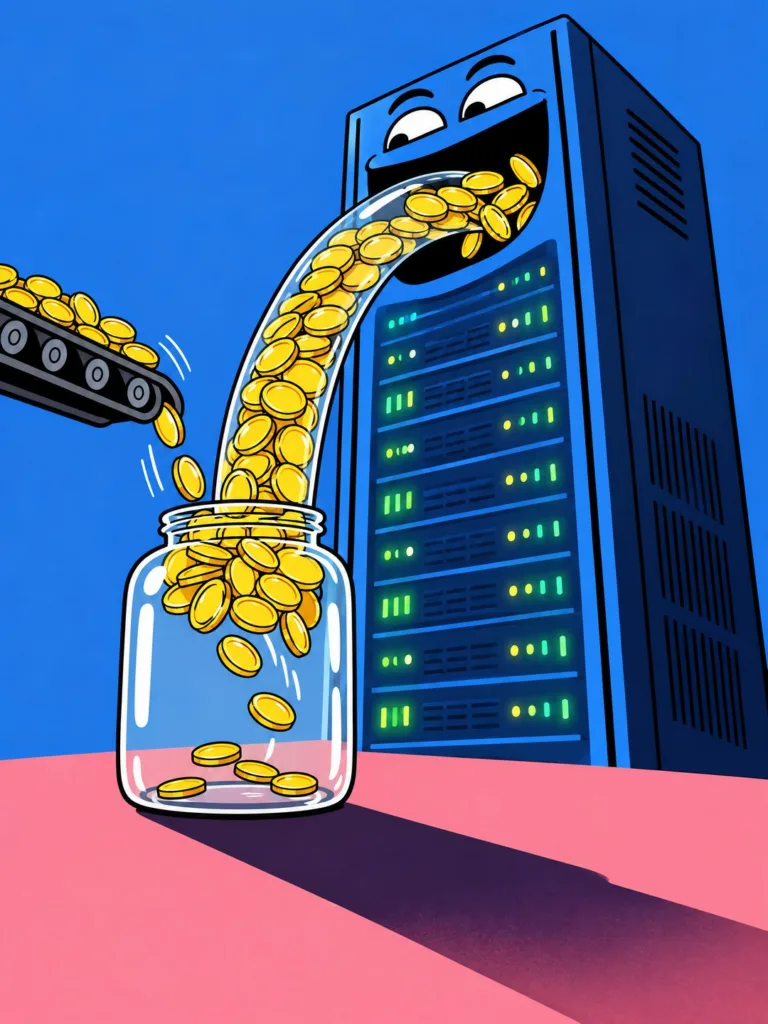
The common explanation is "a slight miss on expectations." But the key point is elsewhere. The number investors looked at first was not sales but free cash flow. Free cash flow is the cash left after a company subtracts capital spending, such as servers and data centers, from the cash its operations bring in.
- Sales were strong, so what was the problem?
Results were mixed by business. Cloud sales rose 103% to $30.7 billion. Brent Thill, an analyst at Jefferies (a U.S. investment bank), called cloud the only business that beat expectations.
Search, which makes up half of sales, grew 12% to $63.35 billion, about $1.6 billion below the analyst estimate of $64.96 billion. The biggest money-maker grew more slowly than hoped. Still, the stories reporting the stock drop pointed first not to search but to the free cash flow deficit.
- Why did free cash flow turn negative?
Cash coming in from operations this quarter was $42.29 billion. But Alphabet spent $51.36 billion on capital spending, including AI data centers. As a result, free cash flow was negative $9.07 billion.
Put simply, it spent more than it earned. Think of getting a 25% raise and then, in the same month, spending more than a month's pay on a home renovation: your bank balance goes negative. Google's renovation, though, buys machines that will earn money later, so it is not waste.
- How bad was it in numbers?
Capital spending more than doubled from $24.0 billion a year earlier to $51.4 billion. Over the same period, cash from operations actually fell from $48.4 billion to $42.3 billion. That is why free cash flow, about positive $24.5 billion a year ago (calculated from those two numbers), turned negative.
The bigger shock was the gap with expectations. Analysts expected negative $2.7 billion, but the actual figure was negative $9.1 billion, more than three times as large. That estimate comes from analysts' figures reported by one outlet, and other tallies differ.
- Why does a stock fall even when sales grow?
A stock's price is today's value of the cash a company will leave for its shareholders in the future. Buybacks (when a company buys its own shares to reduce the share count), dividends and debt repayment all come out of free cash flow. If capex grows faster than sales, shareholders' share shrinks.
[Hypothetical] Here is a hypothetical, for illustration only. Say a shop's sales rise from KRW 10 million to KRW 12.5 million (up 25%). If it spends more on a renovation than the added sales, the owner is left with no cash. Investors will put a low price on that shop until they can see when the renovation will bring customers back.
- Will capital spending come down?
The company left its full-year capex outlook of $195 billion to $205 billion unchanged. That is more than the $159.8 billion spent over the past year (the last four quarters). Anat Ashkenazi, the chief financial officer, said, "We continue to expect 2027 capex to increase significantly." There is still no sign that capital spending will fall.
Free cash flow over the past year is still positive at $19.7 billion. But capex of $159.8 billion over the same period is close behind operating cash of $179.6 billion. The narrower that gap gets, the more likely a negative quarter becomes.
- BITPRESS Insight
This drop is not a sign that "Google did badly in business." Cloud profit tripled in a year, from $3.6 billion to $11.1 billion. The problem is that capital spending is growing faster than the pace at which that money is earned. Until investors can see when the gap will close, they give less credit to future profit.
As Google's results show, in the race to build AI capacity, news that sales grew is not enough to lift a stock. What sets the size of the discount is whether free cash flow is left over after the spending.
When reading earnings stories, look first not at sales growth but at whether free cash flow, the cash from operations minus capital spending, is positive. If the answer is negative even when sales rise 25%, the stock can fall.
Sources
https://www.sec.gov/Archives/edgar/data/0001652044/000165204426000080/googexhibit991q32026.htm
https://finance.biggo.com/news/32a3f9be-3427-4979-89ee-eaac8d6d7784
https://slguardian.org/alphabet-shares-slide-more-than-10-as-ai-spending-drives-9-billion-free-cash-outflow/
https://www.investing.com/news/stock-market-news/alphabet-shares-tumble-65-as-earnings-miss-overshadows-cloud-boom-4980569
Glossary
Free cash flow — The cash left after subtracting what a company spent on equipment such as factories and servers from the cash its operations brought in.
Capital spending — Money spent to buy long-lived assets such as data centers, servers and chips; often shortened to capex.
After-hours trading — Trading that continues after the regular session ends, where a stock first reacts to results released after the close.
Earnings per share (EPS) — A company's net profit divided by its number of shares: the profit earned by one share.
BITPRESS articles are information to help your investment decisions, not a recommendation to buy or sell any stock or coin. Investment decisions and their results are your own responsibility.