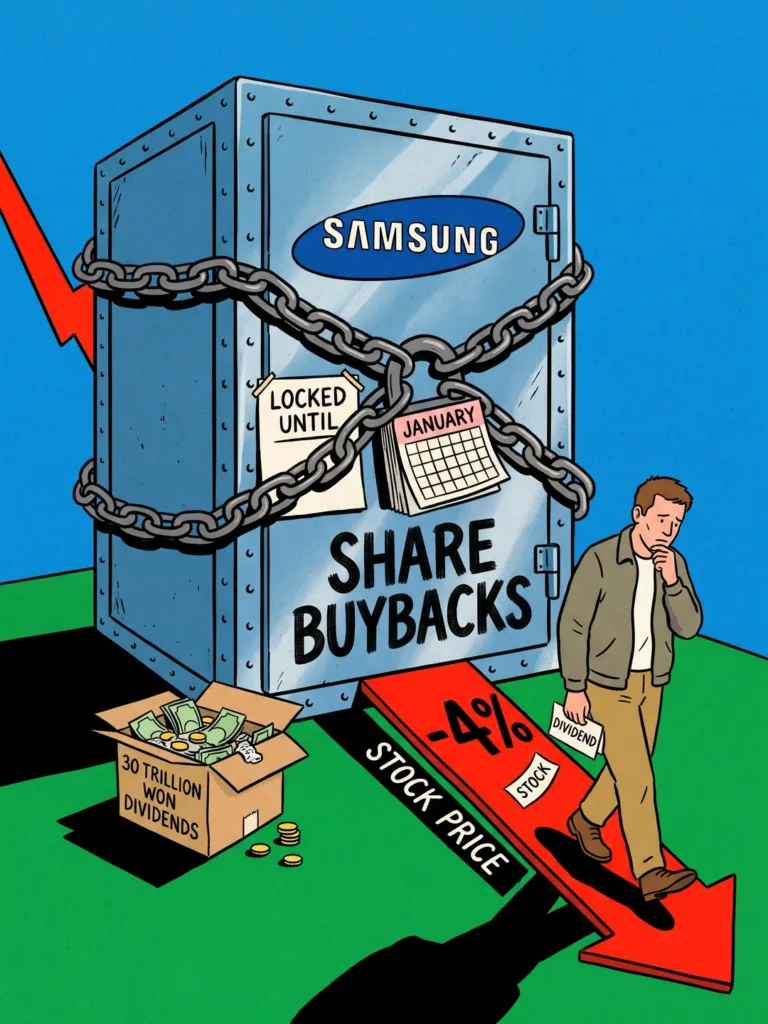
Samsung Electronics announced third-quarter operating profit of 107.4405 trillion won and a cash dividend of 30 trillion won (to be paid in November) on Oct. 29. Yet its shares, which had climbed as high as 249,000 won during the session, turned partway through the earnings call and closed down 4.13%.
The common reading is, "Record profit and a record dividend, and the market overreacted." But the real point is elsewhere. A share price moves less on "how much will they pay" than on "will they pay more than expected, and when?" On this day Samsung merely confirmed numbers that were already known, and pushed the number the market was waiting for to January.
- Why did the stock go the wrong way on a record-profit day?
Third-quarter consolidated sales were 195.2532 trillion won, up 126.9% from a year earlier, and operating profit was up 783.1%. Operating profit in the DS (Device Solutions) division, which makes chips, alone was 106.5 trillion won.
The problem is that the numbers were already out. The 107 trillion won figure came with the preliminary results on Oct. 8, and the stock fell 2.42% that day too. What was new this time was the breakdown by division. Kim Seok-hwan, an analyst at Mirae Asset Securities, explained that the stock "reversed after the chip division's operating profit came in below the raised expectations."
Put simply, even if you bring home a good report card, if your parents expected a higher score, "that's lower than I thought" comes before the praise.
- Why was the 30 trillion won dividend not news?
The board approved a third-quarter dividend of 4,601 won per share for both common and preferred shares (shares that get dividends first), about 30 trillion won in total, with payment in November. But the 30 trillion won had already been reported on the morning of the announcement, as a plan to "pay about 30 trillion won in cash dividends."
One shareholder in his 40s said, "It came out exactly as expected. I was hoping for an extra dividend, so I'm disappointed." There was no "something extra" on top of the 30 trillion won already built into the share price.
Suppose you held 10 million won of the stock and the gap shows. At the previous close (about 242,000 won), 41 shares (about 9.92 million won) would earn a dividend of about 189,000 won before tax in November. The 4.13% drop that day, by contrast, cut the value of those shares by about 410,000 won. The price drop was more than double the dividend before you even received it.
- Why did the remaining 55-75 trillion won weigh on the stock?
Samsung has put this year's total shareholder returns (dividends plus share buybacks and cancellations) at 90-110 trillion won. Subtract 35 trillion won (4.9 trillion won in first-half dividends plus this 30 trillion won) and 55-75 trillion won remains. The company said it will spend that money on cash dividends along with "buying back and cancelling a substantial amount of its own shares," but that the size and method will be set at a board meeting in late January 2027.
If the annual total is the 110 trillion won ceiling, about 68% of it is money whose "when and how" is still undecided; even at the 90 trillion won floor, about 61% is. Lee Kyung-min, an analyst at Daishin Securities, said, "Investor sentiment weakened because no specific shareholder-return plan was presented."
There was a comparison, too. A day earlier SK hynix had announced an additional shareholder-return program worth 60 trillion won, and its shares rose 2.62% that day, a fifth straight daily gain. Kwak Byung-yeol, a former head of research at Leading Investment & Securities, said SK hynix's plan was more detailed, while Samsung's delay until next January made the outlook harder to predict.
- How do dividends and share cancellation work differently for shareholders?
A dividend moves money from the company's vault into shareholders' bank accounts. You have cash the moment you receive it, but the company has that much less. Share cancellation means the company buys its own shares on the market and destroys them. No money lands in your account, but with fewer shares outstanding, each remaining shareholder owns a bigger piece of the company.
Think of one pizza. A dividend is cutting off part of the pizza and handing it out. Cancellation leaves the pizza whole but reduces the total number of slices, so the slices held by remaining shareholders get bigger. However, cancellation also involves the company buying shares on the market itself, so when and how much it buys affects the share price separately.
The company did not say how it will split the remaining 55-75 trillion won between dividends and share cancellation. That split stays blank until late January.
- Samsung has fallen on every earnings day this year. What is different this time?
This year, the stock fell on every earnings day.
| Earnings date | What was announced | Share price that day |
|---|---|---|
| Jan. 29 | Last year's fourth-quarter results | -1.05% |
| Apr. 30 | First-quarter results | -2.43% |
| July 30 | Second-quarter results | -0.72% |
| Oct. 8 | Third-quarter preliminary results | -2.42% |
| Oct. 29 | Third-quarter final results and dividend | -4.13% |
On July 30 the stock also rose more than 8% during the session before ending lower. The pattern repeated: expectations rise first, and when the announcement fails to beat them, the price gives the gains back.
What is different this time is that the next date to check is set. The company said that at the board meeting in late January 2027 it will announce the size and execution plan for the remaining funds, along with a new shareholder-return policy for 2027 and beyond.
- BITPRESS Insight
The drop came not because earnings were bad, but because the announcement did not beat the expectations already built into the price. The 30 trillion won was a number everyone knew, and the use of the 55-75 trillion won that could have been new news was put off for three months.
Dividends and share cancellation are not the same money either. A dividend is cash that ends on the day you receive it, while cancellation raises the stake of the remaining shareholders. That is why the market cared more about "where and when" than about "how much in total."
Judge a shareholder-return announcement not by the total, but by whether it is bigger than the number already known and whether an execution date has been set. If neither is true, even a big amount will struggle to lift the stock.
Sources
https://www.hankyung.com/article/2026102940987
https://imnews.imbc.com/replay/2026/nwdesk/article/6861752_37004.html
https://www.newsis.com/view/NISX20261028_0003845284
https://www.thelec.kr/news/articleView.html?idxno=64531
Glossary
Share retirement — When a company buys its own shares on the market and then cancels them, reducing the total number of shares.
Shareholder returns — A catch-all term for a company returning the money it earned to shareholders through dividends or share buybacks and cancellations.
Preliminary results — A rough estimate of revenue and operating profit that a company releases right after a quarter ends; the final results, with figures by division, follow a few weeks later.
Regular dividend — The basic dividend a company pays steadily every quarter under a policy it has set.
DS (Device Solutions) division — The division of Samsung Electronics that runs the semiconductor business, including memory and foundry.
BITPRESS articles are information to help your investment decisions, not a recommendation to buy or sell any stock or coin. Investment decisions and their results are your own responsibility.