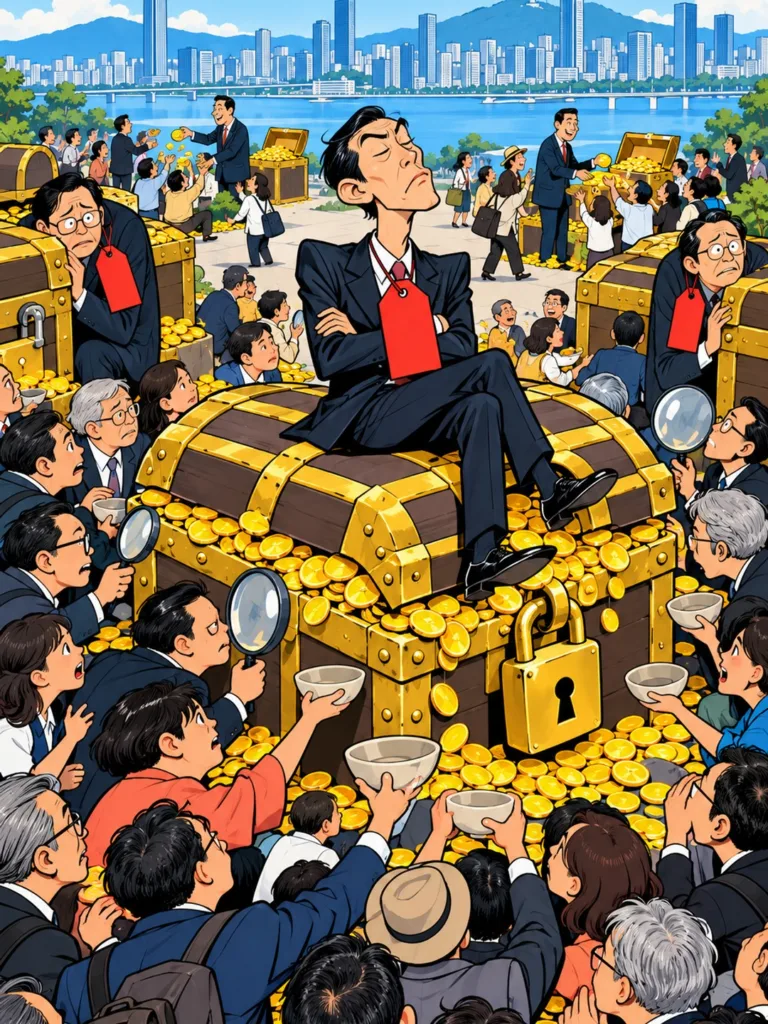
On Nov. 1 the Korea Exchange named 151 listed companies as "low-PBR companies" for the first time. Their PBR (the share price divided by the net assets the company owns) averages about 0.25 on a simple basis, far below the roughly 1.8 for all listed companies. Companies with a market value above 1 trillion won, such as Hyundai Steel, E-Mart and Lotte Shopping, are on the list too.
There are two common readings. Either this is a list of stocks the market admits are cheap, so they will rise someday, or it is a list of shamed companies chosen by the exchange, so they will fall. But the key point is elsewhere. Of the 185 companies that met the criteria, 34 that filed plans to raise shareholder value were left off. The list is less a mark of "cheap" than a mark of "nothing has changed yet."
- How were the 151 low-PBR companies chosen?
A PBR below 1 means the whole company's value (its market capitalization) is less than its net assets on the books. If a company with 1 trillion won in net assets has a PBR of 0.15, the market values it at 150 billion won. E-Mart's PBR was 0.15 as of Oct. 22.
The exchange split 2,431 listed companies into 11 sectors and picked those whose PBR over the past three years (six half-years in a row, or six of seven half-years) was in the bottom 25% of their sector on the KOSPI or the bottom 10% on the KOSDAQ. That left 185 companies. Companies are compared within the same sector because a normal PBR differs by sector. In this very list, the average on the KOSPI was 0.11 for real estate and 0.63 for information technology.
- Why were only 151 of the 185 made public?
A company that filed a corporate value-up plan (a promise of what it will do to lift its share price) at least seven trading days before the release was exempt from being named for one year. Of the 62 companies that filed plans by Oct. 22, 49 met the low-PBR criteria, and 34 of those were left off the list.
The other 15 filed plans and still stayed on the list. A company that stayed in the bottom group for the past six years (12 half-years in a row, or 12 of 13 half-years) gets no exemption even if it files a plan. It is like a teacher who takes the name off the list for a student who handed in homework, but not for one who has handed in the same homework for six years.
Put simply, of the 151, 136 are "companies that filed no plan at all" and 15 are "companies that filed a plan but have stayed put too long."
- What gets attached to a company on the list?
The list stays on the value-up page of KIND, the exchange's disclosure site, until May next year, and brokerages' MTS (mobile stock apps) and HTS (PC stock programs) are set to show a "low PBR" tag on those stocks. The exchange publishes a new list every May and November. Yonhap News described this as a "naming and shaming" approach that publicly names companies to embarrass them.
The exchange will give all 151 companies one-on-one, tailored PBR improvement consulting in 2027. The exchange said, "Some companies could have been exempted from the list by submitting a PBR improvement plan, but we understand they could not submit one because they struggled to diagnose the cause of the low PBR accurately or to draw up specific improvement measures." The way off the next list is also set: file a plan.
- Why does the real pressure come from institutional investors?
A tag alone does not change a company. The pressure actually reaches a company through institutional investors that hold a lot of its shares. The Financial Services Commission is revising its stewardship code guidelines (a code of conduct for institutions to oversee the management of the companies they invest in) to encourage institutional investors to engage with low-PBR companies.
The commission said it will closely check whether institutions actually engaged, through talks with management, requests for improvement and voting. The flow goes like this. The list is published. Institutions are checked on what they demanded of each company. Institutions press the company for a plan at the shareholder meeting. The company chooses how to answer: more shareholder returns, better capital efficiency or better governance.
Think of an item on a secondhand app that is listed far below the going price. Being cheap does not sell it at once; it gets a price only when the seller steps up to fix the flaw. With stocks, though, there is a difference: if the seller (the company) does not move, shareholders can make it move with their votes.
- Why does a low PBR not simply mean "cheap"?
The fact that 34 companies were dropped shows what this list is. Those companies also have low PBRs. But they filed plans, so their names were removed. What the exchange singled out is not the "cheapest companies" but "cheap companies with nothing to say to shareholders."
So the same low PBR can mean different things. The low PBR of a company that files a plan and raises its dividend is not the same as that of a company with no plan that has sat in the same place for years. The latter may be a price the market sets on a company that "only piles up cash and does not share it with shareholders."
- BITPRESS Insight
What this list changes is not the share price itself but the question a company faces. Until now, a low PBR was a problem shareholders put up with alone. Now it is set to be visible to every investor through a tag on the app screen, and institutional investors are checked on what they demanded of the company. Before the next release in May next year, a company must choose between filing a plan and keeping its name up for six more months.
So when you look at a stock on the list, "how low is the PBR?" is not the first question. What comes first is whether the company answers this pressure with a shareholder-return plan or holds out. As the 15 companies that have already held out for six years show, one sheet of paper does not settle it either.
A low PBR is a number to judge by "has the company shown it is willing to change?" rather than "how cheap is it?"
Sources
https://www.hankyung.com/article/2026103177206
https://www.yna.co.kr/view/AKR20261031025200008
https://www.hankyung.com/article/202611018265i
Glossary
PBR (price-to-book ratio) — The share price divided by net assets per share. A value below 1 means the company's market capitalization is less than its net assets on the books.
Corporate value-up plan — A plan in which a listed company discloses on its own what it will do to raise its share price. It is also called a value-up disclosure.
Stewardship code — A code of conduct that tells institutional investors, such as pension funds and asset managers, to monitor the management of the companies they invest in and to exercise their voting rights faithfully.
MTS·HTS — The mobile stock trading apps (MTS) and PC stock trading programs (HTS) that brokerages provide.
GICS — An industry classification standard used in stock markets worldwide. This selection was compared across the 11 sectors of that standard.
BITPRESS articles are information to help your investment decisions, not a recommendation to buy or sell any stock or coin. Investment decisions and their results are your own responsibility.