Money is moving into bank products that are not regular savings accounts. Maeil Business Newspaper reported that KRW 50 trillion flowed in a single month into bank products that can earn more than ordinary deposits, such as retirement pensions, trusts (products where the bank holds your money and invests it in an agreed way), and equity-linked deposits (ELD). That KRW 50 trillion is not ELD alone but the total for all of these products combined.
ELD is sold with the pitch “your principal is safe, and you earn extra interest if stocks rise.” That comes with the reading that it is a smart deposit with nothing to lose.
But the key point lies elsewhere. The extra return from an ELD is not free. It appears to work by putting the interest you would have earned on a bet on stock prices, and if the index does not move as hoped, you can end up with less than a regular deposit.
- Where did the KRW 50 trillion in one month go?
Maeil Business Newspaper grouped this money under the heading “deposits other than savings.” If deposits and installment savings pay an agreed interest rate, the products in this group pay different amounts depending on how the money performs. Specified money trusts, retirement pensions, funds, and ELD fall into it.
ELD sales are also rising every year (section 5).
- How does ELD protect principal?
An ELD is a type of time deposit that banks create and sell. The difference is that its interest is set by the movement of a stock index such as the KOSPI 200 (an index of 200 large Korean stocks). If you hold it to maturity, you get your principal back, and deposit protection covers up to KRW 100 million per person. But if you cancel early, fees are deducted and your principal can shrink.
According to explanations from the banking industry, a bank lends out about 97% of the money deposited to earn a deposit-loan spread (the gap between loan interest and deposit interest), and uses the remaining 3% or so for derivatives (financial products whose value depends on things like stock prices), such as options linked to a stock index (rights that only have value if certain conditions are met). If you deposited KRW 10 million, about KRW 9.7 million would go to loans and about KRW 300,000 to options (a hypothetical calculation applying the ratios as given). Some explanations say the customer's money stays in safe assets and only the interest it earns goes into derivatives, so the roughly 3% can be seen as the interest you would have earned being spent on options.
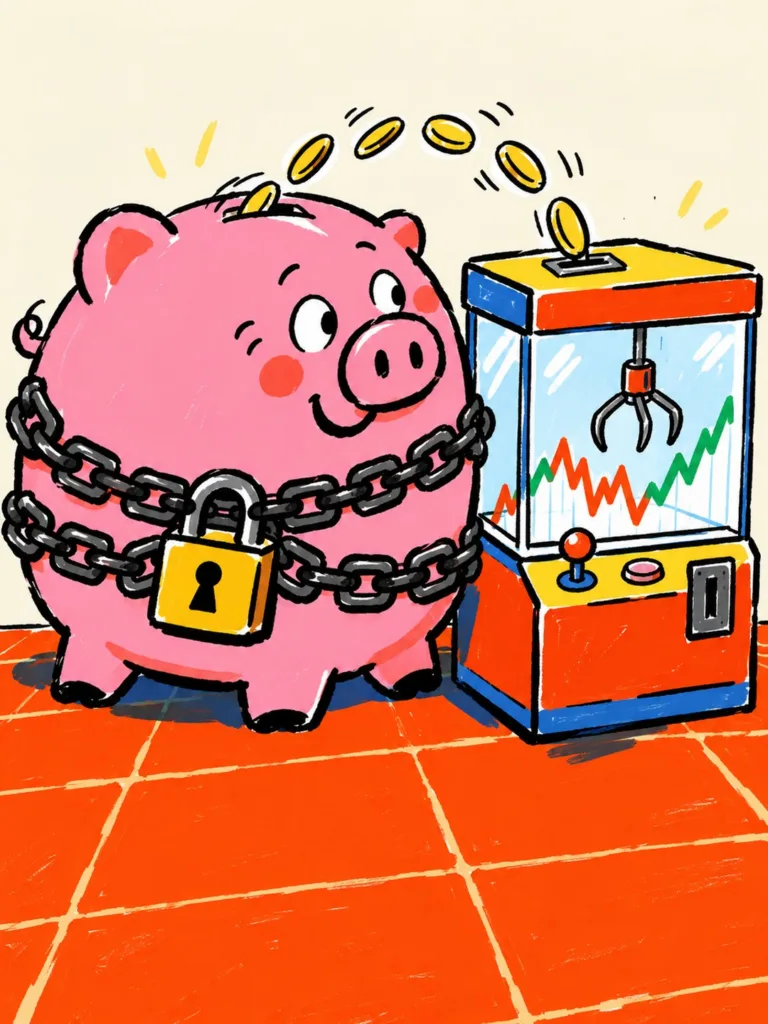
Think of it like using the points you earn while grocery shopping to buy a raffle ticket. The groceries (principal) stay with you, and only the points (interest) are put at stake. The catch is that with an ELD you cannot choose whether to use the points. Once you sign up, your share of interest appears to go into options from the start.
- When does the option pay off?
The option inside an ELD pays off when the stock index lands within a set range (the span of index gains each product sets), and its gain is added to the interest; if the index falls below the range (depending on the product, 0% may count as inside), the option leaves nothing.
That is why ELD interest is presented from the start as two lines, a “maximum rate” and a “minimum rate.” An ELD tied to the KOSPI 200 that NongHyup Bank launched this year pays individuals up to 9.45% a year if the index rises by 0% to 45%, and 2.70% a year if it falls outside that range. Because this product's range starts at 0%, the index staying flat still lands inside the range.
- Why did stocks rise but the rate stay at the minimum?
A trap also appears when the index rises too much. With a “knock-out on the upside” ELD, if the index crosses the top of the range even once during the observation period (the period over which the index's movement is measured), the maximum-rate condition disappears and only the minimum rate is paid.
A July analysis found that most maturing products paid the minimum rate. Herald Business (U.S. edition) analyzed the KOSPI 200-linked ELDs that the five major banks have launched since last year, as of July, and found that the fixed rates on products that had matured by then this year ranged from 1.60% to 3.00% a year. As of July, current 12-month time deposits paid 2.55% to 3.30% a year once preferential rates were added. However, these are rates at the time of analysis, not at the time people signed up for the ELD, and because the top of the ELD range (3.00%) is higher than the bottom of the deposit range (2.55%), it cannot be said that everyone received less.
To see the widest gap, put the ELD minimum of 1.6% a year (the fixed rate on a product bought in the past) against the deposit maximum of 3.3% a year (the current rate as of July) and suppose KRW 10 million is deposited for one year. At 1.6% a year that is KRW 160,000 before tax, and at 3.3% it is KRW 330,000. The KRW 170,000 difference is the maximum, comparing two endpoints from different points in time (a hypothetical calculation).
- Why do banks push ELD?
For banks, ELD is a way to hold on to money leaving for the stock market. Sales of ELD at four banks, KB Kookmin, Shinhan, Hana, and NongHyup, rose from KRW 7.3733 trillion in 2024 to KRW 12.3338 trillion last year. When the products lost appeal in a bull market, banks changed the terms by raising the knock-out level while lowering the maximum rate. KB Kookmin Bank raised that level from 20% to 25% (as of July).
A commercial bank official said in July, "However much we raise deposit and savings rates, it is only 0.1-0.2 percentage points, so it is hard to keep customers in a stock boom like this."
- BITPRESS Insight
“Principal protected” does not mean there is no loss. Instead of putting your principal at risk, an ELD appears to put the share equal to the interest a regular deposit would have paid on a bet on the stock index. If the index lands within the set range, you can earn more than a deposit, and if it falls outside, you get only the minimum rate. The place where you can lose has moved from your principal to your interest.
Right now, the top rate on time deposits at Korean banks averages 3.58% a year (as of Oct. 25). The higher deposit rates go, the wider the gap with the ELD minimum rate becomes.
When looking at a principal-protected product, the maximum rate is not what to weigh. What matters is how much lower the minimum rate you get when the index misses is than today's deposit rate. If the index misses, you receive that much less than a deposit would have paid.
Sources
https://www.mk.co.kr/news/economy/12193047
https://www.fnnews.com/news/202607011811114875
https://www.heraldk.com/article/2026070519550853145
https://www.dailian.co.kr/news/view/1564541
https://www.sisadn.com/13888
Glossary
Equity-linked deposit (ELD) — A bank time deposit whose interest is set by the movement of a stock index such as the KOSPI 200. If you hold it to maturity, you get your principal back and are covered by deposit protection.
Options — A right that only has value when set conditions are met. In an ELD, it is the ingredient that pays extra interest when the index rises within a set range.
Knock-out up — An ELD in which, if the index crosses the top of the range even once during the observation period, the maximum-rate condition disappears and only the minimum rate is paid.
Funds other than deposits and savings — Money a bank takes in that goes into trusts, retirement pensions, funds, ELD, and similar products rather than deposits and savings accounts, so the amount you receive varies with how the money performs.
Lending margin — The difference between the interest a bank earns on loans and the interest it pays on deposits.
BITPRESS articles are information to help your investment decisions, not a recommendation to buy or sell any stock or coin. Investment decisions and their results are your own responsibility.