Tether, the company behind USDT (a coin pegged one-to-one to the U.S. dollar), said on Oct. 30 that it earned $1.5 billion in operating profit in the third quarter. Profit for January through September totals $4.5 billion.
When a crypto company is said to have made a fortune, people usually assume coin prices went up. But Tether said most of this money came from short-term U.S. Treasuries and reverse repos (transactions in which cash is lent out for a short period against Treasuries as collateral). The key point is that the money used to buy those Treasuries is the dollars paid in by holders.
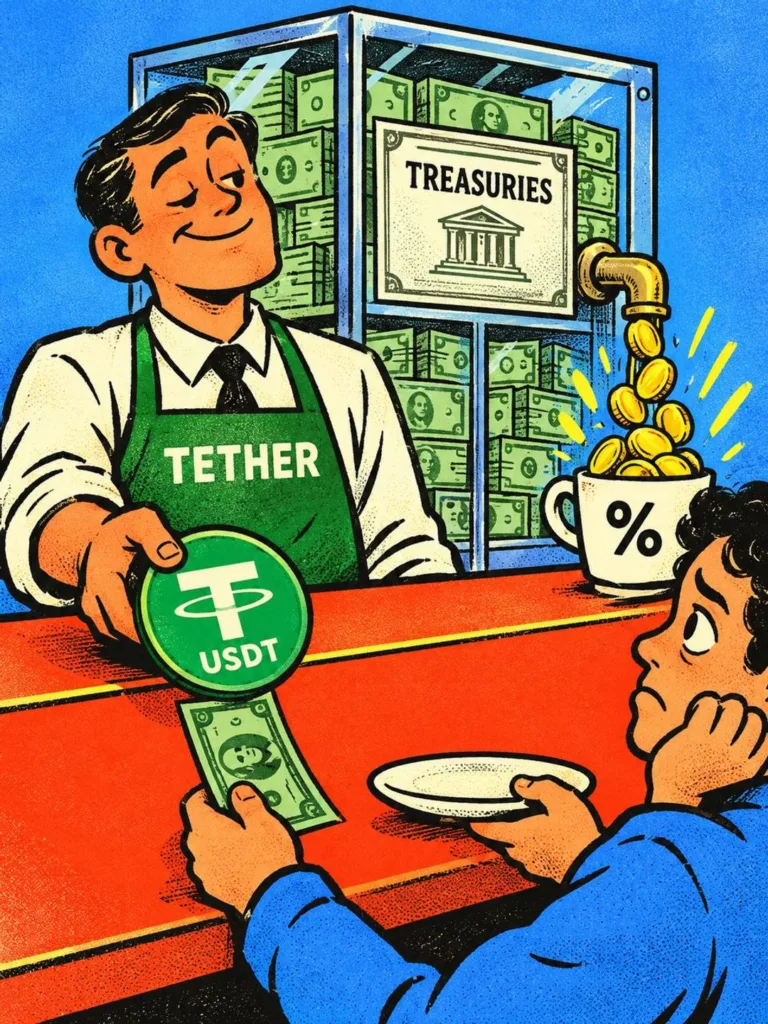
The money trail goes like this. A holder pays in dollars → Tether issues USDT → Tether buys Treasuries with the holder's dollars → Tether keeps the Treasury interest.
- Where do the holders' dollars go?
Tether's terms promise to return 1 dollar for each USDT (only verified customers who have a trading agreement with Tether can redeem, and fees may apply). It is similar to handing cash to a gift card shop and receiving a gift card for the same amount. The shop can put that cash to work until customers come to use their cards.
At the end of September, $184 billion of USDT was in circulation. Tether's assets that day were $191.5 billion, and $132.4 billion of that was short-term U.S. Treasuries (IOUs the U.S. government sells to borrow money, which pay interest; held directly and indirectly). The dates differ (Tether's figure is from the end of September, South Korea's from August), but it is about the same size as the $134.2 billion in U.S. Treasuries South Korea held in August, according to U.S. Treasury Department data.
Put simply, one company holds about as many U.S. Treasuries as an entire country.
USDT is the world's largest stablecoin. By data firm DefiLlama's count, it makes up about 60% of the $297.3 billion stablecoin market. Tether CEO Paolo Ardoino said on Oct. 30 that USDT has passed 700 million users. The more holders pay in dollars, the more dollars Tether has to put to work.
- How did Tether earn $1.5 billion in three months?
Tether said most of its profit came from short-term U.S. Treasuries and reverse repos. A reverse repo is a short-term loan of cash in which the lender takes Treasuries as collateral.
The Fed's benchmark rate is 3.75%-4% as of Oct. 28. Suppose Tether held its end-of-September $132.4 billion in Treasuries all three months at 3.75%. Three months of interest would be roughly $1.2 billion, which explains most of the $1.5 billion in reported operating profit (this is a rough calculation that applies the quarter-end holdings to all three months). In reality, most of the third quarter came before the Sept. 16 rate hike, so rates were lower for longer than this assumes.
Excess reserves, the amount by which Tether's assets exceed what it owes, rose from $4.1 billion at the end of June to $7.95 billion at the end of September. That surplus belongs to the company, not to holders.
- Why don't USDT holders get interest?
There are two reasons. First, Tether's terms promise only that one USDT can be redeemed for $1, and only verified customers who have a contract with Tether can redeem, possibly with fees. There is no promise of interest like a bank deposit pays.
Second, the GENIUS Act (the U.S. stablecoin law, signed July 18, 2025) says stablecoin issuers, in the U.S. or abroad, may not pay holders interest or yield solely for holding a coin. That covers cash and tokens alike. The ban applies to issuers; rewards paid by third parties such as exchanges are not addressed by this provision. This article could not confirm when it takes effect.
Compare that with a bank deposit. A bank puts your money to work and pays you back part of what it earns as interest. With USDT, what the money earns stays with the company. Under the terms, there is also no government guarantee or U.S. deposit insurance.
- Who earns more when rates rise?
The Fed, the U.S. central bank, raised its benchmark rate (the policy rate it sets) by 0.25 percentage points to 3.75%-4% on Sept. 16, and held it steady on Oct. 28. When rates rise, the interest on newly bought short-term Treasuries rises too.
Assume another 0.25 percentage points on $132.4 billion in Treasuries, and the result is about $330 million more per year. That extra interest goes to Tether's profit, while the holders' share is zero whether rates rise or fall.
Flip it around: when rates fall, Tether's profit shrinks first. In other words, U.S. interest rates move Tether's profit more than coin prices do.
- BITPRESS Insight
USDT may look like a coin, but it is closer to a "dollar locker that pays no interest." Holders keep each USDT worth $1, and in return Tether keeps the interest those dollars earn.
Say you hold about $7,470 of USDT (10 million won) for one year. Assuming that money sits in Treasuries at 3.75% (the low end of the U.S. benchmark rate range), a year of interest would be about $280, and none of it reaches the holder. Exchange-rate changes are left out of this calculation.
In short, there are two reasons holders get no interest: the terms and the law. USDT is handy as money that sits briefly between buying and selling coins, but in this assumed calculation, the longer you hold it and the higher rates are, the more interest you give up. The terms and the issuer's disclosures say all this.
Sources
https://tether.io/news/tether-generates-1-5-billion-in-q3-net-operating-profit-as-reserve-buffer-doubles-to-almost-8-billion/
https://cointelegraph.com/news/tethers-excess-reserves-nearly-double-to-8b-as-q3-profit-hits-15b
https://www.federalreserve.gov/newsevents/pressreleases/monetary20261028a.htm
https://www.federalreserve.gov/newsevents/pressreleases/monetary20260916a.htm
https://www.nortonrosefulbright.com/en/inside-fintech/blog/2025/07/breaking-down-the-genius-act-stablecoin-legislation-passes-in-the-senate-and-house—18-july-2025
https://www.theblock.co/post/363425/trump-signs-stablecoin-genius-act-cementing-first-major-crypto-framework-in-us-law
https://tether.to/en/legal/
https://www.poundsterlinglive.com/history/USD-KRW-2026
Glossary
Stablecoin — A coin designed so that its value is pegged 1 to 1 to a fiat currency such as the dollar; USDT is the largest.
Short-term U.S. Treasuries — A certificate of debt in which the U.S. government borrows money and promises to repay it within 1 year, paying interest.
Reverse repo — A transaction in which cash is lent for a short period against Treasuries as collateral, with interest earned on the loan.
Excess reserves — The portion by which an issuer's assets exceed the amount of coins it owes back, a cushion that belongs to the company.
GENIUS Act — A U.S. stablecoin law signed in July 2025 that bars issuers from paying interest simply for holding their coins.
BITPRESS articles are information to help your investment decisions, not a recommendation to buy or sell any stock or coin. Investment decisions and their results are your own responsibility.