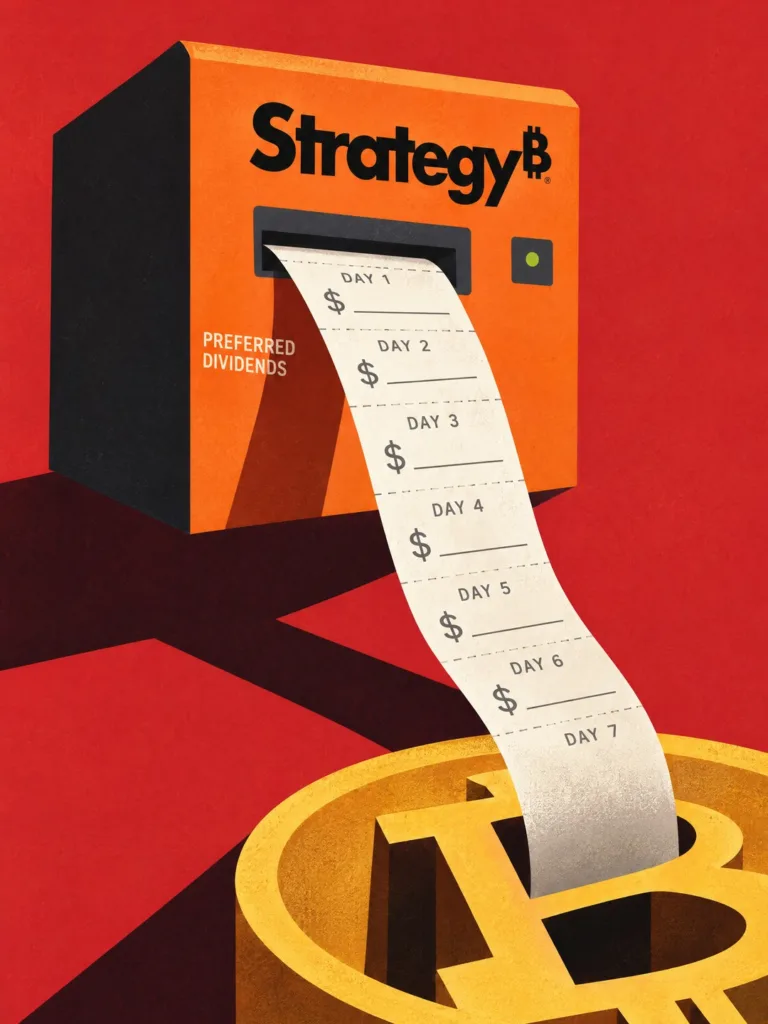
Strategy (the company led by Michael Saylor, and the publicly traded company that holds the most bitcoin), which holds 848,517 bitcoin, is changing its four preferred stocks to pay dividends every day. In preliminary results filed Oct. 28, 99.3% of votes were in favor. STRC, the first in line, is due to start paying dividends every business day on Nov. 2, and the other three, STRF, STRK and STRD, on Jan. 4, 2027.
At first glance it looks like a gift to shareholders. But the annual dividend rate has not gone up by a cent. The point lies elsewhere: split the dividend into small pieces so the share price swings less, turn the shares into something easy to hold like cash, and sell more of them. The money raised goes into bitcoin.
- Does paying daily mean getting more?
No. Strategy said the change raises neither the dividend rates on the four stocks nor the total regular dividends the company has to pay. The annual rates stay at 8% for STRK, 10% for STRF and STRD, and 12% for STRC (a variable rate the company adjusts with market conditions).
Take one STRC share (par value $100): it pays $12 a year. Today it pays $0.50 twice a month. Under the new plan, about 3 cents a day builds up and arrives every business day. Weekend and holiday amounts are paid together on the next business day.
Think of a salary: whether you are paid once a month or in daily installments, the yearly total is the same. If you hold $10,000 of STRC at 12%, that is about $1,200 a year before tax, and changing the schedule does not change it. The difference is that with daily payments, the money can be spent as soon as it arrives.
- So why change it? The price swung on every dividend date
Once the date that decides who gets the dividend passes, the share price drops by about that amount. This is called the ex-dividend drop. The bigger the dividend paid at once, the bigger the drop that day.
According to the company, STRC fell about 0.49% on the ex-dividend day under monthly payments, and about 0.36% after the switch to twice a month. With daily payments, each day's share is just over 3 cents, so the company calculates the swing can be flattened further.
The company wants STRC to trade at $99 to $100. When the daily dividend was proposed, the Sept. 24 close was $98.31, a little short of the target. Put simply, the aim is to smooth out a product whose price zigzags around every dividend date.
- A steadier price lets the stock work like cash
With a flatter price, the preferred stock is easier to use as cash parked for a short time. Funds value their holdings at month-end, and if an ex-dividend drop lands on that day, returns look uneven. The company's explanation is that daily dividends smooth out this month-end bump and make the shares easier to pledge as collateral.
Saylor wrote on X that the change is meant to support price stability, liquidity and demand. He said more than $9 billion of STRC has been issued and that it trades over $100 million a day. To grow an already large product, buyers have to feel safe holding it.
- The better the preferred stock sells, the more money for bitcoin
Strategy said paying dividends more often makes the preferred stocks more attractive and improves its ability to raise money with them. The company has been selling securities to buy bitcoin. In its Oct. 19 filing, it mainly used $22 million raised from selling common stock to buy 267 bitcoin.
Here is the company's logic. Pay dividends daily, so the preferred price swings less; more people want to hold it like cash, so more of it sells; the money from those sales buys more bitcoin. The company is aiming for this loop. Strive, the fourth-largest public bitcoin holder, has also paid daily dividends on its SATA preferred stock since June, and its 15% SATS is due to start daily payments on Nov. 9.
Put simply, what the company is after with daily dividends is less a present for shareholders than a better way to sell its preferred stock.
- Operations alone can't cover that dividend
The remaining question is what pays for it. In the first half of 2026, Strategy's cash from operations was about $9.85 million. Dividends paid on preferred stock in the same period were about $629.18 million, 64 times as much.
Operating cash can't cover the dividends, so the company has to lean on outside funding and its USD reserve (cash set aside to pay preferred dividends and interest on debt). As of Oct. 18 the reserve was $4.83 billion, and in the week of Oct. 12-18 the company drew $45.5 million from it to pay dividends. It is like paying rent not from your salary but from a savings account. The catch is that once the account shrinks, new money has to be raised from somewhere to refill it.
- BITPRESS Insight
What changes is the judgment of the person buying the preferred stock. Dividends that arrive every day can feel as safe as a deposit. But the 8-12% a year is unchanged, and that money comes not from the company's core business but from outside funding and its stored-up reserve.
The better daily dividends work, the more preferred stock sells, and the more dividends the company owes. The money raised goes to bitcoin while the dividends rely on funds from outside the business, so how long this loop holds depends on the size of the reserve and of the new money coming in.
What matters more than how often the dividend arrives is whether the company pays it from money it earned or money it saved.
Sources
https://www.sec.gov/Archives/edgar/data/0001050446/000119312526435451/mstr-20261028.htm
https://www.sec.gov/Archives/edgar/data/0001050446/000119312526424688/mstr-20261019.htm
https://www.sec.gov/Archives/edgar/data/0001050446/000105044626000044/mstr-20260630.htm
https://theblock.co/news/business/2026-09-25-strategy-proposes-daily-dividends-for-strc-strd-strf-and-strk-preferred-stocks-416869
https://bitcointreasuries.net/news/strategy-proposes-daily-dividends-on-strc
https://cointelegraph.com/news/strategy-shareholders-approve-daily-dividends-for-four-preferred-stocks
Glossary
Preferred shares — A stock that is promised dividends ahead of common stock, at a set rate.
Ex-dividend drop — The fall in a share price, by about the dividend amount, once the date that decides who gets the dividend has passed.
Variable dividend rate — A setup, like STRC's, in which the company can raise or lower the dividend rate to fit market conditions.
Par value — The base price set when the security was first issued; for STRC it is $100.
USD Reserve — Cash Strategy has set aside to pay preferred dividends and interest on its debt.
BITPRESS articles are information to help your investment decisions, not a recommendation to buy or sell any stock or coin. Investment decisions and their results are your own responsibility.