
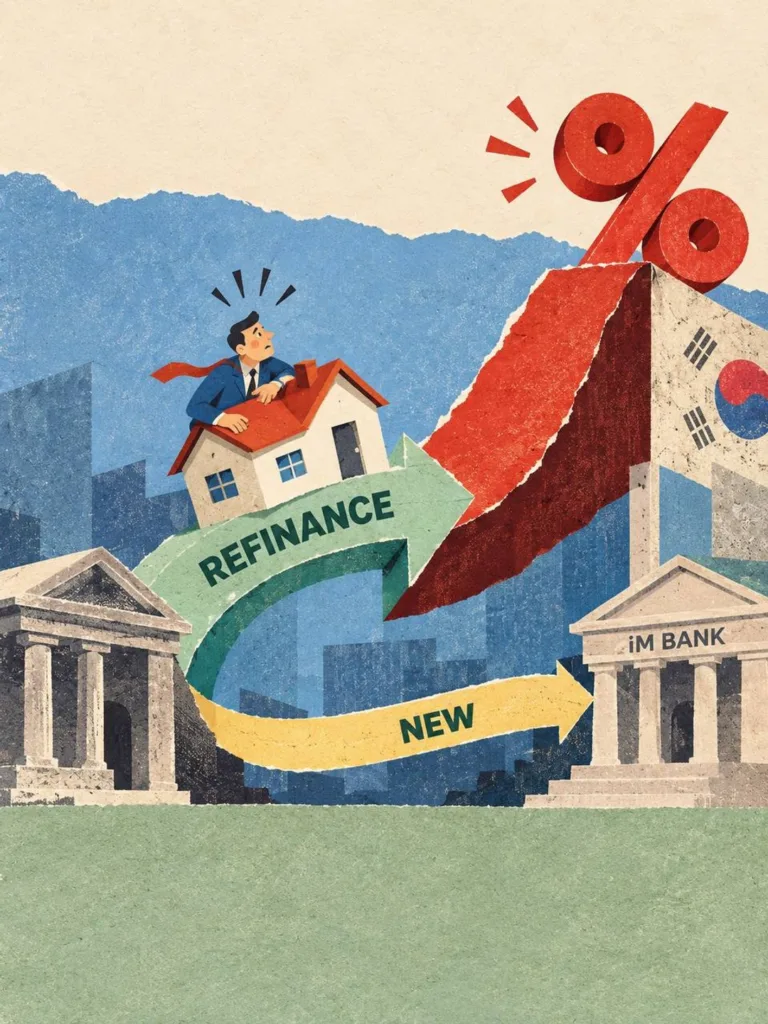
Switching a loan cost more than borrowing fresh. As of July, at 11 of the 16 Korean banks that offer mortgages, the average rate on switch-in loans (moving an existing loan to another bank) was higher than on new loans. The widest gap was at iM Bank (formerly Daegu Bank, which became a nationwide commercial bank in 2024): 7.17% a year to switch in, 4.84% for a new loan.
It is easy to read these numbers as "banks gouge people who switch." But comparing averages has limits, and banks have their own reasons. Every bank has a set cap on how much its household lending may grow in a year, and a loan switched in from a rival bank uses up that cap too.
- At 11 of 16 banks, switching cost more
Rep. Park Sung-hoon of the People Power Party, a member of the National Assembly's financial committee, obtained the data from the Financial Supervisory Service (the agency that inspects and supervises banks) and released it on Sept. 27. At iM Bank, the switch-in rate was 2.33 percentage points higher than the new-loan rate; at Jeonbuk, Jeju, Busan and Suhyup banks the gap was 0.39-0.53 points.
Three of Korea's five biggest banks (KB Kookmin, Shinhan, Hana, Woori and NongHyup) showed the same pattern. Woori charged 4.71% to switch in versus 4.34% for a new loan, 0.37 points more; NongHyup was 0.24 points higher and Hana 0.18 points. Unsecured personal loans flipped the same way at 10 of the 16 banks; at Hana, a new personal loan cost 4.70% and a switch-in 5.72%.
- Averages alone can't prove overcharging
An average rate blends loans taken by very different people. Switchers and new borrowers can differ in credit, in the value of the home pledged as collateral, and in the loan products they pick. Financial regulators also say the average gap alone can't show that switch-in loans were priced higher.
Still, switching was designed from the start to help borrowers move to a cheaper bank. "Since the system was built to let people switch loans for a cheaper rate, consumers can't help but question whether it works," Park said.
- Every bank has a yearly lending cap
The banks' side of the story comes from Korea's household-loan cap (regulators set how fast household lending across the financial sector may grow in a year and split that target among banks). This year's growth target was 1.5%, and the government raised it to 3.0% in its Aug. 13 measures. July, the month of the rate data, fell under the 1.5% target.
Even after the increase, there was little room. The five biggest banks' annual household-loan growth target (excluding policy loans) rose from about 4.34 trillion won (~$3.19 billion) to about 7.11 trillion won (~$5.23 billion). But by Sept. 3 their lending was already 6.9096 trillion won (~$5.09 billion) above last year-end, leaving about 200 billion won (~$147 million) of room.
A loan switched in counts as new lending at the bank that takes it. When the same gap appeared last December, one banker explained: "For most banks, taking switch-in applications is a loss," adding, "As year-end nears we have to worry about the lending cap, so there's no need to lower the rate."
- Banks did narrow the switching window
The window narrowed this year as well. To stay under the cap, IBK Industrial Bank limited switch-in loans from other banks from July 21, except through the online loan-switching platform. After the cap rose, IBK reopened them on Sept. 15, saying it "partly lifted household loan restrictions as the Aug. 13 measures eased the household-loan cap." NongHyup Bank also resumed in-branch mortgages that move loans over from other banks.
Neither regulators nor the banks have officially explained the July gap. Structurally, though, a bank with little cap room has little reason to lure a rival's customers with a low rate. Last December, the five biggest banks' average fixed-rate switch-in mortgage rate was 4.48%, 0.3 points above the 4.18% average floor for comparable regular mortgages. Reports at the time said banks without room for switch-ins were effectively raising the bar with higher rates.
- The exit narrowed as rates rise
When the system worked, switching paid off. When the Financial Services Commission (the government body that sets financial policy) tallied early users of mortgage switching in 2024, those who moved to a lower rate cut it by 1.55 percentage points on average, saving 2.94 million won (~$2,160) a year each in interest.
With that exit narrower now, regulators are focusing on expanding fixed-rate lending to soften the blow of rising rates. They are considering more government-backed mortgages such as Bogeumjari and Didimdol loans, whose rates stay put when market rates rise, and plan to discuss with banks the launch of 10-year-plus fixed-rate mortgages and incentives for them. The rate gap between some banks' 10-year fixed mortgages and 6-month variable mortgages is close to 1 percentage point.
- BITPRESS Insight
This gap is less about discriminating against switchers than about where a bank spends a fixed yearly lending cap first. Even the extra room must go first to group loans for new apartment complexes and to young borrowers and people buying homes to live in. A loan switched in from a rival bank drops to the back of the line.
So the switching door opens and closes with a bank's remaining room. When the cap rose from 1.5% to 3.0%, IBK and NongHyup reopened switch-ins from other banks. When room ran short at year-end, as last December, the window closed or rates rose.
The rule of thumb fits in one line: the tighter a bank's yearly lending cap, the sooner switching from a rival gets pricier; when the cap widens, the switching window is the first to reopen.
Sources
https://www.yna.co.kr/view/AKR20260923166500002
https://news.jkn.co.kr/post/997913
https://www.yna.co.kr/view/AKR20260925042800002
https://news.tf.co.kr/read/economy/2366645.htm
https://www.etoday.co.kr/news/view/2625696
https://www.newsis.com/view/NISX20251211_0003437989
https://news.nate.com/view/20251214n00820
https://www.sentv.co.kr/article/view/sentv202505200107
Glossary
Loan switching — Moving an existing loan to another bank's loan on better terms, often called "switching" a loan.
Household-loan cap — Regulators set how much household loans may grow in a year and split the target among banks, which may not lend beyond it.
Switch-in from another bank — Moving a loan taken at another bank to this bank; the receiving bank books it as new lending.
Fixed rate — An interest rate that stays the same for a set period even if market rates rise.
Online loan-switching platform — An online service that lets borrowers compare banks' loan terms in an app and switch without visiting a branch.
BITPRESS articles are information to help your investment decisions, not a recommendation to buy or sell any stock or coin. Investment decisions and their results are your own responsibility.