
Kia set a new US monthly sales record in August, selling 83,793 cars. Hybrid sales (cars that combine a gasoline engine with an electric motor) rose 65.7% from a year earlier. But the stock went the other way. Kia shares, at KRW 131,000 at the end of August, fell 11.9% to KRW 115,400 on Sept. 23, the last trading day before the Chuseok holiday.
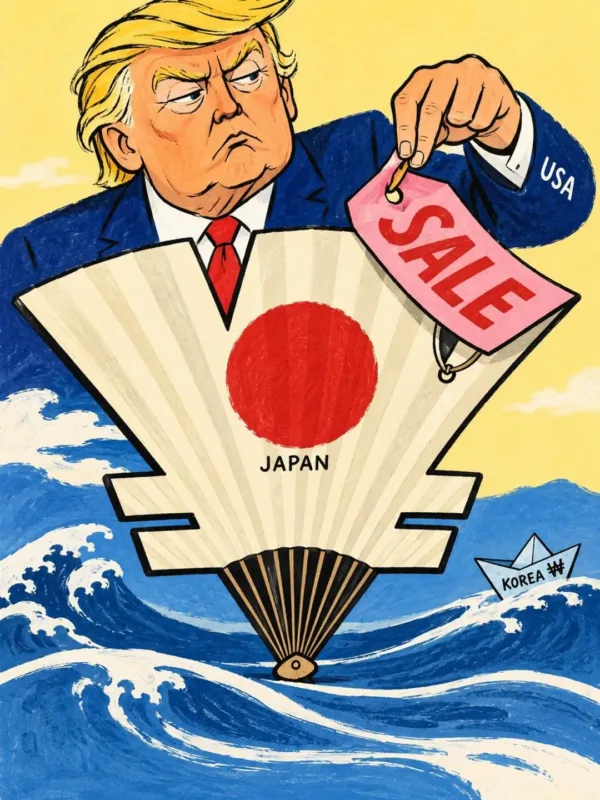
It is tempting to call this an unfair hit to a company with strong results. But the reason analysts point to is not how many cars Kia sold. It is the moment the sales money is converted into won. As the won gets more expensive, Kia keeps fewer won from every car it sells.
- More cars sold, fewer won kept
The dollar-won exchange rate (how many won it takes to buy one dollar) fell 216.6 won, or 13.9%, in just over two months, from 1,555.8 won on July 2 to 1,339.2 won on Sept. 10. The smaller the number, the more expensive the won (a stronger won).
Kia sells cars in the US in dollars, then converts those dollars into won for its results. Take one $30,000 car: at the July 2 rate it was worth about KRW 46.67 million, but at the Sept. 10 rate only about KRW 40.18 million. The price of the car is unchanged, yet it brings in about KRW 6.5 million fewer.
- The currency boost to profit is now running in reverse
From the first quarter of 2023 through the second quarter of this year, a rising dollar (a weaker won) is estimated to have added KRW 4.3 trillion to Kia's operating profit. When the exchange rate turns, that effect turns too.
Analysts estimate that if the average dollar-won rate falls by 100 won, Kia's annual operating profit shrinks by about KRW 1.4 trillion. That is about 14% of the KRW 10.2 trillion operating profit Kia is targeting this year. One analysis also found Kia's exchange-rate sensitivity (how much profit swings when the currency moves) to be the highest of the three companies it compared.
A stronger won does not cut every number. The money set aside to cover warranty repairs on cars sold abroad (warranty costs) shrinks when the won strengthens. On July 27, Korea Investment & Securities estimated that if exchange rates held, third-quarter warranty costs would fall KRW 250 billion from the previous quarter.
- The more EVs Kia sells, the thinner its margins
Electric vehicles weighed on the stock as well. Kia's global EV sales rose 88.4% from a year earlier to 110,000 in the second quarter. Yuanta Securities said that "in terms of profit, this is a deterioration in mix that erodes the company-wide operating margin." Mix means the combination of cars a company sells. Korea Investment & Securities noted that a big factor was larger sales incentives as competition with Chinese brands intensified in Europe and Kia expanded EV sales.
Second-quarter revenue hit a quarterly record of KRW 33.037 trillion, but operating profit fell 4.9% to KRW 2.6285 trillion. Per-car discounts and promotions (incentives) rose $400 in the US and €1,000 in Europe, cutting profit by KRW 723 billion. On July 24, the day results came out, the stock fell 12.88%. The slide did not start in September. The July 24 plunge came from earnings eroded by sales incentives; over the next two months a stronger won added to the pressure and the stock failed to rebound. Shares at KRW 149,800 on July 23 were down 23.0% by Sept. 23.
- Hybrids change both volume and mix
Hybrids sit on the other side. Kia's US hybrid retail sales rose 226.4% from a year earlier to 59,000 in the second quarter, and climbed another 65.7% to 24,948 in August. In the same month, Kia's US EV sales fell 44.7% to 3,046, which is attributed to the end of the US EV tax credit at the end of September last year.
Analysts see a better product mix from growing US hybrid sales as a variable that will decide whether the stock is re-rated. In other words, hybrids can change not just how many cars Kia sells but how much it keeps per car.
- The stock is already on the cheap side
As of Sept. 21, Kia's price-to-earnings ratio (PER, the share price as a multiple of a year's earnings) was 6.67, below the industry average of 7.97, and its dividend yield was 5.67%. Target prices issued on July 27, after second-quarter results, were KRW 190,000 from Yuanta Securities and KRW 220,000 from Korea Investment & Securities. They are 65-91% above the Sept. 23 close, but they came before the September drop and the stronger won.
The exchange rate was not the only driver. Across auto stocks, the burden of US tariffs added to the pressure, and Yuanta Securities also cited a lack of second-half catalysts and weak expectations for Kia's new robotics business as reasons the stock fell after second-quarter results.
- The remaining card: more than KRW 20 trillion in net cash
Another variable analysts point to is what Kia does with its more than KRW 20 trillion in net cash (cash minus debt). That is over 40% of Kia's market value of KRW 46.8496 trillion on Sept. 21.
At its April investor event, Kia set a total shareholder return target (the share of net profit returned to shareholders through dividends and share buybacks and cancellations) of 35% or more for 2026-2028. The company cannot undo the profit a stronger won takes away, but it can decide how much of its cash pile to return to shareholders. Buying back shares and canceling them reduces the share count, so each remaining share gets a bigger slice of profit.
- BITPRESS Insight
An exporter's stock reacts first to "how many won the sales money buys" rather than "how much it sold." When every 100-won drop in the dollar takes KRW 1.4 trillion out of annual operating profit, record sales headlines alone are hard pressed to hold the stock up.
The exchange-rate outlook also points to a stronger won. Korea Investment & Securities expects a fourth-quarter average of 1,350 won per dollar, and Shinhan Securities expects around 1,300 won by year-end. The rate on the day before the Chuseok holiday, 1,358.4 won, is already close.
Here is the rule of thumb. While the won stays strong, what can hold Kia's stock up is not the number of cars it sells, but how much it keeps per car through hybrids and how much of its more than KRW 20 trillion in net cash it returns to shareholders.
Sources
https://www.hankyung.com/article/202609255795i
https://www.hankyung.com/article/2026071067586
https://kr.investing.com/news/stock-market-news/article-93CH-2028251
https://www.seoul.co.kr/news/economy/car/2026/09/03/20260903031004
https://www.etoday.co.kr/news/view/2624151
https://www.imaeil.com/page/view/2026092309381751175
https://www.mt.co.kr/stock/2026/07/27/2026072708202089657
https://www.etoday.co.kr/news/view/2607548
https://www.topstarnews.net/news/articleView.html?idxno=16204094
https://biz.heraldcorp.com/article/10713667
https://www.sedaily.com/article/20094610
https://query1.finance.yahoo.com/v8/finance/chart/000270.KS?range=3mo&interval=1d
Glossary
Stronger won — When the dollar-won rate falls so a dollar buys fewer won; exporters then keep fewer won from the dollars they earn.
Currency sensitivity — How much a company's profit rises or falls when the exchange rate moves by a set amount.
Mix — The combination of products a company sells; when higher-margin products take a bigger share, the mix is said to improve.
Net cash — The cash a company holds minus the debt it has to repay.
Total shareholder return ratio — The share of net profit returned to shareholders through dividends and share buybacks and cancellations.
BITPRESS articles are information to help your investment decisions, not a recommendation to buy or sell any stock or coin. Investment decisions and their results are your own responsibility.