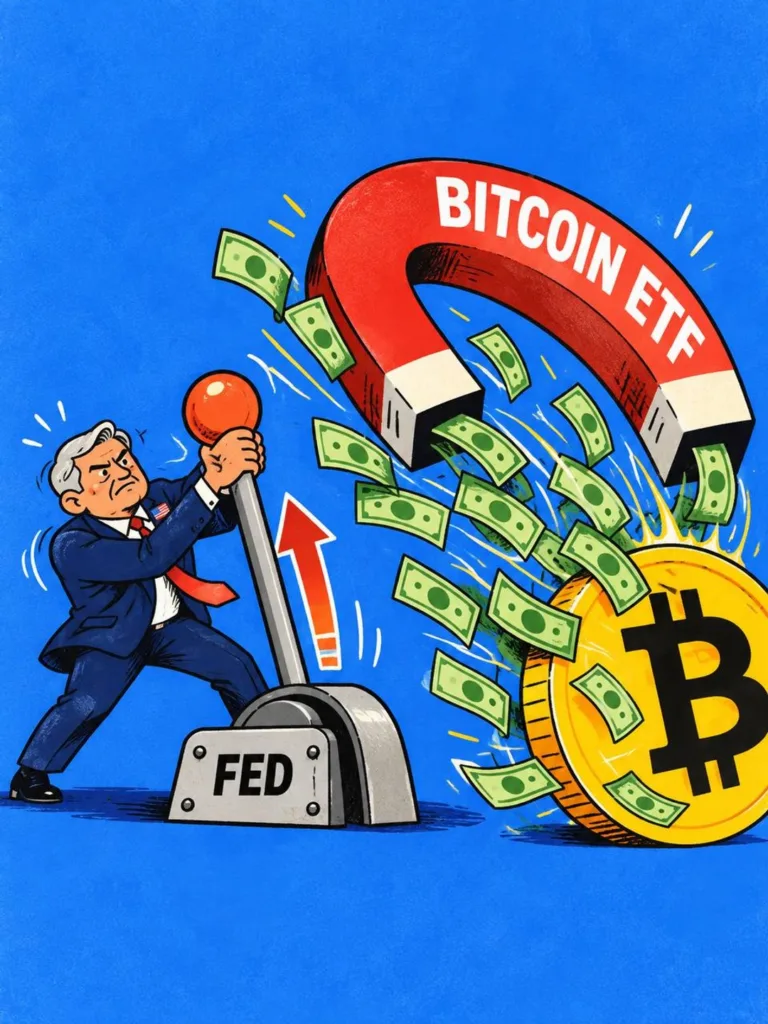
The Federal Reserve, America's central bank, raised its policy rate by 0.25 percentage point to 3.75-4% on Sept. 16. It was the first hike since 2023. Yet the very next week, Sept. 21-25, US spot Bitcoin ETFs (funds that buy and hold real bitcoin and trade like stocks) took in $2.4 billion (about 3.26 trillion won). It was the biggest week of the year, and the biggest since October last year.
Conventional wisdom says higher rates hurt bitcoin, which pays no interest. So this news is easy to read as "bitcoin beats a rate headwind." But follow the dates one by one and the money was drawn by price, not by rates. And that money shrank day after day through the week.
- The rate hike was already in the price
On the day of the Fed decision, bitcoin traded near $75,980, down only about 1%. Markets had expected the hike for days and had already priced it in. All 12 voting members backed the hike, and most officials expect one more before year-end.
What pulled money out of the ETFs was a bill, not rates. In the US Senate, a procedural vote to open debate on the CLARITY Act, which would set the rules for the crypto market, failed 49 to 50. Starting debate needed 60 votes. After that, Bitcoin ETFs lost $450.4 million on Sept. 15 and $295.9 million on Sept. 16.
- What brought the money back was a price rebound
The flow turned on Sept. 17. Once the hike passed as expected without the sell-off markets had feared, investors started buying risk assets again. The Fed's outlook was read as signaling only about one more hike through the end of 2027, easing fears of a long run of increases. On Sept. 18, when bitcoin broke above $78,000, short sellers (who borrow and sell, hoping to buy back cheaper) in derivatives markets such as futures were forced out of their bets (liquidated), which pushed the price higher. As bitcoin climbed from $76,400 to $80,900 that day, spot buying through the ETFs, separate money from the liquidations, piled in too. ETF analyst Eric Balchunas read this as patient individual investors rather than momentum chasers.
On Monday, Sept. 21, $999 million flowed in, the ninth-largest day since the funds launched in January 2024. The same day, bitcoin hit an intraday high of $87,397. Around Sept. 21, roughly $648 million to $920 million of short bets were liquidated across the crypto market. When short sellers buy back to cap their losses, that buying pushes the price up again.
The ETF money pushed the price further. That day's $999 million inflow meant buying about 11,530 bitcoin on the open market. As a result, the price rose above the average ETF buyer's cost of $81,722, putting the average investor in profit for the first time since January.
- In numbers: $6.7 billion changed direction in about two months
The $2.4 billion week was the largest since October last year, when $2.7 billion came in. BlackRock's (the world's largest asset manager) Bitcoin ETF, IBIT, took in $1.2 billion, and FBTC from Fidelity, another large US fund manager, took in $701.7 million. Seven straight days of inflows from Sept. 17 to Sept. 25 added up to about $2.98 billion.
The year-to-date total flipped too. Year-to-date flows stood at minus $5.8 billion on July 13 and reached plus $934.1 million by Sept. 25. That is a swing of about $6.7 billion.
- But daily inflows shrank every day
Split the week into days and the picture changes: $999 million on Monday, $714.7 million on Tuesday, $347 million on Wednesday, $190.6 million on Thursday and $134.5 million on Friday. That is an 87% drop from Monday to Friday.
Monday's big inflow coincided with the day liquidations drove the price up fastest. As bitcoin settled near $84,000 on Sept. 26, daily inflows slipped to the $100 million range. The price was up 3.3% on the week but down about 4% for the year.
A short squeeze is buying that happens once. When everyone who has to buy back has done so, that force stops pushing the price.
- Rates are still a burden for bitcoin
The effect of higher rates has not gone away. When safe places like cash and Treasuries pay more interest, investors need to take less risk to earn a return. Borrowing to invest also costs more.
The Sept. 16 hike barely moved bitcoin because everyone expected it. The further hike most Fed officials expect before year-end remains a live factor for Bitcoin ETF flows.
- BITPRESS Insight
This $2.4 billion was less "money that came in despite a rate hike" than "money drawn by a price rebound and a short squeeze after the hike was already priced in." Rates did not change the flow; price did.
So the yardstick is price too. Above the average cost of $81,722, the typical ETF investor is in profit; below it, back to a loss. Matching last year's total inflow of $21.35 billion would take about $300 million a day, and Friday's $134.5 million was less than half of that.
The rule of thumb in one line: what shows real demand is not a single big week, but whether daily inflows stay positive after the price stops rising.
Sources
https://www.theblock.co/news/markets/2026-09-26-bitcoin-etfs-turn-positive-for-2026-with-2-4-billion-weekly-inflow-their-largest-since-october-416944
https://decrypt.co/379391/bitcoin-etfs-notch-seven-day-winning-streak-as-2026-flows-turn-green
https://247wallst.com/investing/cryptocurrency/2026/09/26/bitcoin-etf-inflows-reach-2-4-billion-this-week-but-daily-figures-decline-is-the-momentum-fading/
https://247wallst.com/investing/cryptocurrency/2026/09/22/bitcoin-etfs-just-pulled-in-1-billion-in-a-day-as-investors-break-even/
https://www.tokenpost.kr/news/briefing/414593
https://www.federalreserve.gov/newsevents/pressreleases/monetary20260916a.htm
https://www.blockhead.co/2026/09/17/fed-raises-rates-25-basis-points-to-3-75-4-first-hike-since-2023-as-bitcoin-holds-near-76-000/
https://cryptodaily.co.uk/2026/09/fed-rates-3-75-4-00-bitcoin-macro-shock
https://www.techtimes.com/articles/327946/20260923/record-bitcoin-etf-inflows-short-squeeze-drive-btc-eight-month-high.htm
https://www.cryptotimes.io/2026/09/24/inside-bitcoins-september-2026-rally-btc-reclaiming-87k-2b-in-etf-inflows-and-a-short-squeeze/
Glossary
Spot Bitcoin ETF — A fund that buys and holds real bitcoin, with shares traded on the stock market like any stock.
Short selling — A bet in which you borrow a stock or coin, sell it first, then buy it back cheaper if the price falls and keep the difference.
Liquidation — When a bet made with borrowed money or margin hits its loss limit and the exchange forcibly closes the position.
Average cost — The average price investors paid; above it they are in profit on average, below it at a loss.
CLARITY Act — A US bill meant to set oversight and rules for the crypto market, blocked in a Senate vote to open debate in September.
BITPRESS articles are information to help your investment decisions, not a recommendation to buy or sell any stock or coin. Investment decisions and their results are your own responsibility.