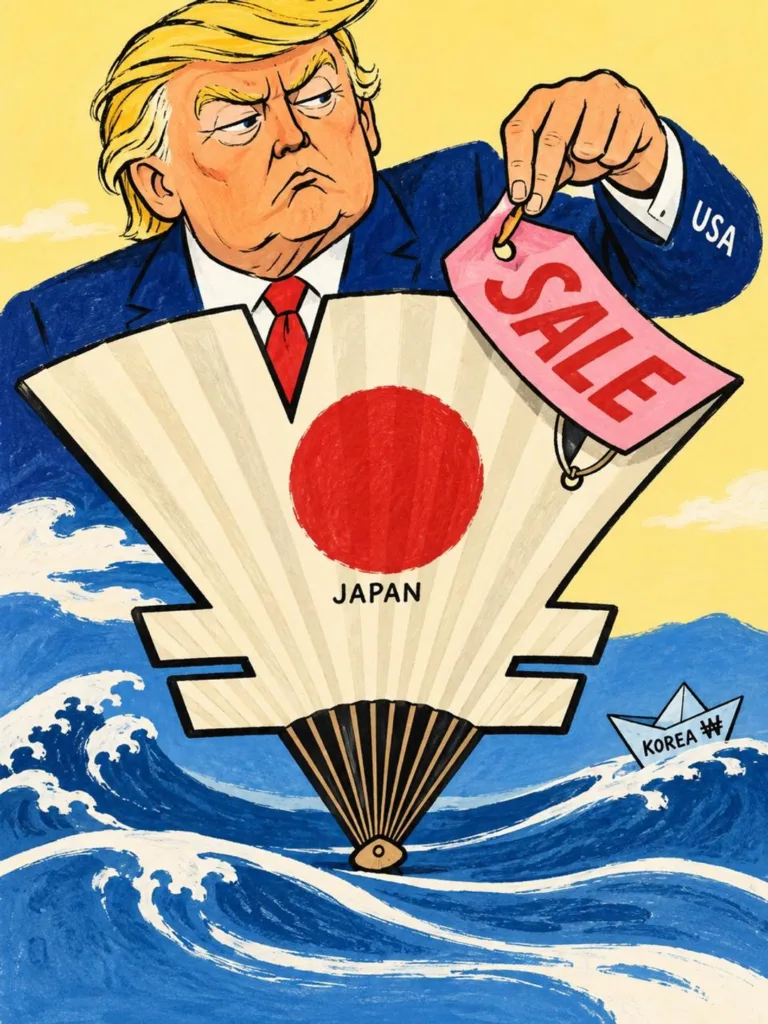
The yen gained about 1% in a single day on Sept. 25. The number of yen needed to buy one dollar (the dollar-yen rate) fell from 158.81 to 157.19. The lower the number, the stronger the yen. It was set off by two people's words. At a news conference, Japan's Finance Minister Satsuki Katayama (the counterpart of Korea's finance minister) disclosed that "President Trump expressed concern about the yen's weakness," and the same day Prime Minister Sanae Takaichi said at her own news conference that Trump had told her "US trade is becoming difficult because of the weak yen."
News like this is easy to dismiss as Japan's own business. But something is odd. Conventional wisdom says a cheaper currency helps a country's exports, yet this time the US president was worried about another country's currency losing value. Understand why America wants a stronger yen, and you can also see how to read the Korean won, which has tended to move with the yen.
- Japan went out of its way to disclose what the leaders said
President Trump and Prime Minister Takaichi held a summit in New York on Sept. 22 on the sidelines of the UN General Assembly. At a news conference on the 25th, Katayama said she was disclosing the exchange for the first time after consulting the Prime Minister's Office. According to Katayama, Takaichi replied that, as a general principle, an excessively cheap yen is a problem.
Talks between leaders are usually kept private. Making this one public was a warning to the market. Right after Katayama's disclosure the yen edged up from 158.60 to around 158, and after Takaichi's news conference the same day, the gain had grown to about 1% by the end of New York trading. On the 24th the yen had slipped as far as the 159 range per dollar in New York, close to 160, the level markets see as a line for intervention risk (the government stepping in to buy yen directly to check the exchange rate). Even though the Bank of Japan (Japan's central bank) raised its rate to 1.25% on Sept. 18, expectations that the Fed (the US central bank) will hike further have widened the rate gap between the two countries.
- Reason one: trade
The worry Takaichi relayed from Trump was about trade. The logic is simple. When the yen gets cheaper, Japanese cars and machinery sell for less in the US, while American goods become pricier in Japan.
A weak yen is like attaching a discount coupon to every Japanese export. That is hardly welcome for Trump, who wants to shrink the trade deficit.
- The bigger reason: US Treasuries
Japan is the world's largest holder of US Treasuries (the IOUs the US government issues when it borrows). To prop up the yen, Japan has to sell dollars and buy yen. If it sells large amounts of Treasuries to raise those dollars, Treasury prices fall and US interest rates rise. That makes borrowing more expensive for the US government.
That is why the US bought yen alongside Japan on July 31, the first joint US-Japan yen purchase since 1998. The Peterson Institute for International Economics (PIIE), a US think tank, argued that when the US buys too, Japan needs to buy fewer yen and so sell fewer Treasuries. Reuters also reported that the US is worried a selloff in Japanese bonds could spill over into the Treasury market.
The effect did not last. The yen, which had slid to nearly 164 per dollar before the intervention, strengthened to 155.20, but it weakened back into the 160 range on Sept. 2. It bounced as high as 152.9 intraday on Sept. 8, then was back in the 159 range on Sept. 24.
- Reason three: an Asian currency domino
US Treasury Secretary Scott Bessent has worried that yen weakness could spread into broader weakness across Asian currencies. If Asian currencies all get cheaper at once, the discount coupon on Japanese exports spreads to Asian exports as a whole. PIIE, too, read that concern as a wish for the dollar to get less expensive against Asian currencies.
Those Asian currencies include the Korean won. The one-year correlation between the dollar-won and dollar-yen rates (how closely two numbers move in the same direction; 1 means in lockstep) reached 0.9 through the end of June. Both Korea and Japan lean on chip and car exports, and markets treat the two currencies as a single "Asian currency" bloc.
- The won does not always follow the yen
Still, the twin formula does not always hold. On July 24 the one-month correlation of the two rates was -0.6, meaning they moved in opposite directions. In July, while the yen slid to nearly 164, the won gained 8.81% in a month, its biggest rise since March 2009.
On Sept. 23, the day before the Chuseok holiday, the dollar-won rate dipped into the 1,340 range intraday before closing at 1,358.4 won. Korea's stock market closed for the holiday on Sept. 24-25 and reopens on the 28th. The currency market, however, switched to 24-hour trading in July, so dollar-won trading continues through the holiday.
- BITPRESS Insight
A weak yen is no longer a card Japan plays on its own. Because a cheaper yen shakes both US trade and US Treasury yields, the US stepped in directly, with money on July 31 and with the president's words on Sept. 22.
That is also why markets are watching 160. Japanese officials say they care about the speed of moves rather than any specific level, but markets see the area around 160 as a line where intervention risk rises. A strategist at Singapore's OCBC Bank read Trump's concern as a sign of deeper US-Japan coordination to support the yen.
The rule fits in one line: as the yen nears 160, what grows is not just the risk of it getting cheaper, but the chance that the US and Japan step in together. The rule for the won fits in one line too. Over a year, the won moved almost in step with the yen, but in July it went the other way. "When the yen rises, the won rises" is a tendency that usually holds, not a formula.
Sources
https://www.nbcnews.com/world/asia/japan-says-trump-voiced-concern-weak-yen-summit-pm-takaichi-rcna599791
https://www.investing.com/news/economy-news/japan-says-trump-voiced-concern-over-weak-yen-in-summit-with-pm-takaichi-4916765
https://finance.yahoo.com/markets/currencies/articles/yen-heads-best-day-two-064223233.html
https://www.hankyung.com/article/202609266259i
https://www.ajunews.com/view/20260925133148028
https://www.pinpointnews.co.kr/news/articleView.html?idxno=490313
https://www.piie.com/blogs/realtime-economics/2026/trying-prop-yen-us-wants-have-its-cake-and-eat-it-too
https://www.aljazeera.com/economy/2026/8/3/japan-and-us-confirm-rare-joint-intervention-to-prop-up-yen
https://www.seoul.co.kr/news/economy/finance/2026/08/03/20260803031001
https://www.hankyung.com/article/2026090946621
https://imnews.imbc.com/replay/2026/nwdesk/article/6834618_37004.html
https://www.mt.co.kr/economy/2026/09/23/2026092315301712830
https://www.sedaily.com/article/20094610
https://query1.finance.yahoo.com/v8/finance/chart/JPY=X?range=1mo&interval=1d
Glossary
Dollar-yen exchange rate — The number of yen needed to buy one dollar; the higher the number, the cheaper (weaker) the yen.
Weak yen — A low value of the yen, which makes Japanese goods cheaper abroad and imports pricier in Japan.
Currency intervention — When a government buys or sells its own currency in the foreign exchange market to curb sharp swings.
US Treasuries — Bonds the US government issues to borrow money; heavy selling lowers their price and pushes up US interest rates.
Correlation coefficient — A value from -1 to 1 showing how closely two numbers move in the same direction; the closer to 1, the more they move together.
Chuseok — Korea's autumn harvest holiday, when families gather and Korean stock markets close for several days.
Dollar-won rate — How many Korean won it takes to buy one dollar; a lower number means a stronger won.
BITPRESS articles are information to help your investment decisions, not a recommendation to buy or sell any stock or coin. Investment decisions and their results are your own responsibility.