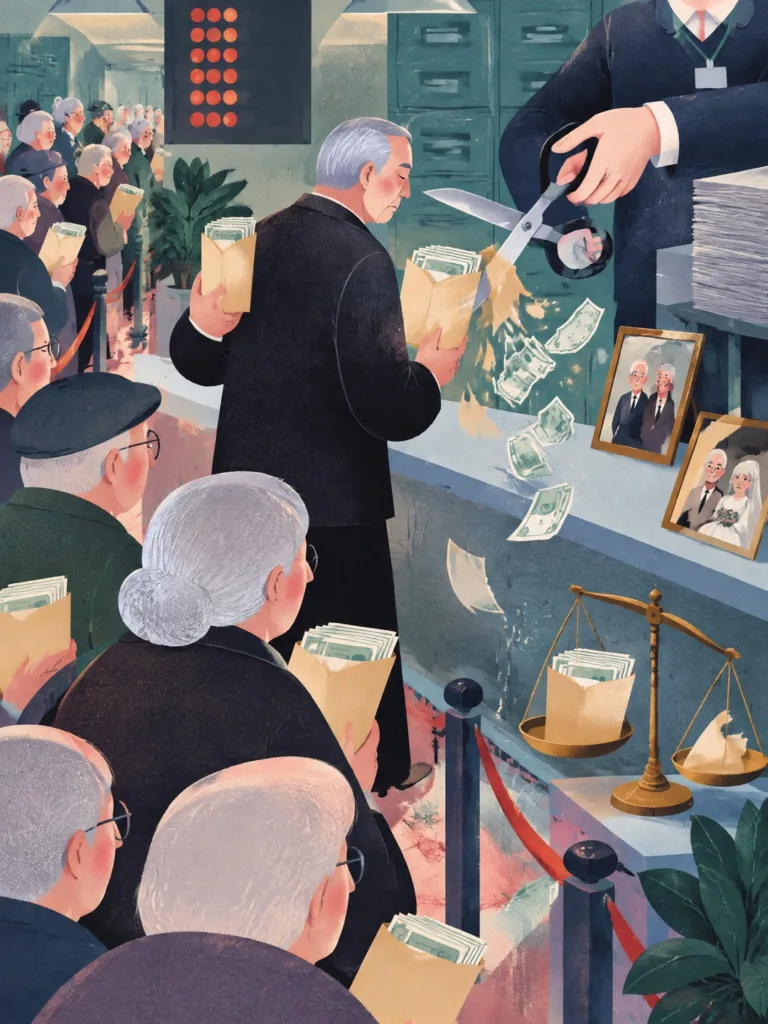
In 2025, 208,242 people became entitled to both their own national pension and the survivor pension from a spouse who had died. Of them, 36,695 received none of their own pension, which they had built up over a lifetime of premiums.
It sounds like an unfair exception. Both spouses paid premiums, so it seems only natural that the survivor would receive their own pension and the spouse's survivor pension in full.
But the key lies elsewhere. Under the national pension system, when two pension rights overlap, a person can take only one. If the survivor pension is much larger than their own, taking it pays more, and then their own pension becomes KRW 0.
- Why the survivor cannot receive both pensions
Say a husband and wife both draw national pensions, and the husband dies first. The wife now has two rights: her own old-age pension, and a survivor pension from her husband (a pension paid to family when a contributor dies).
Under Article 56 of the National Pension Act, you can only pick one in this situation. This is the so-called duplicate benefit adjustment system. If you pick your own old-age pension, you receive all of it plus a bonus equal to 30% of the survivor pension. This article calls that 30% the bonus. If you pick the survivor pension, you receive all of it, but your own old-age pension payments stop.
It is like a store that lets you use only one of two discount coupons per purchase. But unlike coupons, these pensions are rights each spouse built with their own premiums, so people are frustrated. The stated purpose of the rule is to spread a fixed pool of pension funds across more people.
- The 30% was not there from the start
Before 2007, choosing one meant the other was not paid at all. As criticism grew that couples lost out even though they paid premiums together, the system changed in 2007 to add 20% of the survivor pension when you chose your own pension. In 2016, it rose to 30%.
According to a National Pension Research Institute report, after the reforms the share choosing their own pension rose from around 60–70% to over 90% among people who had been receiving a survivor pension and then gained an old-age pension right. These figures cover a different group from the 82% seen among all people with overlapping pensions.
- Overlapping cases rose 67.9% in four years
The number of people with overlapping pension rights rose every year: 123,994 in 2021, 143,995 in 2022, 159,527 in 2023, 182,653 in 2024, and 208,242 in 2025. That is a 67.9% increase in four years.
Dual-income households also grew. In 2025 there were 6,153,000 of them, or 48.6% of households with a spouse.
In 2025, 82% of those with overlapping pensions (171,547 people) chose their own pension, and 18% (36,695 people) chose the survivor pension. The share choosing the survivor pension rose slightly from 16% in 2021. Put simply, eight out of ten judged that taking their own pension with the bonus was better.
- One calculation decides which option pays more
First, you need to know the size of the survivor pension. For national pension survivor benefits, the amount is 40% of the basic pension amount if the deceased contributed for less than 10 years, 50% for 10 to 20 years, and 60% for 20 years or more, plus the dependent-family benefit amount.
Let's run an example. Suppose the husband's basic pension amount is KRW 1 million a month and he contributed for more than 20 years. Then the survivor pension is KRW 600,000 a month, excluding the dependent-family add-on. If the wife's own pension is KRW 500,000 a month, choosing it brings KRW 500,000 + KRW 180,000 (30% of KRW 600,000) = KRW 680,000, which beats the KRW 600,000 survivor pension. If her own pension is KRW 300,000 a month, the total is KRW 480,000, so the KRW 600,000 survivor pension is better.
The crossover is 70% of the survivor pension. In the example above, that is KRW 420,000. If your own pension is larger than this, taking it pays more each month; if smaller, the survivor pension pays more each month.
- The same loss leaves different amounts depending on the pension type
Civil servant, private school teacher, and military pensions add 50% of the survivor pension when a person's own pension overlaps with it. That is 20 percentage points more than the national pension. A couple where one spouse is in the national pension and the other in a civil servant pension is not directly covered by the adjustment rule, so each receives both pensions in full.
Survivor pensions are not large in themselves. In 2024, the 1,080,466 survivor pension recipients received an average of KRW 354,044 a month. Of them, 90.1% were women, and the relative poverty rate among recipients aged 65 and over was 60.34%.
- BITPRESS Insight
What the survivor receives is not the sum of two pensions, but 'the bigger one plus a bonus.' If you pick your own pension, the bonus is 30% of the survivor pension; if you pick the survivor pension, the bonus is KRW 0. So 'KRW 0 from my own pension' is less a sum taken away than the result of choosing the survivor pension. If the survivor pension is much bigger than your own, picking it pays more.
The bonus is smaller than it sounds. The survivor pension is 40–60% of the deceased's basic pension amount, and the bonus is 30% of that. In the example above, of the KRW 1 million basic amount, the bonus that reaches the wife is KRW 180,000. How much household income drops after one spouse dies, compared with when both were drawing pensions, depends on the size of this bonus.
The rule fits in one line: if your own pension is more than 70% of the spouse's survivor pension, take your own; if less, take the survivor pension.
Sources
https://supple.kr/news/cmwscoogpe37tkwp8ij08wfha
https://supple.kr/news/cmwsfjhbrhj6akwp8eo9gtgff
https://www.sentv.co.kr/article/view/sentv202611230023
https://www.mk.co.kr/news/economy/12215806
Glossary
survivor pension — A pension paid to a family after a national pension subscriber or recipient dies.
overlapping-benefit adjustment — A rule that, when a person has two or more pension rights, requires choosing one and reduces or stops the others.
Basic pension amount — The base amount calculated from years of contributions and premiums paid. Survivor pensions are calculated from the deceased's basic amount.
Dependent-family add-on — An extra amount added when the pensioner supports a spouse, child, or parent.
Relative poverty rate — The share of people whose income is less than half the median income of all households.
BITPRESS articles are information to help your investment decisions, not a recommendation to buy or sell any stock or coin. Investment decisions and their results are your own responsibility.