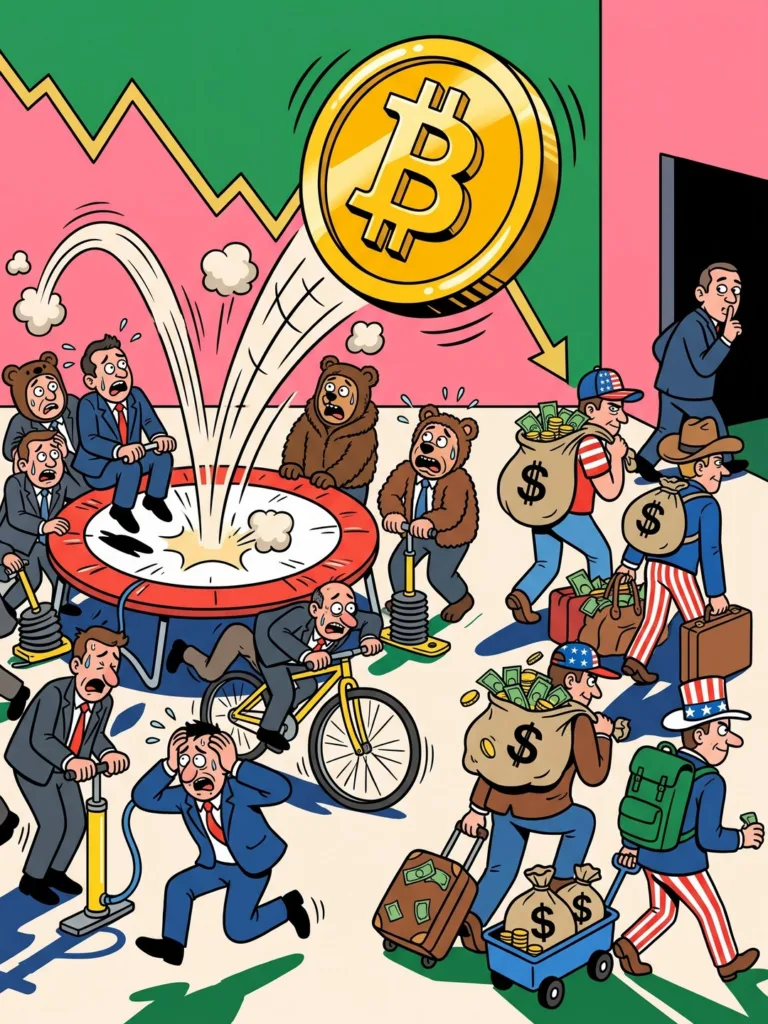
On Monday, Nov. 23, Bitcoin climbed to $64,505 on the Bitstamp exchange. That is more than 17% above the 26-month low it touched at the end of last week. The same day, Nvidia's stock jumped as much as 35% intraday after Jensen Huang's return as CEO was confirmed.
The common reading goes like this. AI stocks are back, so Bitcoin, another risk asset, should recover along with them. But Bitcoin slipped back below $62,000 later that day. The key question is whether the money behind the rebound is fresh money, or money forced to buy to stop losses.
- What drove the rebound
According to CoinGlass, a data firm that tracks crypto derivatives trading, more than $500 million in positions were liquidated across the crypto market in the four hours before 4 p.m. UTC on the 23rd. When the stock rally took off, short sellers, who had bet that prices would fall, were caught off guard.
A short position loses more as the price rises, and when its collateral runs out, the exchange forcibly buys back Bitcoin to close the position. That forced buying pushes the price higher, and the higher price liquidates the next round of short positions. Think of someone who sold borrowed umbrellas in advance, then had to buy them back at a high price when it suddenly rained. But this buying does not come from people who want Bitcoin. It stops once the liquidations end.
- U.S. spot ETFs lost $4.14 billion in November alone
According to SoSoValue, U.S. spot bitcoin ETFs (listed funds that buy and hold actual Bitcoin) had a net outflow of $1.79 billion last week. That was the third-largest weekly outflow since trading began in January 2024. Outflows have now run for four straight weeks, adding up to $4.34 billion.
From Nov. 1 through Friday, Nov. 20, outflows reached $4.14 billion, only about 8% below June's record of $4.51 billion. Year-to-date net outflows are about $3.8 billion, so November's outflows alone exceed the total for the year so far. The math implies that money that had been flowing in slightly through October left all at once this month.
The biggest share came from BlackRock's IBIT, the Bitcoin spot ETF run by the world's largest asset manager. About 76% of last week's outflows, or $1.37 billion, left through this fund. On Thursday, $541.1 million left in one day, a record daily outflow; on Friday, $544.7 million broke that record again. Put simply, money is leaving fastest through the easiest way to buy and sell Bitcoin in the U.S.
- Bitcoin weakened during U.S. market hours
Tesseract's Adam Heims noted that since Huang stepped down on Nov. 12, Bitcoin fell in seven of eight U.S. trading sessions. He said that last week, the drops lined up each day with that day's ETF outflows. In effect, selling through ETFs during U.S. daytime pushed prices down.
Their recoveries also diverged. According to Heims, Nvidia has recovered more than four-fifths of what it lost after Huang left. Bitcoin, which fell from $74,000 to below $56,000, has recovered only about one-quarter of that drop.
- Rate-hike expectations and a strong dollar are weighing on Bitcoin
Heims said the market almost fully expects the Federal Reserve (the U.S. central bank, or the Fed) to raise interest rates in December. The yield on the 2-year U.S. Treasury has climbed back to around 4.7%, and the dollar is at its strongest since March 2025. He sees both as a burden for Bitcoin.
It works like this: when deposit rates rise, there is less reason to keep money in gold or cash, which pay no interest. Bitcoin pays no interest either. But Nvidia's rebound had a company-specific reason, Huang's return as CEO, while Bitcoin had no such reason.
- ETF flows will decide whether the rebound is real
Heims said the ETF flow figures due the night of the 23rd will be the first test of this rebound. Jasper De Maere of Wintermute, a crypto trading firm, said a few days of data cannot confirm a trend. He said he would believe a bear-market bottom only when several straight weeks of ETF net inflows come together with growing stablecoin supply (coins pegged to the dollar).
The remaining variables also come from the U.S. Next up: the October U.S. PCE inflation report (the personal consumption expenditures price index) on Wednesday, Nov. 25, followed by a thin-volume Thanksgiving week.
- BITPRESS Insight
What separates this rebound is not the price but the nature of the money. Buying from short liquidations ends once the wave passes, while ETF money has to keep flowing in day after day to support the price. Right now, U.S. investors are cutting their Bitcoin through ETFs in the face of rate-hike expectations and a strong dollar, and that selling shows up as weakness during U.S. trading hours.
Nvidia rebounded on its own reason: Huang's return. Bitcoin can rise on the same day as AI stocks, but the money that would hold up its price did not come along with it.
A rebound while money is leaving ETFs is a rebound built by short sellers being forced to buy back; only a rebound during several straight weeks of ETF inflows is one built by new money.
Sources
https://www.coindesk.com/markets/2026/11/23/bitcoin-rebound-already-losing-steam-as-ai-trade-returns-with-a-bank
https://cointelegraph.com/markets/bitcoin-etfs-third-largest-weekly-outflows-1-8-billion
https://cointelegraph.com/markets/bitcoin-rebounds-lows-nvidia-rally-sparks-500m-crypto-liquidations
Glossary
Short selling — A bet that a price will fall. The short seller profits if it drops and loses money if it rises.
Liquidation — The exchange forcibly closes a position whose collateral has run out from losses. For a short position, liquidation means forced buying of Bitcoin.
Spot ETF — A fund that buys and holds actual Bitcoin and lets investors trade its shares on an exchange, like stocks.
Net outflow — The gap when more money leaves a fund than flows into it.
Stablecoin — A coin whose value is pegged at $1. Its total supply shows how much money is waiting on the sidelines of the crypto market.
BITPRESS articles are information to help your investment decisions, not a recommendation to buy or sell any stock or coin. Investment decisions and their results are your own responsibility.