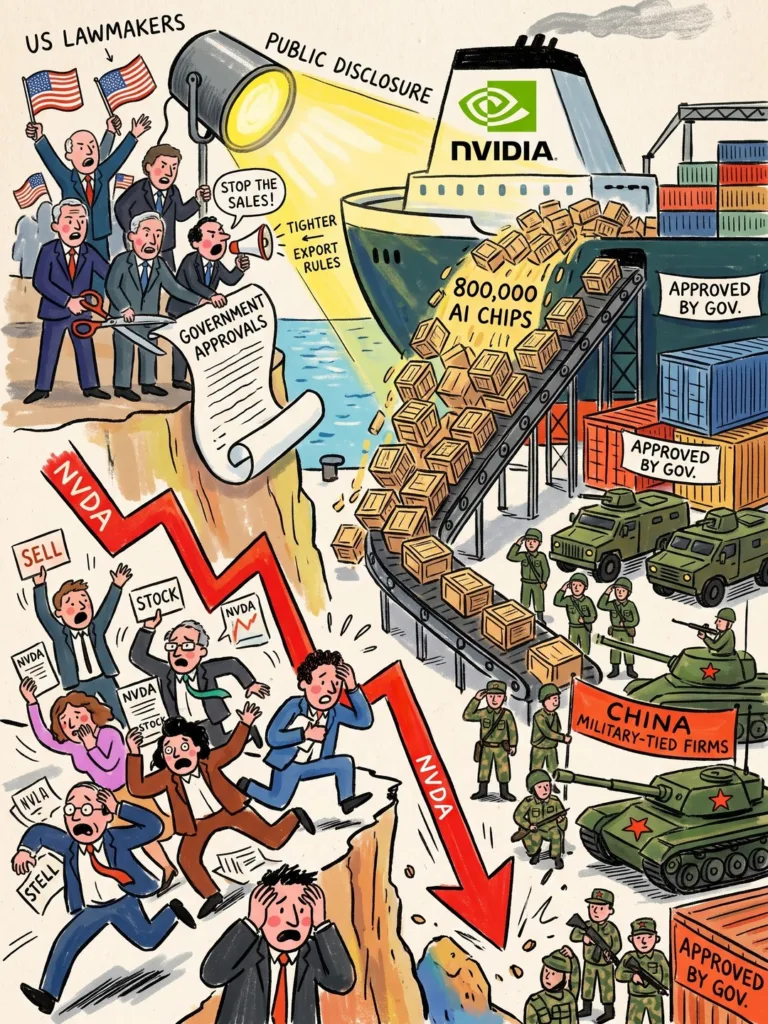
On November 19, Nvidia's stock fell 3.3%. It was down for six straight trading days, and the market value lost over those six days exceeds $600 billion. The same day, the House Foreign Affairs Committee released records showing the Commerce Department had approved sales of 879,868 Nvidia and AMD AI chips to China.
At first glance it looks like good news, since selling more than 800,000 chips to China should boost sales. But the key is not the approval number. The fact that Congress challenged the approval and made the full list public is a heavier signal for investors.
- What was in the license records Congress released?
Brian Mast, chair of the House Foreign Affairs Committee, decided to release the records. Under the Export Control Reform Act (the US law that governs the licensing of advanced technology exports), he said keeping the records hidden was not in the national interest, and made them public.
According to the records, requests to sell 3,444,160 AI chips to China came in from December 2025 through May 2026. As of May 11, 21 requests covering 879,868 chips had been approved. Nvidia's chip is the H200 (Nvidia's high-performance AI chip; its newest chip, Blackwell, cannot be sold to China), and AMD's chip is the MI325X.
The problem is who receives them. Tencent and its subsidiaries were approved for 150,000 chips, Alibaba for 75,000, Baidu for 43,000, and EV maker BYD for 4,000. All four are on the Department of War's list of Chinese military companies. Put simply, the Commerce Department approved sales of advanced chips to companies that the Department of War has linked to the Chinese military.
Chair Mast suspects that Maginfra and Beijing Newmatrix, listed as chip installers in Nvidia's application, are smuggling channels, and said, “Both are fake companies.”
- Why the approval for 800,000 chips has not turned into sales
According to the records, as of May 11 these chips were “approved but not shipped.” The records alone cannot show how many actually reached China. Nvidia said, “It received some approvals but later stopped shipping H200 chips to China.”
It's like having permission to post items on a secondhand app, but having already taken your listing down. Even if the approved number is large, no money has come into the bank account. The difference from a secondhand sale is that the government can take this permission back.
So this disclosure has created virtually no new sales. What it has created is a new question: “Who approved licenses for companies tied to the military, and why?”
- What will Congress do next?
Gregory Meeks, the Democratic ranking member of the Foreign Affairs Committee, said the government's chip export control approach had put “national security and technological advantage at risk,” and that Congress must closely oversee government policy. Chair Mast also said they would “get answers” on how the approvals were made.
A schedule is also set. On December 1, Jensen Huang (Nvidia founder) will hold closed-door meetings with three congressional committees (which committees has not been made public). On December 2, Nvidia's general counsel Tim Teter will appear. On November 16, the Commerce Department had already closed off the route by which Chinese companies rented computing power from Nvidia chips through data centers in third countries.
A proposal to revoke existing licenses has not been reported yet. But stock prices move on worries before decisions come out. Worries that tighter oversight could lead to revoked licenses or stricter export controls have piled on top of six straight days of declines.
- Is this news alone behind the stock drop?
Not entirely. On November 19, the whole market fell. The Nasdaq dropped 2.2% and the S&P 500 fell 1.8%. That one record cannot fully explain Nvidia's decline.
What stands out is AMD, which was also named in the same records. AMD fell 7.7% that day, more than three times the Nasdaq's decline. Put simply, both companies named in the license records fell faster than the market.
- What happened in April 2025?
On April 9, 2025, the US government told Nvidia that exporting its China chip, the H20, would require a license. Nvidia said the H20-related costs could reach about $5.5 billion, and the stock fell more than 6% in after-hours trading. If licenses are blocked, chips already made and contracts already signed turn into costs.
There are also differences from now. Back then, the stock reacted after the regulation actually came out. This time, it is before any regulation, at the stage where Congress has disclosed the license details.
- BITPRESS Insight
Nvidia's China sales depend on Washington's decisions before they depend on company results. Even if a license is granted, shipments stop if Congress challenges it; if licenses are blocked, chips already made become costs. So reading the headline “China sales license” as good news gets the order backwards.
While Congress is questioning how the licenses were granted, even good earnings may not lift the stock, because this worry can weigh on it. The license numbers have grown, but whether they become sales is decided not by Nvidia but by the US Congress and the Commerce Department.
If you hold Nvidia or AI chip stocks, the standard is simple. It is less about how many chips can be sold to China, and more about whether the US Congress and the Commerce Department are challenging those licenses, because that is what moves the stock first.
Sources
https://www.nytimes.com/2026/11/19/business/economy/nvidia-chips-commerce-china-huang.html
https://www.marketwatch.com/story/nvidias-stock-falls-further-it-has-lost-611-billion-in-six-trading-days-434af231
https://www.investing.com/news/stock-market-news/license-information-for-ai-chips-sent-to-china-released-by-us-house-committee-5039850
https://www.unite.ai/mast-releases-nvidia-and-amd-ai-chip-license-records-for-china/
https://www.inquisitr.com/house-panel-chip-approvals-china/
https://www.zerohedge.com/geopolitical/revealed-trump-admin-cleared-879868-nvidia-amd-ai-chips-china-third-pentagon-listed
https://www.ibtimes.com/us-approved-nvidia-amd-ai-chip-exports-china-3809991
https://casrai.org/news/house-foreign-affairs-ai-chip-china-licence-data-2026
https://gokhshtein.com/news/2026-11-19-nvidia-sheds-669b-in-six-days-as-ai-premium-compresses
https://www.theregister.com/2025/04/16/trump_responds_to_nvidias_us/
Glossary
Export license — Official US government approval, given case by case, to sell strategic goods such as advanced chips to a specific country or company.
Export Control Reform Act — The US law that governs the licensing of advanced technology exports, and lets Congress make license records public in the name of the national interest.
List of Chinese military companies — The list of Chinese companies that the Department of War (the Defense Department) has named as helping the Chinese military.
H200 — Nvidia's high-performance AI chip; the Nvidia product that received China sales approval this time.
After-hours trading — A trading session that runs after the regular market closes, where news released after the close is reflected first.
BITPRESS articles are information to help your investment decisions, not a recommendation to buy or sell any stock or coin. Investment decisions and their results are your own responsibility.