Brent crude (oil from the UK's North Sea), the world's benchmark for oil prices, fell from the $108 range to below $100 within a week, then jumped back to the $103 range in a single day. Oil prices feed into inflation, interest rates and the won-dollar exchange rate, so they reach Korean investors' money too. This time, though, the ups and downs came in the opposite order from what common sense would suggest.
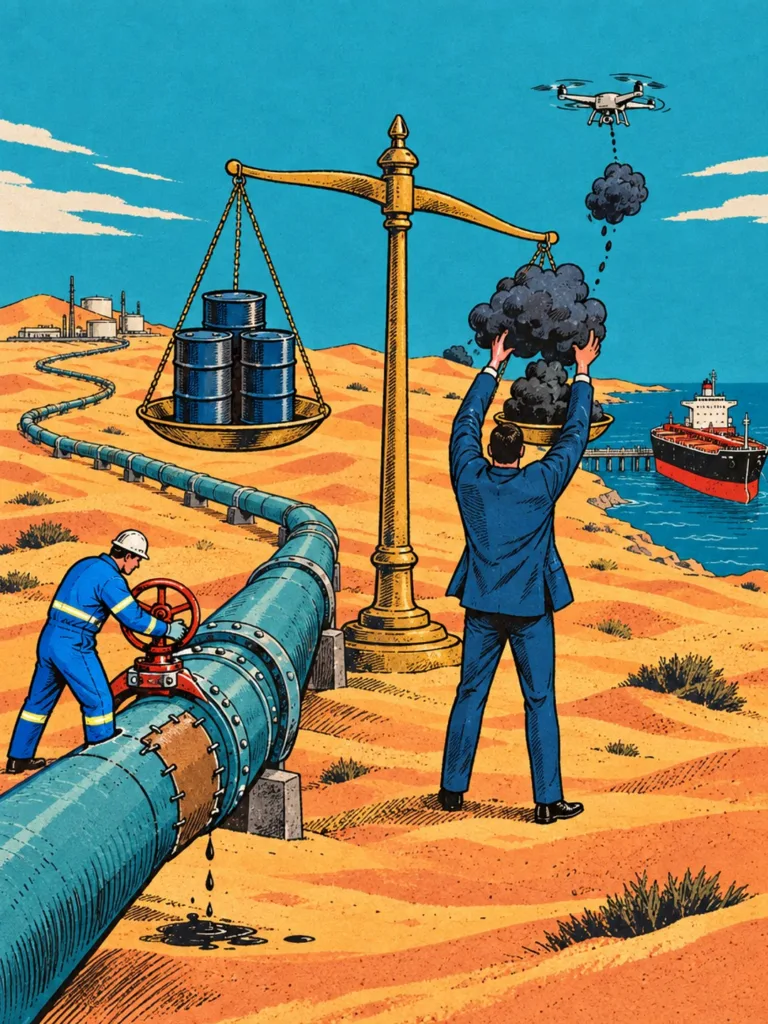
According to Saudi Arabia's Ministry of Energy, the kingdom's East-West Pipeline was hit by drone attacks on Sept. 10, and Saudi Arabia shut the pipeline down on Sept. 11. The crude pipeline runs about 1,200 km from oil fields in the east of the country to the port of Yanbu on the Red Sea in the west. On Sept. 15, Brent closed at $108.75, its highest in about four months. Yet from the next day, while the pipeline was still shut, it fell for five straight days.
On Sept. 22 it closed at $99.25, below $100 for the first time since Sept. 8, and the following day in New York trading it jumped about 4% back to the $103 range. The common explanation is that “Middle East tensions eased, then flared up again.” But what this week really shows is what the ‘war premium’ in oil prices is made of, and how easily it gets added and taken away.
- This pipeline was a detour around a blocked sea route
The war between the US and Israel on one side and Iran on the other began on Feb. 28. From March, the Strait of Hormuz (a narrow sea lane at the mouth of the Persian Gulf that carried a fifth of the world's oil and liquefied natural gas before the war) was effectively closed. Just before the war, Brent crude was trading at about $72 a barrel.
Instead of that sea route, Saudi Arabia had been sending crude through the East-West Pipeline to its western port. According to Reuters, about 4 million barrels a day, around 4% of global supply, was rerouted this way. When drones cut off that detour, oil prices jumped.
- With the pipeline still shut, what pulled oil prices down?
The first was talks. In New York, where the UN General Assembly was meeting, US and Iranian officials sat down together for the first time since June. President Trump said the meeting went “very well.”
The second was supply. While the pipeline was down, Saudi Arabia redirected some of its crude through the Strait of Hormuz. Then on Sept. 22 it restarted the pipeline. Only a small amount is flowing so far, but state oil company Saudi Aramco is working to bring flows back to about 4 million barrels a day within a few weeks. Iraq also said it is exporting more than 3 million barrels a day.
The third was inventories. Figures from the American Petroleum Institute (API, a US oil industry group) released on Sept. 22 showed US crude inventories rose by about 1.79 million barrels in the week ended Sept. 18. The market had expected a decline. According to Reuters, the number added further pressure on oil prices in Asian trading on Sept. 23, and Brent briefly fell to $98.16 during the Asian session.
- On the day inventories rose even more, oil prices jumped instead
On Sept. 23, Iranian President Masoud Pezeshkian said in a speech at the UN that Iran would never surrender to the US but still believes in diplomacy. It was his answer to President Trump, who had warned at the same forum a day earlier that he could “annihilate” Iran.
The same day, the US Energy Information Administration (EIA, a government statistics agency) reported that crude inventories rose by 3 million barrels to 426.4 million barrels, 2% above the five-year average. Normally that number would push oil prices down. Yet Brent rose about 4% that day. In a market at war, a single line from the negotiating table moved prices more than the numbers from the storage tanks.
- The war premium is an insurance premium on ‘the chance of a fire’
The war premium in oil prices works like a fire insurance premium. The premium is set not by whether a fire has broken out, but by the chance that one will. When the pipeline stopped, most of the price jump was not for oil actually lost but for the probability of “what if the detour gets cut off too?”
That is why prices fell before the oil actually came back. The pipeline only started running again, at low volumes, on Sept. 22, but oil prices had begun falling on Sept. 16, six days earlier. Conversely, when a single line in a speech raised the odds again, the premium came back in a day. Expectations change in a day, but real supply takes weeks to return.
- What oil around $100 means for Korean investors
Even as the premium rose and fell, oil was still about $30 above its prewar level based on the Sept. 23 close. When oil is expensive, inflation is hard to tame, and when inflation won't come down, interest rates go up. On Sept. 16, the US central bank (the Fed) said the economy was expanding at a solid pace and “inflation remains elevated,” and raised its benchmark rate by 0.25 percentage points to 3.75%–4%, its first hike since July 2023. On Sept. 23, strong US economic data added to the pressure, pushing the US 10-year Treasury yield to its highest since 2007, and markets put the odds of another hike in October at 71%.
Korea is not free from this pressure either. The Bank of Korea's base rate is 3%, 1 percentage point below the top of the US rate range. Korea relies on imported energy, so when oil prices rise it needs more dollars to pay for oil, which tends to weaken the won. On Sept. 22 the won-dollar exchange rate stood at 1,358.2 won per dollar, up from 1,336.1 won on Sept. 9, the lowest rate in 23 months.
The Ministry of Trade and Industry froze the fuel price cap at 1,784 won for gasoline and 1,773 won for diesel (the maximum supply price per liter) for four weeks starting Sept. 19. In exchange, the budget to cover refiners' losses has swelled to KRW 5.65 trillion. In effect, the national budget is absorbing the cost of not passing global oil prices fully through to pump prices.
- BITPRESS Insight
This week held two paradoxes. Prices fell before the oil actually came back, and prices jumped again on the day more oil was reported piling up in storage. In wartime, a 4% one-day move in oil is less a signal that the amount of oil has changed and more a signal that thinking about ‘the odds of a blockade’ has changed.
So what should weigh on investors is not the premium, but the floor that remains even after the premium is gone. Even the Sept. 22 close, when oil dipped below $100, was about $27 above its prewar level. The pressure pushing up US interest rates and weakening the won comes from this floor, not from a one-day premium.
A day when oil falls on negotiation news is ‘a day the odds went down.’ The day the Hormuz shipping lane returns to normal will be ‘the day the floor comes down.’
Sources
https://www.irishtimes.com/business/markets/2026/09/23/oil-falls-on-better-supply-outlook-hopes-for-us-iran-talks/
https://www.dtnpf.com/agriculture/web/ag/news/world-policy/article/2026/09/22/oil-100-bbl-u-s-iran-diplomacy-u-n-2
https://www.dtnpf.com/agriculture/web/ag/news/world-policy/article/2026/09/23/oil-futures-jump-ulsd-dips-despite
https://lufkindailynews.com/news_reuters/business/wall-street-falls-as-oil-rebounds-middle-east-tensions-simmer/article_21ff45a3-f58e-51d8-ae97-eb03f721a05f.html
https://arynews.tv/pezeshkian-says-iran-wont-surrender-after-trumps-annihilation-threat
https://oilprice.com/Latest-Energy-News/World-News/Oil-Set-for-Longest-Losing-Streak-Since-August-2025.html
https://oilprice.com/Energy/Energy-General/EIA-Reports-3M-Barrel-Crude-Build-as-Distillate-Stocks-Fall-12-Below-Average.html
https://www.infobae.com/america/agencias/2026/09/15/el-brent-cierra-a-10875-dolares-su-precio-mas-alto-en-casi-cuatro-meses/
https://finance.yahoo.com/energy/articles/oil-prices-surge-past-108-171815703.html
https://www.rigzone.com/news/brent_oil_passes_108_per_barrel-14-sep-2026-184604-article/
https://www.aljazeera.com/news/2026/9/12/saudi-arabia-shuts-critical-oil-pipeline-after-drone-attack-what-happened
https://www.koreatimes.co.kr/economy/others/20260922/won-dollar-rate-back-on-roller-coaster-as-1400-won-mark-looms
https://www.mt.co.kr/economy/2026/09/18/2026091816121493397
https://en.sedaily.com/finance/2026/09/18/korea-spends-56-trillion-won-to-cap-fuel-prices-experts
https://finance.yahoo.com/energy/articles/oil-prices-rebound-traders-monitor-094021108.html
https://www.chase.com/personal/investments/learning-and-insights/article/federal-reserve-raises-rates-officials-signal-one-more-hike-in-2026
https://investinglive.com/central-banks/the-full-statement-from-the-federal-reserve-board-for-september-2026/
Glossary
Brent crude — Crude oil produced in the UK's North Sea. Most of the world's oil trades are priced against it.
War premium (geopolitical premium) — The extra amount added to oil prices not because oil is actually short, but because of worry that ‘supply might get cut off.’
Strait of Hormuz — A narrow sea lane linking the Persian Gulf to the open ocean, and the biggest route for Middle Eastern oil to reach the rest of the world.
Crude inventories — The amount of crude oil stored in warehouses and tanks. A rise means there is oil to spare, so it usually pushes oil prices down.
Fuel price cap — A system in which the government sets a ceiling on gasoline and diesel supply prices and uses the budget to cover refiners' losses.
Won-dollar exchange rate — How many Korean won it takes to buy one US dollar. A higher number means a weaker won, so imported goods like oil cost Korea more; a lower number means a stronger won.
Bank of Korea base rate — The key interest rate set by the Bank of Korea, Korea's central bank, much like the Fed's rate in the US. When it sits well below US rates, money tends to flow toward the dollar, which adds pressure on the won.