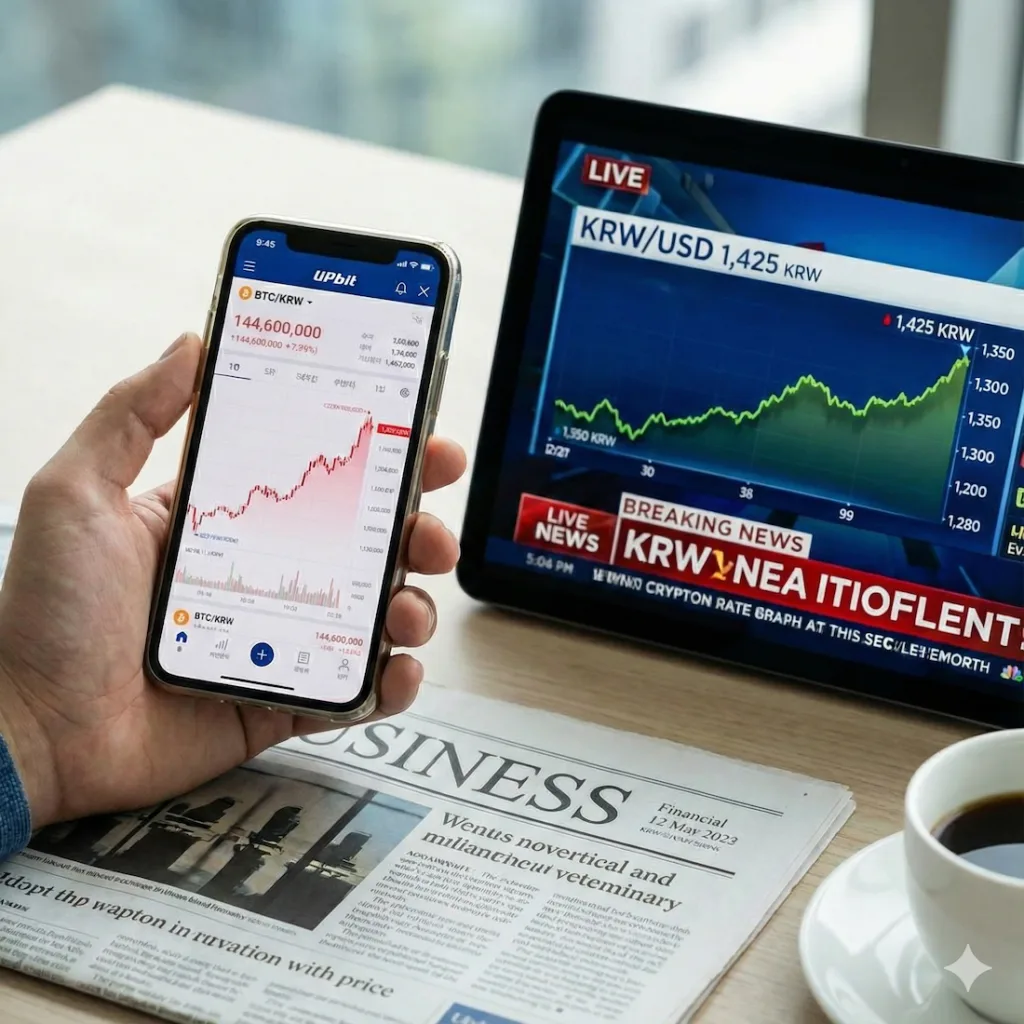
If the exchange rate rises, does Bitcoin's price rise too?
Many investors have had this experience.
“Bitcoin news is quiet, so why did the Upbit price go up?”
At the heart of this question is the won exchange ratehere.
To start with the conclusion:
- Bitcoin's global price is not determined by the exchange rate
- But the won price you see on Upbit can rise with the exchange rate
If you don't understand this difference, you will misread signals of a rise.
1. Where is Bitcoin's price determined?
Globally, Bitcoin in dollars (BTC/USD) is priced.
- Dollar pairs on global exchanges
- Global average price
- Global liquidity and supply and demand
In other words, Bitcoin's ‘benchmark price’ is its dollar price.
The won is not the benchmark but a conversion currency.
2. How is the Upbit price formed?
The Bitcoin price you see on Upbit is KRW/BTC, that is, denominated in won.
This price is formed by the following structure.
Upbit won price = dollar-based Bitcoin price × won/dollar exchange rate
So when the exchange rate changes,
the Upbit price changes even if Bitcoin stays put.
3. When the exchange rate rises, the Upbit price really does rise
Let's take an example.
- Bitcoin dollar price: $50,000 (unchanged)
- Exchange rate KRW 1,300 → about KRW 65 million
- Exchange rate KRW 1,400 → about KRW 70 million
In this case,
- Bitcoin itself did not rise, but
- the won price you see on Upbit rises.
In other words,
Rising exchange rate = rising Upbit price effect
.
4. But is this a ‘real rise’?
An important distinction is needed here.
- Rise in Bitcoin's dollar price → a real rise
- Rise in the won price due to a higher exchange rate → a perceived rise
Whether the Upbit price rose
because of Bitcoin supply and demand or because of the exchange rate are completely different matters.
5. The exchange rate also affects investor sentiment and supply and demand
Beyond simple conversion, the exchange rate also indirectly affects Korean investor sentiment.
Weak won (rising exchange rate) phase
- Avoidance of won assets
- Growing preference for dollars and Bitcoin
- Buying on Korean exchanges may strengthen
Strong won (falling exchange rate) phase
- Returns in won become less attractive
- Profit-taking pressure may increase
However, this is not a rule that always leads to the same outcome.
It is only a tendency and cannot be taken as certain.
6. This is also why the kimchi premium arises
When a surging exchange rate, capital-movement restrictions and concentrated domestic demand overlap,
Bitcoin becomes more expensive in Korea than overseas.
This is the so-called Kimchi premium.
- Rising exchange rate
- Difficulty of overseas arbitrage
- Concentrated domestic buying
→ Upbit price rises above the global price
Summary: the Upbit price can rise, but look at the reason
Here are the key points.
- The exchange rate does not determine Bitcoin's global price
- The exchange rate directly moves the won price on Upbit
- You cannot conclude that a rising Upbit price = a strong Bitcoin
- Looking at the dollar price and the exchange rate separately reduces errors of judgment
BITPRESS Insight
Even if you trade Bitcoin in won, your yardstick should be the dollar price.
Every time the Upbit price rises,
if you don't ask “why did it rise?”,
you will keep chasing buys, mistaking exchange-rate moves for signals of a rise.
- BTC price in dollars
- Won/dollar exchange rate
- Whether there is a domestic premium
Looking at these three together
is the most realistic view a won-based investor can have.