
The key driver of Bitcoin's price is the US Federal Reserve's (the Fed's) capacity to supply money. 2026 is expected to be the year the rate-cutting cycle that began in late 2024 enters a ‘stable phase’ while uncertainty over monetary policy is resolved. Based on forecasts from major global investment banks (IBs) and the Fed's dot plot, we analyze the liquidity environment for each quarter of 2026.
1. Three key variables for liquidity supply in 2026
There are three key factors that will determine the liquidity environment in 2026.
- Rates settling: After the policy rate at the end of 2025 (upper bound 3.75%), whether there are further cuts during 2026 to the terminal rate of around 3.0–3.25%.
- End of quantitative tightening (QT): The point at which Fed asset sales stop and the cash the system needs is reinjected.
- Fed chair succession veto: Fed Chair Jerome Powell's term ends in May 2026, and the resulting policy-continuity risk.
2. 2026 quarterly liquidity outlook and expected Bitcoin reaction
Q1: The prelude to expanded supply (Transition to Ease)
- Liquidity plan: As the aftereffects of the temporary shutdown in late 2025 are resolved, federal government spending normalizes. The Fed is likely to hold the policy rate around 3.50% or consider another 25bp cut.
- BTC impact: The market enters a policy ‘vacuum.’ Rather than a liquidity explosion, it is likely to see a time correction that digests last year's year-end gains, and a floor is likely to form as institutions rebalance their portfolios.
Q2: A policy inflection point and a bottom for the dollar (Policy Pivot)
- Liquidity plan: Market volatility may rise around the end of Chair Powell's term in May. However, Goldman Sachs and others expect the Fed to cut rates to around 3.25% in this period, cementing its easing stance. This is when the dollar index (DXY) confirms the bottom of its long-term downtrend.
- BTC impact: ‘Uncertainty resolved’ is the keyword. Short-term volatility may arise depending on the new chair's leanings, but if the easing stance is confirmed, liquidity will flow faster into asset markets.
Q3: Accelerating credit creation (Credit Creation)
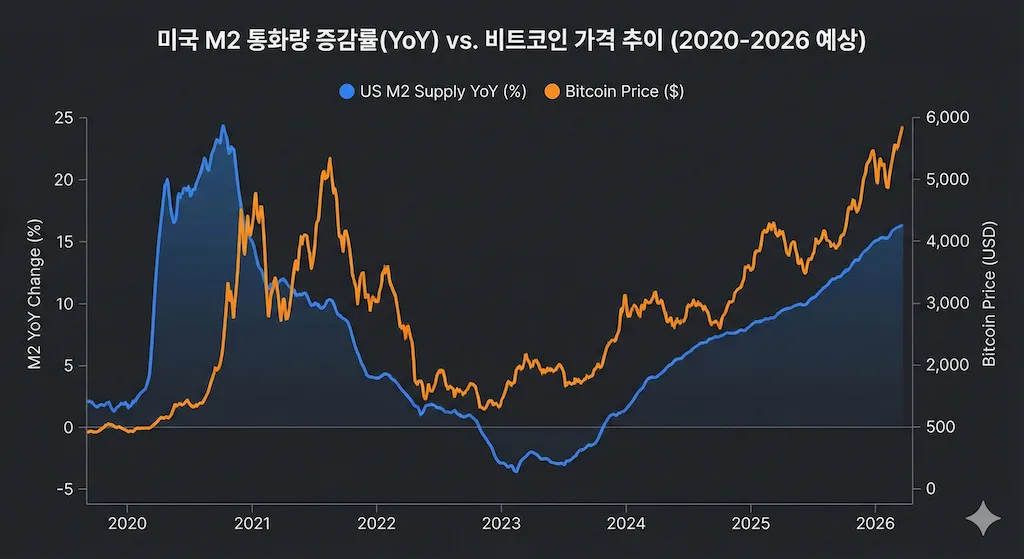
- Liquidity plan: This is when the cumulative effect of rate cuts spreads to the real economy and bank lending (credit). As commercial banks lower lending barriers, M2 money supply growth is expected to steepen. There is speculation that the Fed's balance sheet could return to slight growth.
- BTC impact: This is the stage where the liquidity-driven rally ‘kicks into full gear.’ The positive correlation between M2 growth and the Bitcoin price may be at its clearest, and strong momentum to try breaking the previous high may form.
Q4: Real-economy recovery and inflation risk (Cycle Maturity)
- Liquidity plan: The Fed holds rates around 3.0% and aims for growth without a hard landing. As the US Treasury adjusts the volume of bonds issued to address the fiscal deficit, the bond market stabilizes and risk-on sentiment peaks.
- BTC impact: This is when concerns may arise about asset overheating from excess liquidity. Along with the store-of-value narrative as ‘digital gold,’ speculative demand in the market is expected to peak, and volatility is likely to hit its highest level too.
3. [Insight] 2026: the conclusion Bitcoin investors should focus on
The 2026 liquidity environment is likely to be driven not by aggressive injections like ‘quantitative easing (QE)’ but by private credit expansion through ‘low rates settling in’.
- A higher floor: As rates stabilize lower, Bitcoin's downside will be limited. A rising liquidity low will support the price low.
- Regulation meets liquidity: 2026 is the year the crypto rules set after the US presidential election mesh with liquidity supply. Unlike speculative markets of the past, watch for the ‘qualitative change’ of ample liquidity flowing into institutional assets (such as ETFs).
- Exchange-rate variable: The outlook for a weaker dollar gives Bitcoin a strongly favorable environment. In the liquidity peak of the second half of 2026, profit-taking for asset allocation and risk management should go hand in hand.