
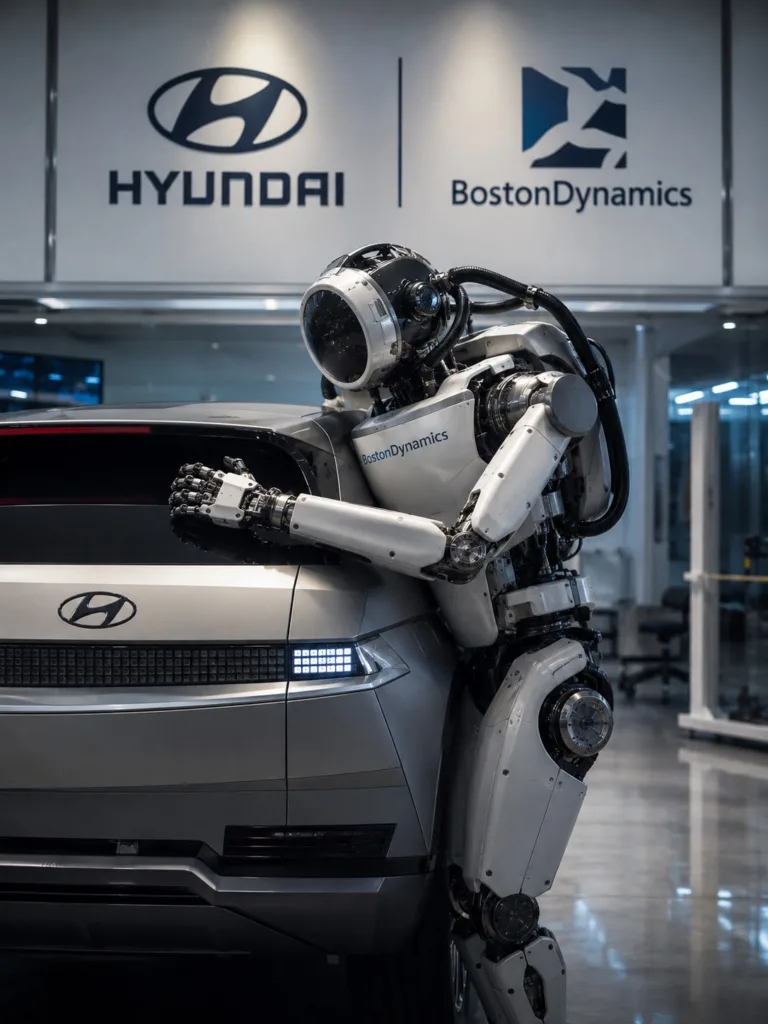
If you ask why Hyundai bought Boston Dynamics, the simplest answer is “to prepare for the machine that comes after the car.” More precisely, Hyundai is running an experiment: building cars with robots, turning the robots themselves into products along the way, and in the long run transforming from a carmaker into ‘a company that builds machines that move.’
Hyundai Motor Group acquired an 80% stake in Boston Dynamics in 2021. That deal valued Boston Dynamics at $1.1 billion. On the surface, it could have looked like an expensive toy. Boston Dynamics was famous for videos of robot dogs dancing and humanoids jumping and doing backflips, but at the time it was hard to call it a company that had succeeded in large-scale commercialization.
Looking back now, though, what Hyundai bought was not a company that made viral robot videos. What Hyundai bought was ‘the technology of movement.’ A car is a machine that travels on roads, and a robot is a machine that moves through spaces other than roads. The only difference is whether it has wheels or legs; both are ultimately physical platforms that move people and things in the real world.
- Hyundai wants to build cars with robots
The first goal is the factory. Hyundai uses Boston Dynamics’ Spot for inspection and predictive maintenance at industrial sites, and it plans to put the humanoid robot Atlas into its car plants. According to Reuters, Hyundai has unveiled plans to deploy Atlas at its plant in Georgia, U.S., from 2028 for parts sequencing, and from 2030 to expand its use to more complex tasks such as parts assembly.
Parts sequencing
The job of preparing and supplying the parts an auto assembly line needs in the right order. Because countless parts must arrive at a car plant at precise times, this work may look like simple hauling, but it has a big impact on production efficiency.
The key point is that Hyundai is not planning to hand robots the entire job of assembling cars from the start. Car plants are already full of robot arms and automation equipment. The problem is that most of that equipment repeats set tasks in fixed positions. Humanoid robots, by contrast, can fit into spaces built for people without major changes. They differ from existing automation robots in that they can walk like people, grip objects like people and move around factories designed for humans.
In other words, Hyundai’s first calculation is clear. A car plant is the best place to test robots. It has plenty of dangerous, repetitive work, it generates data, and productivity gains are easy to measure. A car plant is exactly the right place to verify whether robots can actually make money.
- Hyundai wants to build the ‘Hyundai Motor’ of the robot era
But if that were all, the Boston Dynamics acquisition would be nothing more than a factory automation investment. The bigger picture Hyundai sees is turning robots themselves into a business.
At CES 2026, Boston Dynamics unveiled the new Atlas and said it would begin producing a product-grade humanoid robot. The robot is designed for industrial tasks such as logistics, material handling and order fulfillment, and it will be deployed first at Hyundai and Google DeepMind sites. Hyundai said it is targeting production capacity of 30,000 robots a year by 2028.
This is the crucial part. Hyundai is not a company that buys and uses robots; it is a company that can mass-produce them. The hardest part of the robot industry is not making impressive demo videos. It is building hardware that doesn’t break down, sourcing parts reliably, cutting costs and maintaining quality across thousands of units. That is exactly what carmakers do best.
It is in the same vein that Nvidia CEO Jensen Huang recently said, in effect, that “no company is better positioned than Hyundai in manufacturing, mobility and large-scale production.” In the era of AI robots, being good at software is not enough. You need the ability to build tens of thousands of machines that move in the real world. On this front, Hyundai has strengths that set it apart from Tesla, Chinese robot companies and Big Tech.
- Boston Dynamics is Hyundai’s testing ground for ‘physical AI’
The keyword Hyundai keeps using lately is physical AI. Put simply, it means AI that sees, decides and moves in the real world, rather than AI that only answers on a screen.
Physical AI
Artificial intelligence that combines sensors, cameras, robot bodies, autonomous driving technology and AI decision systems to move and work on its own in physical space. If a chatbot is AI that writes sentences, physical AI is closer to AI that moves objects, inspects factories and works alongside people.
For Hyundai, physical AI is a concept that runs through both cars and robots. A self-driving car is a machine that perceives the real world, makes decisions and moves. So is a humanoid robot. If a self-driving car is AI on wheels, a humanoid robot can be seen as AI on legs.
Seen this way, it becomes clear why Hyundai is tied to Boston Dynamics, Nvidia and Google DeepMind at the same time. Boston Dynamics builds the robot body, Nvidia provides AI training and simulation infrastructure, and Google DeepMind supplies AI models that help robots learn faster. Hyundai adds real factories, manufacturing data, mass-production capability and a global supply chain.
Ultimately, what Hyundai wants is not just a single robot. It wants a loop in which robots learn, are deployed in factories, build up work data and are replicated into more robots: car plants build robots, and those robots in turn make car plants more automated.
- For now, though, ‘hard commercialization’ is more realistic than ‘a wonderful future’
Still, the robot industry should not be taken lightly. Boston Dynamics’ Atlas is remarkable technology, but for a robot to go into a factory and make money, it has to meet a different standard from a tech demo. Boston Dynamics CEO Robert Playter has said that to be useful in a factory, Atlas must be able to learn a new task within a day or two and needs reliability of around 99.9%. That means many challenges remain.
For a robot, working reliably every day, week and month is far harder than moving impressively once or twice. In a factory, the moment a robot falls over, picks up the wrong part or gets in a worker’s way, production disruptions and safety problems follow. Humanoid robots in particular are complex, which means heavy cost and maintenance burdens.
Foreign media outlets such as AP and Reuters are reporting both hopes and concerns about the humanoid robot market. Chinese robot companies are ramping up production quickly, but some point out that real demand and commercial uses are still lacking. In other words, like electric vehicles in their early days, robots are indeed “a market that will be big someday,” but when, for whom and how much profit they will bring is still being tested.
- Hyundai still has the edge because ‘its first customer is itself’
Hyundai’s strength is that it doesn’t have to look only outside for customers to buy Boston Dynamics’ robots. Hyundai Motor, Kia, Hyundai Mobis, Hyundai Glovis, their factories, logistics centers and parts supply chain are all potential customers and testbeds.
Testbed
A space or system for testing and validating new technology in real-world conditions. In the robot industry, real factories and logistics sites, not labs, are especially important testbeds.
This structure is similar to Tesla’s strategy of putting Optimus into its own factories. But Hyundai already owns a specialized robot company in Boston Dynamics and has a wide range of sites through its auto, parts and logistics affiliates. Even if its robots are not sold to outside customers as finished products from day one, they can be used within the group to build up data and improve.
That is why Boston Dynamics matters to Hyundai. Hyundai can use robots to make its factories more efficient, and at the same time use those factories to make robots into better products. If internal demand carries the early market, it also opens the door to expanding into outside sales and services later.
- Conclusion: for Hyundai, Boston Dynamics is ‘a production platform for the post-car era’
To sum up why Hyundai acquired Boston Dynamics in one line: it is a bridgehead for moving from a car company to a physical AI company. In the short term, the main goal is to use robots to build cars more safely and efficiently. In the medium to long term, the bigger goal is to prepare for an era of mass-producing, selling, operating and servicing robots the way it does cars.
So the answer to “Does Hyundai want to build cars with robots?” is close to “yes.” But if you ask, “Is that all?” the answer is “no.” What Hyundai is really after is not robots inside car plants but a future in which robots become a huge industry, just like cars.
The car was the defining machine for moving around in the 20th century. The smartphone was the defining personal computer of the early 21st century. If the key machine of the next era is the robot that moves through the real world, Hyundai wants to be not just an observer in that market but a manufacturer, operator and platform business.
For Hyundai, Boston Dynamics is not just a cool robot company. It is the most expensive business card and the most important laboratory Hyundai bought to say, “We are not a company that only makes cars.”
BITPRESS Insight
The picture Hyundai is painting with Boston Dynamics goes beyond “putting robots in car plants.” It is a declaration that Hyundai will fully transform into a robot platform company built on its hardware manufacturing capabilities. Atlas is the first product, and the IPO is the fundraising tool that will complete that transformation.
From an investor’s perspective, three points stand out. First, the timing of the Boston Dynamics IPO and its offering price range, which ties directly into a revaluation of Hyundai Motor Group as a whole. Second, the results of putting Atlas to work at the Georgia plant. 2028 is the first test, and the outcome will determine its commercial credibility. Third, how the market splits with Tesla’s Optimus. If the market divides into high-performance industrial robots and low-cost general-purpose ones, Hyundai could secure a firm position in the premium B2B market.
If an era comes when robots become as common as cars, Hyundai’s moves today may be remembered as the earliest preparation for that era.
Sources and references
https://biz.heraldcorp.com/article/10696617
https://www.hyundaimotorgroup.com/ko/story/CONT0000000000199553
https://www.newsspace.kr/news/article.html?no=13851
https://www.tech42.co.kr/현대차-보스턴다이내믹스-아틀라스-공개-2028년-공장
https://zdnet.co.kr/view/?no=20260215004347
https://v.daum.net/v/20260420082855842
https://www.mt.co.kr/industry/2026/05/07/2026050715474871183
https://www.buffettlab.co.kr/news/view.php?idx=54331
https://www.newsspace.kr/news/article.html?no=12932
https://www.seoul.co.kr/news/economy/industry/2026/02/19/20260219500212
https://www.startuptoday.co.kr/news/articleView.html?idxno=802945