
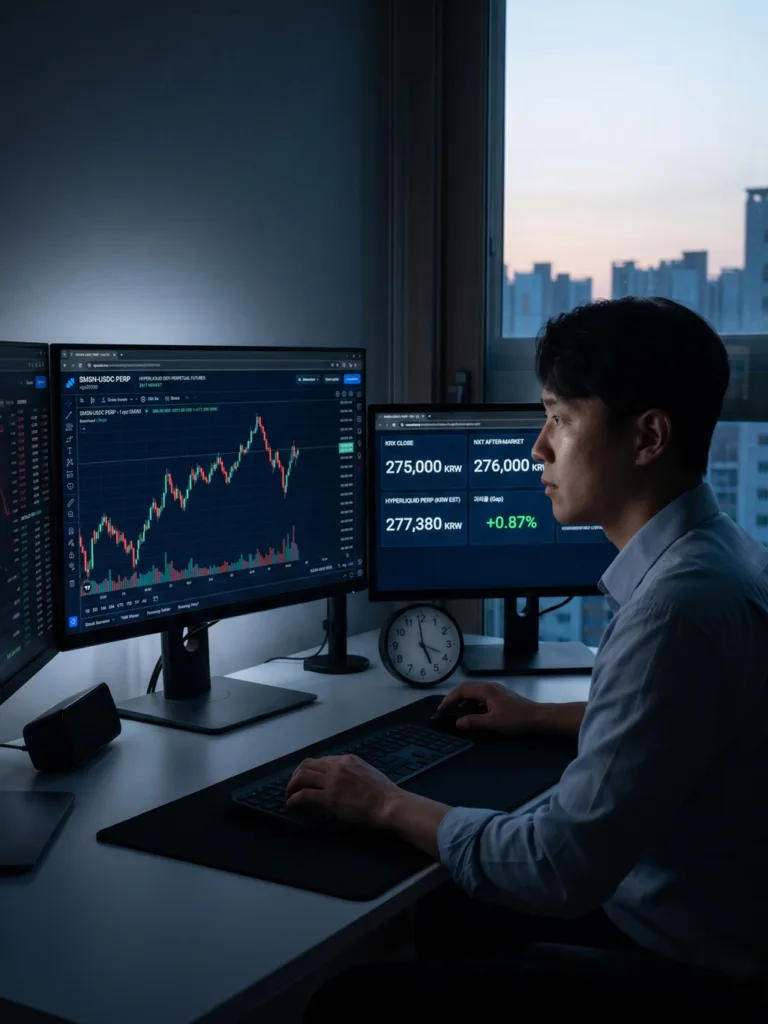
It's before 9 a.m., when the Korea Exchange's regular session opens. Many people want to know whether Samsung Electronics shares will rise or fall but assume there's no way to check. Yet in overseas DeFi markets, prices for Samsung Electronics and SK hynix have already been forming all night.
It is not an official price. But it is not a meaningless number either.
- Korean stocks trade 24 hours a day?
The Korea Exchange (KRX) regular session runs from 9 a.m. to 3:30 p.m. Since March 2025, when the alternative trading system Nextrade (NXT) opened, trading hours have been extended to 12 hours a day, from 8 a.m. to 8 p.m. But from 8 p.m. until 8 a.m. the next day, and on weekends and holidays, no exchange in Korea is open.
※ Nextrade (NXT): Korea's first alternative trading system, launched March 4, 2025. It runs a pre-market session (08:00–08:50), a main market session (09:00–15:20) and an after-market session (15:40–20:00).
Filling that gap are overseas DeFi derivatives markets. On Hyperliquid, a decentralized perpetual futures exchange, perpetual futures on major Korean names such as Samsung Electronics, SK hynix, Hyundai Motor and the KOSPI 200 trade 24 hours a day, 365 days a year.
※ Perpetual futures (Perp): futures contracts with no expiry date. They are derivatives where you bet by going long if you think the price will rise and short if you think it will fall.
- Where does this price come from?
Hyperliquid's Korean stock perpetuals are markets that anyone can create without permission through a protocol standard called HIP-3. Samsung Electronics trades under the ticker xyz:SMSN and SK hynix under xyz:SKHX. Prices are quoted in dollars (USDC); multiply by the real-time exchange rate to get an estimated price in won.
For example, if xyz:SMSN is trading at $201 and the exchange rate is KRW 1,380 per dollar, the overseas market's estimated won price for Samsung Electronics is about KRW 277,000. How close this comes to the 9 a.m. opening price is the key to this indicator.
The pricing mechanism is simple. Investors around the world take long positions overnight if they think Samsung Electronics will rise and short positions if they think it will fall. The price formed where that supply and demand meet is quoted in dollars, and Upbit's KRW/USDT rate is applied in real time.
This perp price reacts most sensitively when U.S. stocks move sharply overnight or when major events hit, such as Nvidia earnings, the U.S. Consumer Price Index (CPI) or a Federal Open Market Committee (FOMC) announcement. And when the KRX opens the next day, the perp price and the regular-session price tend to converge quickly.
※ CPI (Consumer Price Index): the leading gauge of inflation, which directly affects the direction of the Fed's rate policy. ※ FOMC (Federal Open Market Committee): the U.S. committee that sets the benchmark interest rate.
- How to actually check it
The fastest way is hlkr.co.kr. It is a monitoring site that shows the KRX closing price, NXT after-market price and Hyperliquid perp price for Samsung Electronics, SK hynix, Hyundai Motor and the KOSPI 200 on one screen, refreshing automatically every 10 seconds. It also shows the premium or discount.
You can also check directly in the Hyperliquid app (app.hyperliquid.xyz). Type SAMSUNG-USDC or HYNIX-USDC into the search bar to see a real-time chart and the current price.
※ Premium/discount: the percentage by which the perp price, converted into won, differs from the KRX closing price. For example, a premium of +5% means the overseas market values the stock 5% higher than the Korean close.
- A reference indicator, not a forecasting tool
You should not trust this price blindly. The reasons are clear.
First, liquidity is thin. There are far fewer participants than in the KRX regular session, so a single large position can move the price a lot.
Second, spreads are wide. The gap between bid and ask is wider than in the regular session, which makes the price less reliable.
Third, the gap does not always close. Even when the premium or discount is large, the opening price sometimes fails to move in the direction of the perp price. In particular, Korea-specific supply-and-demand issues, institutional trading or foreign program trading can change the direction right after the open.
In the end, this indicator is most useful in one situation: when there was a global macro event overnight and it is clear that the shock will directly affect globally linked large caps such as Samsung Electronics or SK hynix. In other situations, it is best used only as a rough guide to direction.
BITPRESS Insight
What makes this indicator interesting is not simply that it shows overnight prices. It is a sign that decentralized derivatives markets have begun to fill the information gap in traditional stock markets.
While Korean exchanges are closed, U.S. rates move, Nvidia reports earnings and chip supply-and-demand news pours out. Until the regular session opened, Korean investors had no official way to respond. Hyperliquid's perp market is performing price discovery in that gap.
Of course, this is not a tool for predicting the future. But it is the fastest window into how global investors are valuing Samsung Electronics at this very moment. Narrowing the information time lag is valuable enough on its own.
Sources
hlkr.co.kr, 24-hour monitoring of Samsung and SK hynix · Hyperliquid HIP-3 perps in real time https://hlkr.co.kr/
hlkr.co.kr, Samsung Electronics 24-hour real-time price · overnight quotes https://hlkr.co.kr/stocks/smsn
Hyperliquid, app.hyperliquid.xyz https://app.hyperliquid.xyz/
Mirae Asset Securities, guide to the alternative trading system (NXT) https://securities.miraeasset.com/mw/event_ats/main.html