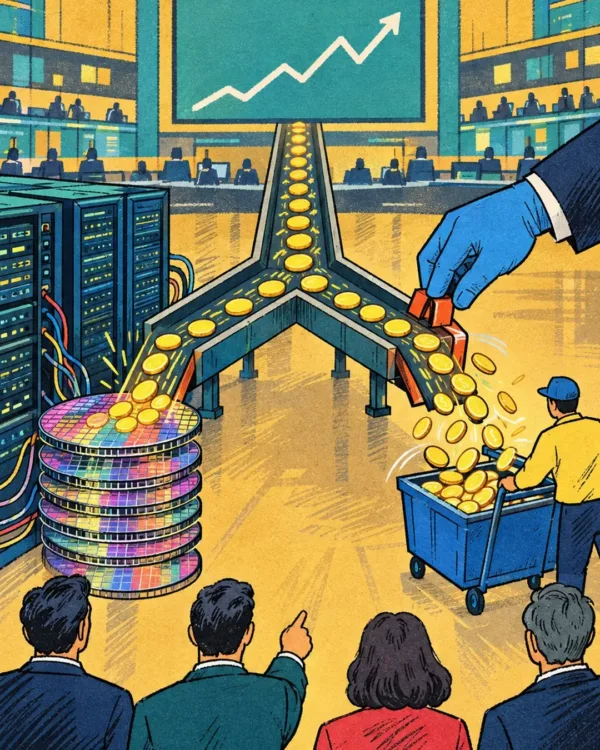
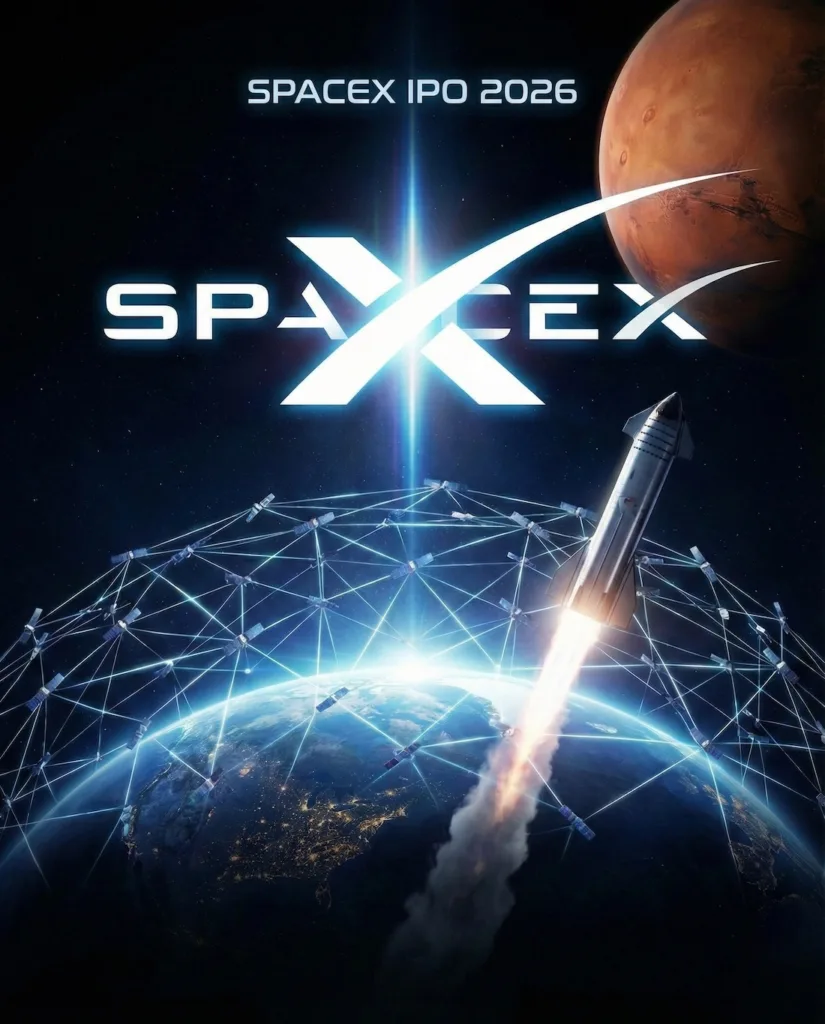
With Elon Musk's SpaceX officially targeting an initial public offering (IPO) in 2026, the market is already calling it “the largest listing ever, bigger than Saudi Aramco.” The key point is that SpaceX is being revalued not as just a rocket company, but as a global satellite internet and space infrastructure platform led by Starlink.
1. Listing timing, valuation and market cap range
- SpaceX has acknowledged its 2026 IPO plans through internal communications and media reports.
- According to Bloomberg and Yahoo Finance,
- the company was valued at about $800 billion (800B) in an insider share sale (for employees and existing investors) in late 2025,
- and a target market cap of up to about $1.5 trillion (1.5T) is being floated for an official IPO.
Two points matter here.
- Timing
- Multiple sources and media outlets point to “middle to late 2026” as the listing window, with the caveat that it could slip to 2027 depending on market conditions.
- A New York listing (Nasdaq or NYSE) is likely, but the exchange has not been decided. That will be officially confirmed when the registration statement (S-1) is filed.
- Market cap (valuation)
- Saudi Aramco set the record for the largest IPO in history, raising $29 billion at a valuation of about $1.7 trillion. For SpaceX, a valuation between $1 trillion and $1.5 trillion and a raise of $25 billion to $30 billion or more are being discussed.
- Articles based on internal simulations say most of the company's value comes from Starlink, while rocket launches and space transport are treated as an “option” for growth and strategic value.
Facts on the offering price and target price:
- No S-1 (the filing submitted to the U.S. SEC) or official IPO price range has been released yet.
- The numbers out there are only estimates based on the “insider share sale price (around $421, for example)” and the “target market cap ($1.5 trillion),” not a confirmed offering price.
- So at this point, it is impossible to state a specific “subscription price or target price” with certainty. This section will need updating once the S-1 and roadshow materials come out.
2. Why is Starlink generating so much excitement?
Starlink is a “low Earth orbit (LEO) satellite internet service” that delivers high-speed internet to remote areas, aircraft and ships worldwide where ground-based cell towers struggle to reach. The market's excitement comes down to four main reasons.
- A growing subscription business with proven cash generation
- Of SpaceX's estimated total revenue of about $13.1 billion in 2024, Starlink is estimated to have contributed about $8.2 billion, or more than 60%.
- Forecasts put revenue at about $15 billion in 2025 and as high as $22 billion to $24 billion in 2026, again driven mostly by Starlink.
- Satellite internet is a subscription model with recurring monthly fees per subscriber (ARR), so it is seen as a “big-tech-style cash cow.”
- A market as big as “the whole planet”
- Starlink already operates in more than 100 countries and territories, and if it wins approval in large emerging markets such as India, its subscriber base could grow exponentially.
- Developing countries with poor ground networks, as well as airlines, shipping, military and government customers, are all potential demand.
- The potential to compete or partner with telecom carriers through “Direct-to-cell”
- SpaceX is pursuing a “Direct-to-cell” service in which Starlink satellites communicate directly with smartphones, and is seeking spectrum partnerships with carriers in various countries to make it happen.
- Valuations reflect the hope that if this model goes commercial, “the satellite becomes the cell tower” in some regions, changing the whole paradigm of telecom infrastructure.
- A key turnkey piece of a space infrastructure and data center platform
- Plans have been mentioned to put IPO proceeds into space-based data centers, AI computing infrastructure, and crewed missions to the Moon and Mars (the Starship project).
- In other words, Starlink is being valued on the narrative that it is not just an internet service but the data and network layer of “space computing and AI infrastructure.”
3. How SpaceX and Starlink make money today
SpaceX's revenue currently rests on two main pillars.
- Rocket launches and space transport
- Launch service contracts from governments (especially NASA and the U.S. Department of Defense) and private satellite operators.
- By sharply cutting launch costs with reusable rockets such as the Falcon 9, it has secured “a near-monopoly share of the launch market.”
- Once Starship is fully commercial, it could generate additional revenue from high-value projects such as heavy cargo and human spaceflight, Moon and Mars exploration, and deploying satellites in bulk.
- Starlink satellite internet business
- B2C: Satellite internet for individuals and households (sales of antenna and router hardware plus a monthly subscription).
- B2B/public sector: High-capacity links and dedicated services for airlines, shipping companies, businesses, and governments and militaries (battlefield communications, disaster response).
- Starlink is estimated to reach more than 8 million subscribers by 2025, and subscribers and revenue grow together as the number of countries served and satellites in orbit increases.
What matters is that the two businesses strengthen each other.
- Because it has its own launch capability, it can launch Starlink satellites cheaply and often,,
- and the cash Starlink earns flows back into rockets and space infrastructure, which expands into more satellites and more services.
4. Future goals: space infrastructure + AI + Mars
SpaceX's medium- to long-term roadmap goes beyond space transport and looks more like an “Earth and space infrastructure company.”
- Space-based data centers and AI computing
- According to internal company documents and Musk's remarks, part of the IPO proceeds will go toward building “orbital data centers” and “AI computing infrastructure.”
- It could expand into a “space version of AWS/the cloud,” delivering AI and cloud services with low latency anywhere on Earth.
- Starship + Moon and Mars projects
- Becoming part of Earth's communications, navigation and surveillance infrastructure
- One scenario holds that over the long term, the Starlink constellation could become a “multi-layer infrastructure” delivering not only communications but also Earth observation, navigation, and defense and security data.
- This could lead to large, long-term contracts with governments and corporations, making the revenue base even more stable.
5. For individual investors: how can you take part in the IPO?
Right now, the ways to invest directly in SpaceX and Starlink are limited. Assuming the IPO actually goes ahead, here are the possible routes for individual (retail) investors.
5-1. Before the listing (pre-IPO)
- Buying private shares directly
- SpaceX regularly runs secondary sales of shares for employees and existing investors, but it is practically impossible for ordinary individuals to take part directly.
- Some people get indirect access through private platforms or pre-IPO funds, but high minimum investments and regulatory risk make this unrealistic for ordinary investors.
- Indirect exposure (listed companies holding stakes, ETFs, etc.)
- Analyses suggest that Alphabet (Google's parent company) and some listed satellite and telecom companies hold stakes in SpaceX,
- and another approach being discussed is spreading investment across the whole “space economy” through thematic ETFs that bundle space, defense and satellite communications.
- Keep in mind, however, that this is not a “SpaceX pure play” but exposure to a partial stake or to the related industry as a whole.
5-2. After the listing: subscription and buying (expected scenario)
Specific subscription methods will depend on the U.S. underwriters, the stock exchange and each country's regulations, but the general framework looks like this.
- In the U.S.
- Investors with a U.S. brokerage account (e.g., Robinhood, Charles Schwab, Fidelity),
- The bigger the IPO, the more shares go first to institutions and high-net-worth investors, and retail allocations are likely to be limited.
- For Korean investors
- The main route will most likely be buying directly on the U.S. market right after the listing, through an overseas stock account at a Korean brokerage.
- Some brokerages may offer a “participate in overseas IPOs” service, but that depends on Korean regulations and whether the brokerage has a partnership with the underwriters, so check the details after the official listing announcement.
- Priority allocation for Tesla shareholders?
6. Risks to check from an investment perspective
Finally, here are the risks BITPRESS readers should be sure to consider.
- Valuation burden
- A $1.5 trillion valuation assumes a very high multiple relative to current estimated revenue.
- If the market does not fully buy the “space infrastructure + AI platform” narrative, volatility right after the listing could become extreme.
- Regulatory and geopolitical risk
- Satellite internet and space infrastructure are directly tied to each country's security and telecom regulations, so operations could be restricted in certain countries or become the target of political conflict.
- If tensions between countries deepen, Starlink could be treated as a “strategic asset” and face regulation or sanctions.
- Musk risk (heavy key-person dependence)
- Risks linked to Musk's other businesses, such as Tesla and X (formerly Twitter),
- and political and reputational risk from his decision-making and communication style could be reflected directly in the share price.
Summary
- SpaceX has officially set a 2026 IPO as its target and is aiming for a market cap of $1 trillion to $1.5 trillion at listing, up from a valuation of about $800 billion in insider trades.
- The market is excited because Starlink is seen both as a subscription satellite internet business that has already proven strong cash generation and as a core layer of future space and AI infrastructure.
- However, the offering price and subscription structure are not yet set, and given the ultra-high valuation, regulation and Musk risk, rather than chasing the stock on the “largest IPO ever” label alone, the better strategy is to wait for the actual S-1 filing and check the business and financial data first.