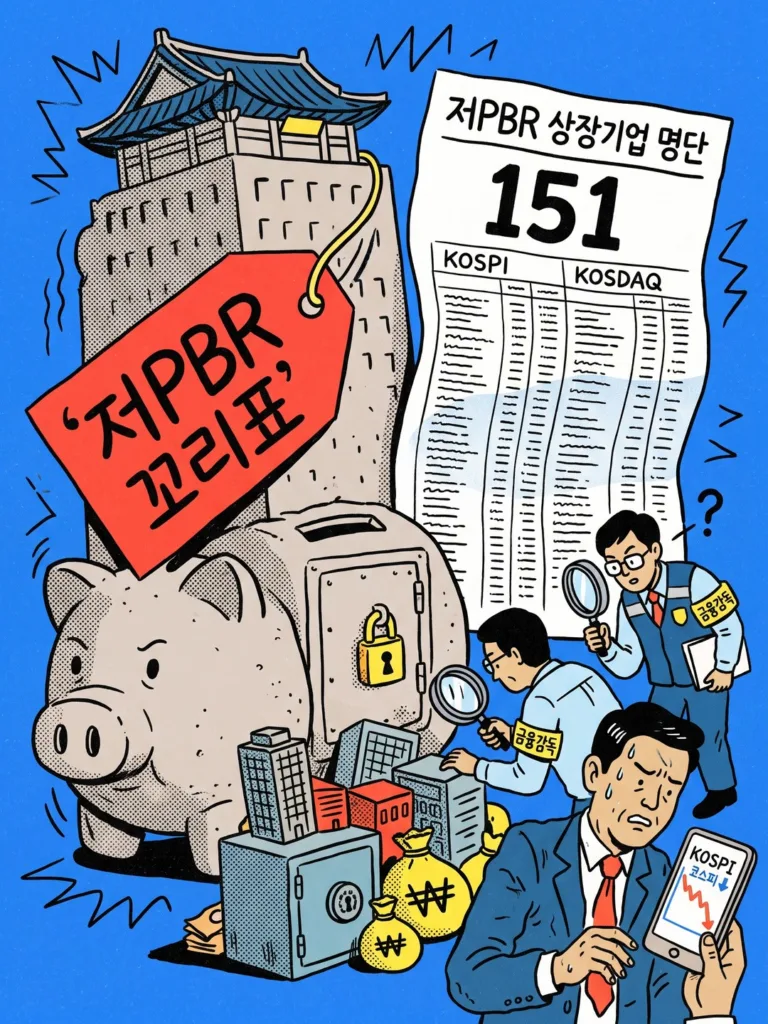
The low-PBR companies the Korea Exchange announced on Nov. 2 number 151: 96 on the KOSPI market and 55 on KOSDAQ. The list is posted under the low-PBR menu of KIND, the exchange's disclosure site. All of these companies had a PBR (market value divided by the company's net assets) of 0.51 or below, and the lowest were SUN&L on KOSPI (0.06) and Aptochrome on KOSDAQ (0.07).
But this list is not a list of the cheapest stocks. It is a record of companies that stayed near the bottom on PBR within their own industry.
- How were the 151 picked?
The exchange ranks listed companies' PBR every half-year (six months) by market and by the 11 GICS sectors (a global industry classification standard). A company qualifies if, within its sector, its PBR was in the bottom 25% on KOSPI or the bottom 10% on KOSDAQ for three cumulative years, meaning the last six half-years in a row. If a company was above the cutoff only once, the seventh half-year is checked, and it is included if it is still near the bottom then. This round's PBR is as of Oct. 22.
- The full list of 151 low-PBR companies
Grouped by market in order of lowest PBR. Company names and PBRs are exactly as in the KIND list.
KOSPI market: 96 companies
| PBR (x) | Company |
|---|---|
| 0.06 | SUN&L |
| 0.10 | Sungchang Enterprise Holdings, Korea Electronics Holdings |
| 0.14 | Hanshin Engineering |
| 0.15 | HL D&I, Lotte Himart, Sewon Precision, Emart, Kolon |
| 0.16 | AK Holdings, SG Segye Mulsan, Dongyang, Moorim Paper, Aprogen Biologics, KBI Dongkuk Industries |
| 0.17 | DRB Dongil, Dongil Steel, Lotte Shopping, SavezoneI&C, Youngpoong, Yoosung Enterprise, Hanjin |
| 0.18 | Daehan Flour Mills, Lotte Chemical, Egger Industries, Intergis |
| 0.19 | BGF, Kyeryong Construction, Daehan Textile, Daehan Synthetic Fiber, Dongil Industries, Hyundai Steel, Husteel |
| 0.20 | Moorim P&P, SJM, Heungkuk Fire & Marine |
| 0.21 | Gisin Jeonggi, Saeron Automotive, SeAH Holdings, Jeonbang, Crown Haitai Holdings |
| 0.22 | Nexen, Shilla Trading |
| 0.23 | CS Holdings, Kiswire, Samyang Holdings, Sebang, GMB Korea, Taekwang Industrial, Korea Engineering Consultants, Hansol Paper, Hansol Holdings, Hwacheon Machinery, Hwanggeum ST |
| 0.24 | DL, Samjung Pulp |
| 0.25 | HS Hwaseong, LG HelloVision, Gangnam Jevisco, DY, Wonrim, Ewha Industries |
| 0.26 | Kyungbang, ITCEN CTS, Ilshin Spinning |
| 0.27 | Korea Line, Jindo, KCC Glass, Hanwha Life |
| 0.28 | E1, Chong Kun Dang Holdings |
| 0.29 | LX Holdings, Kkaeggeushan Nara, Nongshim Holdings, Samyang Corp |
| 0.30 | Samho Development |
| 0.31 | Hite Jinro Holdings, Hyundai Motor Securities |
| 0.32 | Dongbu Construction, Sajo Oyang, Kolon Global, Hyundai Corporation Holdings |
| 0.33 | DB Securities, Muhak |
| 0.34 | Sindoh |
| 0.35 | KT Skylife |
| 0.37 | Dongwha Pharm, Jeil Pharma Holdings |
| 0.38 | DSR Wire |
| 0.40 | Samyoung Electronics |
| 0.43 | Seoheung |
| 0.44 | Whanin Pharm |
| 0.45 | Handok |
| 0.46 | Shinsegae I&C |
| 0.48 | KC |
| 0.51 | Kwangdong Pharmaceutical |
KOSDAQ market: 55 companies
| PBR (x) | Company |
|---|---|
| 0.07 | Aptokrom |
| 0.09 | Ocean IW |
| 0.10 | SG&G |
| 0.12 | Moorim SP, TK Chemical |
| 0.13 | Seohan, Woori Enterprise |
| 0.14 | Daewon, Ecobolt |
| 0.16 | SGC E&C, Actoz Soft, Inzi Display |
| 0.17 | Dongwon Development, Sewon Mulsan, Eyes Vision |
| 0.18 | AztecWB, Wonil Special Steel |
| 0.19 | Dongwoo Farm to Table |
| 0.20 | KCC Construction, Humax |
| 0.21 | Sejung |
| 0.22 | Nexturn & Roll Korea, Mobase, Shinwon Development |
| 0.23 | Sambo Corrugated, Yearimdang |
| 0.24 | Audtec, Hwail Pharm |
| 0.25 | Seungil, Yoosung TNS |
| 0.26 | Kooksoondang, Eugene Corp |
| 0.28 | Daechang Steel, Korea Capital |
| 0.29 | Sunkwang |
| 0.30 | S&K Global, CAP |
| 0.31 | Maeil Holdings, Sungwoo Electronics, Spigen Korea, Incon |
| 0.32 | Fine Digital |
| 0.33 | HK, KM |
| 0.36 | Kyungnam Pharm |
| 0.37 | CU Medical, IDIS Holdings, Coweaver, Parkers |
| 0.38 | Samah Pharm |
| 0.40 | Eco Simplex, Genolution |
| 0.42 | RP Bio |
| 0.50 | Daehan Pharm |
| 0.51 | Wonik |
Using the PBRs in the list, 51 of the 151 companies, more than a third, were below 0.2, worth less than one-fifth of their net assets.
- Why is a low PBR a problem?
A PBR below 1 means the market values the company at less than its net assets on the books. The Financial Services Commission and the exchange said the list is meant to expose companies that ‘leave their share price low or even push it down.’
Under Korea's inheritance and gift tax law, listed shares are valued at the average closing price over the two months before and after the valuation date. If the price is 20% lower in that window, shares normally worth 1 billion won are valued at 800 million won, shrinking the taxable amount by that much. Being on the low-PBR list itself, however, is not grounds for delisting.
- Where is the list posted, and how does a company get off it?
The list is updated on the first trading day of every May and November. A ‘low PBR’ tag also appears next to the stock name in brokers' HTS (PC trading programs) and MTS (mobile trading apps). A company that discloses a value-up plan (its promise of what it will do to raise its share price) including a low-PBR improvement plan before the PBR reference date is exempt from the list for a year. Companies that have been near the bottom for six cumulative years, however, are listed regardless of disclosure.
- BITPRESS Insight: How should you read the list?
First, don't rank companies by PBR alone. The list picks the lowest companies within each sector, so a 0.10 and a 0.40 from different sectors can't be compared directly. By the exchange's count, the median KOSPI PBR at the end of June was 1.49 for information technology and 0.43 for materials.
Second, a low PBR is not proof of 'cheap'; it is a record that the market valued the company low in at least 6 of the last 7 half-years. Being on the list does not by itself remove the reasons for that.
Third, watch the next list. A company whose PBR climbs out of the bottom range can drop off at the next announcement. But filing a plan alone can keep a company off for a year, so dropping off does not mean the company has changed. What to watch is not how low the PBR is, but what the company puts forward to get off the list.
Sources
https://kind.krx.co.kr/valueup/lowpbr.do?method=valueupLowpbrMain
https://www.fsc.go.kr/po010103/87419
https://www.law.go.kr/법령/상속세및증여세법/제63조
Glossary
PBR (price-to-book ratio) — Market value divided by the company's net assets (book value); below 1 means the market value is smaller than net assets on the books.
Corporate value-up plan — A plan a company discloses on what it will do to raise its share price and shareholder value; including a low-PBR improvement plan exempts it from the low-PBR list for a year, except for companies near the bottom for six cumulative years.
GICS — An industry classification standard built by MSCI and S&P that sorts listed companies into 11 sectors such as materials, industrials and information technology.
KIND — The Korea Exchange's disclosure site for listed companies, where the low-PBR list is posted under the ‘low-PBR companies’ menu.
HTS and MTS — A brokerage's PC trading program (HTS) and its mobile trading app (MTS).
BITPRESS articles are information to help your investment decisions, not a recommendation to buy or sell any stock or coin. Investment decisions and their results are your own responsibility.