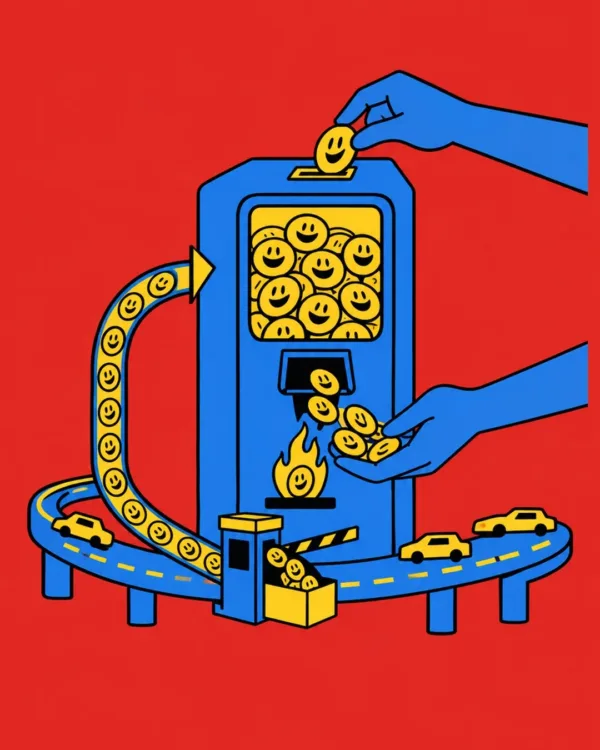

It pays an annual 11.5% in monthly dividends. In cash, every month. It is listed on the Nasdaq and trades at $100 a share. What kind of magic is this? It's a financial product from Strategy, formerly MicroStrategy, led by Michael Saylor, called STRC (Stretch).
What is STRC?
STRC is not a traditional stock, bond or ETF. It is perpetual preferred stock.
The name may make it sound like a high-dividend stock, but the structure is completely different. It is a “perpetual” product the company is never obligated to repay, and its dividend rate is adjusted monthly.
Strategy positions it as ‘short-duration, high-yield digital credit’.
The key is eliminating price volatility. The dividend rate is adjusted so the shares don’t stray far from their $100 par value. If the price falls below $95, the rate goes up to draw investors in; if it rises above $101, the rate can be cut.
In effect, it tries to pin the price at $100, much like a stablecoin.
Where does this money come from?
That’s the key question. Bitcoin pays no interest and no dividends. So who funds the $0.9583 dividend paid out every month?
Strategy’s dividend money comes from three sources.
First, new STRC issuance (the main source). Through an ATM (at-the-market) program, the company continuously sells new STRC shares into the market. This is its biggest cash pipeline. Money from new investors pays dividends to existing ones. STRC currently has about $6.36 billion outstanding.
Second, cash reserves. Strategy holds about $1.8 billion in cash reserves, enough to cover all of its preferred dividends for roughly 2.5 years.
Third, cash flow from the software business. The company’s original business, BI software, brings in about $80 million in revenue per quarter ($320 million a year).
But that alone doesn’t cover even half of the roughly $730 million in annual STRC dividend obligations.
In the end, the heart of this structure is a flywheel: ‘ATM issuance → raise cash → pay dividends + buy Bitcoin’.
When Bitcoin rises, the company’s balance sheet looks stronger, investors buy STRC, and the company sells more STRC to buy more Bitcoin. Saylor has called this the company’s ‘iPhone moment’.
So is this a Ponzi scheme?
To be frank, it is ‘not a Ponzi, but a cash mechanism that resembles one’.
Legally, Strategy is a Nasdaq-listed company that holds real Bitcoin. With more than 780,000 BTC on its books, it isn’t throwing money around out of thin air.
A cumulative dividend clause means that if a payment is missed, the company is still obligated to pay it later.
That is what sets it apart from a Ponzi scheme.
The cash flow tells a different story, though. Most of the dividends paid to existing investors are funded by capital from new investors. Bitcoin itself generates no cash, so for this structure to hold up, there must be a steady stream of new investors buying STRC. That is why some experts criticize it as ‘a Ponzi-grade yield-manufacturing machine’.
STRC is also not directly collateralized by Bitcoin.
If Bitcoin crashes and STRC stays below $95 for a long stretch, ATM issuance stops and only the cash reserves are left. If Bitcoin fails to recover within 2.5 years, a real crisis follows.
What this means for investors
STRC is attractive. For retirees who need monthly cash flow and fixed-income investors, it has become popular as a ‘tax-advantaged high-dividend product’. As of 2025, 100% of STRC dividends were classified as ‘return of capital,’ so no income tax is due right away. For an investor in the 24% tax bracket, the tax-equivalent yield comes to about 18%.
But buying this product indirectly means making a bet on Bitcoin.
For STRC to hold $100, the Bitcoin market has to stay stable or rise. If you already own Bitcoin or MSTR shares, adding STRC is close to going ‘all in.’
In short, STRC is ‘a masterpiece of financial engineering, and a gamble’.
The structure is clever and it works for now, but the preconditions are clear: Bitcoin has to grow at least 2% a year on average, capital markets have to stay open, and investors have to keep buying STRC.
Given that Bitcoin’s average annual growth rate over the past 15 years has been around 80%, a 2% hurdle looks low.
But past performance doesn’t guarantee future results.
An 11.5% monthly dividend is sweet. But you need to know exactly where that sweetness comes from and decide carefully how much of your portfolio this asset should take up. It isn’t a bank deposit, a government bond or an ordinary dividend stock. You’re joining Saylor’s new financial experiment, so read its terms and risks first.
BITPRESS Insight
This article has three key messages for investors.
First, beware the ‘illusion of yield.’ An 11.5% annual yield paid monthly looks like more than five times what government bonds or deposits offer, but the price is clear: exposure to Bitcoin’s volatility and a structural fragility that depends on new capital coming in. Fixed-income investors who see this as a substitute for government bonds must not overlook that its risk profile is entirely different.
Second, Michael Saylor’s ‘financial innovation’ is the evolution of a leverage game backed by Bitcoin. From MSTR stock to STRC preferred shares to STRF (Strife), Saylor keeps inventing new financial products built on Bitcoin, an asset that pays no interest. This creates yield not through business growth but by redesigning the capital structure. Investors need to do ‘structural analysis,’ not company analysis.
Third, the ‘Ponzi that isn’t a Ponzi’ debate ultimately comes down to whether the cash flow is sustainable. STRC is not a Ponzi scheme, but it is true that a large share of its dividends is funded by newly issued capital. Without the ‘external boost’ of a rising Bitcoin price, this structure could be unstable over the long run. Investors shouldn’t settle for ‘it’s working fine right now’; they must run the scenario of ‘what if Bitcoin falls for two years.’