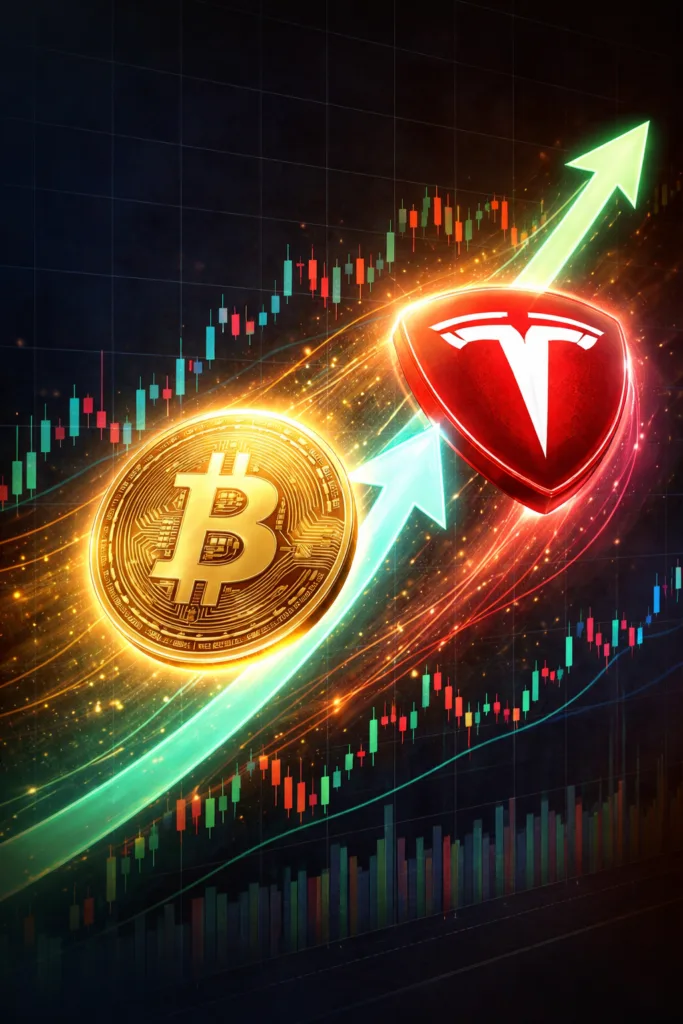
Do Tesla and Bitcoin really move in the same direction?
An interesting pattern keeps repeating in the market lately.
When U.S. tech stocks are strong, Bitcoin rises too,
and when stocks wobble, Bitcoin corrects at the same time.
Among these, Tesla and Bitcoin
are a pair especially widely seen as "moving together."
Is this just an illusion, or a trend that can be explained structurally?
Reason ①: Both are "assets that price in the future"
The most important thing Tesla and Bitcoin have in common is
that their prices react to future expectationsmore than to the present.
Tesla has priced in
- Electric vehicles
- self-driving
- robotaxis
- AI and robotics
and other value that has not yet been fully realized,
and Bitcoin, too, has been valued on
- digital gold
- decentralized currency
- a global store of value
and other future narratives.
The prices of assets like these
are far more sensitive to
interest rates, liquidity and market sentimentthan to earnings or cash flow.
So the two assets
in the same macro environment
are likely to react in the same direction.
Reason ②: Both get stronger together in a market "willing to take risk"
Tesla and Bitcoin are both
classic risk-on assets .
- When interest rates fall,
- liquidity grows,
- and investors start taking on risk,
they are among the first assets to react.
Conversely,
- when interest rates rise,
- the dollar strengthens,
- and the market turns defensive,
they are also among the first to be sold.
That is why the two assets
rather than following each other,
react at the same time to the same "market temperature".
Reason ③: The same investors manage them in the same basket
Looking at recent global money flows,
Tesla and Bitcoin
often move within the same portfolio.
Hedge funds and family offices
often manage the two as one bundle:
- high-beta growth assets
- tech innovation themes
- risk-appetite assets
.
In this structure,
they get sold together when risk is cut,
and bought together when risk is added.
As a result,
their price movements naturally come to resemble each other.
Elon Musk is not the "link" but the "amplifier"
Elon Musk
is the person who brings Tesla and Bitcoin to mind at the same time.
Tesla's past Bitcoin purchases,
the introduction and suspension of Bitcoin payments,
and his various remarks
greatly amplified short-term volatility in both assets.
But Musk
rather than setting the direction of prices,
plays the role of quickly amplifying market trends that have already formed.
When conditions for them to move together are in place,
Musk's remarks
act as a catalyst that speeds things up.
What the data shows
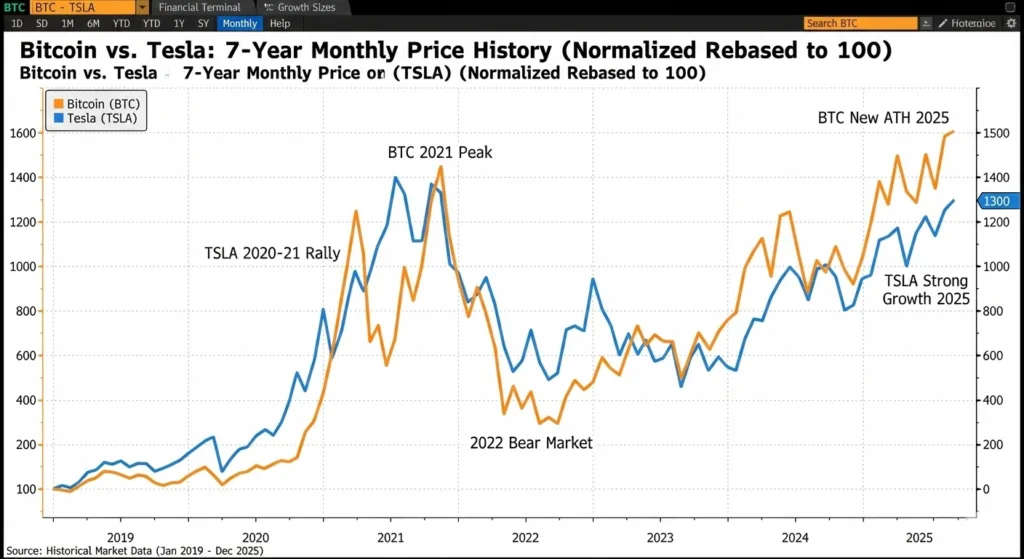
Market data shows that
in parts of 2020-2021 and 2023-2024,
the short-term correlation coefficient between Tesla and Bitcoin
repeatedly rose meaningfully.
It is not perfect synchronization,
but in certain phases
the odds of moving in the same direction clearly go up.
This phenomenon
is evidence that the two assets are exposed to the same kind of money and sentiment.
One last important point
More important than the fact that Tesla and Bitcoin often move together
is this question:
"Why are the two moving together right now?"
- Is it liquidity?
- Is it rate expectations?
- Or is it simply an overheated narrative?
If you chase the move
looking only at the synchronization without answering this question,
opportunity quickly turns into a trap.
Insight
Tesla and Bitcoin moving together
is not a signal that promises profits.
If anything, it is a scene that reveals how optimistic the market has become.
The stronger the two get at the same time,
the more the market usually builds up
excessive expectations, rising leverage and crowded positions.
That is why seasoned investors,
rather than acting "when the two start rising together,"
first question why they are rising together.
Synchronization can be an opportunity,
but at the same time it is a sign of overheating and a warning signalas well.
Tesla and Bitcoin
Not a compass that predicts the future,
but a mirror showing how far market sentiment has gone right now.