On October 28, SK Hynix's board decided to buy back about 20 trillion won more of its own shares. It follows a 40 trillion won buyback that began in August, with the shares scheduled to be cancelled on November 5, bringing this year's share purchases to 60 trillion won. The very next day, October 29, the company bought 250,000 shares, worth 381.6 billion won, in a single day.
The common reading is “record buyback = support for the stock price = good for shareholders.” On October 29, when the KOSPI fell 1.24%, analysts said this buying softened the drop.
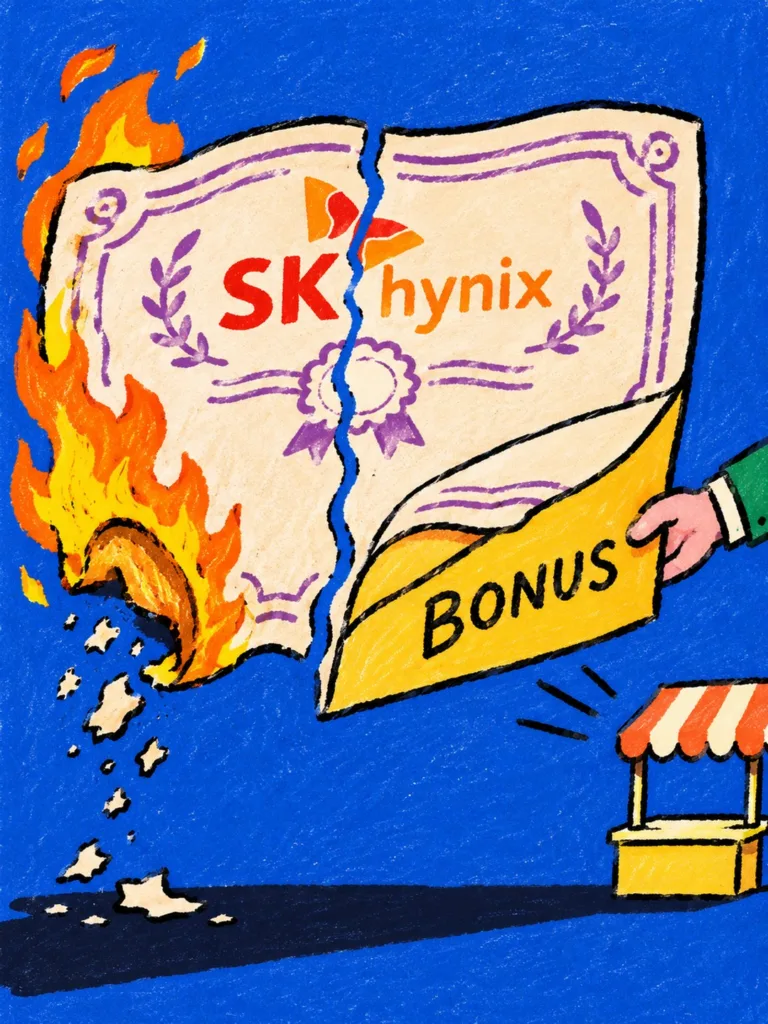
But the real point lies elsewhere. Of this 20 trillion won, only 10 trillion won goes to shares that are bought and then destroyed (cancelled). The other 10 trillion won or so is for shares to be handed out as employee bonuses (pay tied to performance), and the company itself left that part out of its shareholder returns.
- Why does one buyback split into two paths?
Here is what the filing says. The company plans to buy 14.92 million common shares, with purchases running until January 28 next year. Of that, 10 trillion won is meant to ‘raise shareholder value,’ so all of those shares will be cancelled; the other 10 trillion won or so is meant to ‘pay employee bonuses.’
The money comes from the same place. In both cases the company uses its own cash to buy shares on the market. The difference is where the shares go afterward. The cancelled portion disappears, while the bonus portion passes into employees' hands.
| Category | Cancelled | Bonus |
|---|---|---|
| Amount | 10 trillion won | About 10 trillion won |
| What happens to the shares | Destroyed | Given to employees |
| Total share count | Falls | Ends up unchanged |
| Company's category | Shareholder returns | Excluded from shareholder return |
- Why does cancelling shares raise shareholders' stake?
Cancelling shares cuts the number of shares itself. If the company's earnings stay the same but fewer shares split them, the profit per share grows.
The earlier batch, scheduled for cancellation on November 5, is a good example (the date may change). It covers 23,693,272 shares, out of 730,492,365 shares outstanding before the cancellation. About 3.2% disappears, so each remaining share's slice grows by a little over 3%.
Put simply, the pizza stays the same size but fewer people share it. Someone holding 10 million won of stock sees their share of the company rise by that much without buying a single extra share.
- Why don't shares meant for employees raise shareholders' stake?
At the moment of purchase, the bonus portion is bought on the market just like the cancelled portion. But these shares sit briefly in the company's hands and then pass to employees. Once handed over, they are back in circulation, and the total share count is the same as at the start.
It is like using company money to buy gift cards and hand them to employees. The gift-card shop gets more customers that day, but the cards end up in employees' wallets. Unlike gift cards, though, shares come back onto the market for sale if an employee sells them after receiving them.
From a shareholder's view, this 10 trillion won is less a payback than a cost of paying staff. It means paying bonuses in stock instead of cash, and the company did not count this portion in its shareholder returns either.
- In numbers, how much does shareholders' stake grow?
The company set its shareholder returns for fiscal 2026 at about 100 trillion won. That is at least 30 trillion won in cash dividends and at least 60 trillion won in share purchases and cancellations. That 60 trillion won is reached only with the 40 trillion won cancellation, this round's 10 trillion won cancellation, and another 10 trillion won of shares bought and cancelled in the fourth quarter. This round's 10 trillion won bonus portion is not included.
The share count gives another angle. If we assume the 14.92 million shares to be bought are split evenly by value, the cancelled portion is about 7.46 million shares, roughly 1% of all shares. Under the same assumption, the roughly 7.46 million bonus shares do not reduce the share count.
Put simply, the "20 trillion won buyback" figure has only half the power to grow shareholders' stake.
- Why did the market still welcome this buying?
The buying pressure comes from the full 20 trillion won. The 250,000 shares bought on October 29, worth 381.6 billion won, works out to about 1.53 million won per share. That day the KOSPI closed down 74.78 points (1.24%) at 5,937.66, and Daishin Securities analyst Lee Kyung-min said, “The index made up part of its losses as SK Hynix resumed its buyback and net selling by institutions eased.”
In the short run, the bonus portion also supports the stock price. The difference comes after the purchase. Cancelled shares never come back, but bonus shares that are sold after reaching employees become shares for sale.
Chief Financial Officer Kim Woo-hyun said, “We believe our share price is undervalued and does not fully reflect the profit and cash flow the company generates,” adding, “In this situation, we judged that buying back and cancelling shares is an effective way to raise value per share.” In other words, the company itself named ‘cancellation,’ not just buying, as the way to raise value per share.
- BITPRESS Insight: What should you check before the buyback amount?
What this filing changes is how to read a headline like ‘a buyback of X trillion won.’ Even among shares bought on the same day, the cancelled ones permanently raise shareholders' stake, while the bonus ones support demand during the buying and then pass to employees. The earlier 40 trillion won was all for cancellation; this 20 trillion won is split half and half.
That does not mean the bonus portion is wrong. It simply pays employees in stock instead of cash. But it is pay, not a shareholder return, and the money comes out of company funds that belong to shareholders.
In buyback news, there is one question to ask before the amount. Do the purchased shares disappear, or do they pass on to someone else? Your stake grows only by the portion that disappears.
Sources
https://www.newspim.com/news/view/20261030001203
https://www.specialtimes.co.kr/news/articleView.html?idxno=479062
https://www.vegannews.co.kr/news/article.html?no=397628
https://www.koreancenter.or.kr/news/articleView.html?idxno=1430893
https://www.koreancenter.or.kr/news/articleView.html?idxno=1430769
Glossary
Share retirement — When a company destroys shares it bought back, the total share count falls and each remaining share's slice grows.
Employee bonus (stock compensation) — A bonus paid in company shares instead of cash; employees can later buy and sell the shares on the market.
Shareholder returns — Giving profit back to shareholders, through dividends or share cancellation.
Shares outstanding — The total number of shares a company has issued and that remain; it falls when shares are cancelled.
BITPRESS articles are information to help your investment decisions, not a recommendation to buy or sell any stock or coin. Investment decisions and their results are your own responsibility.