



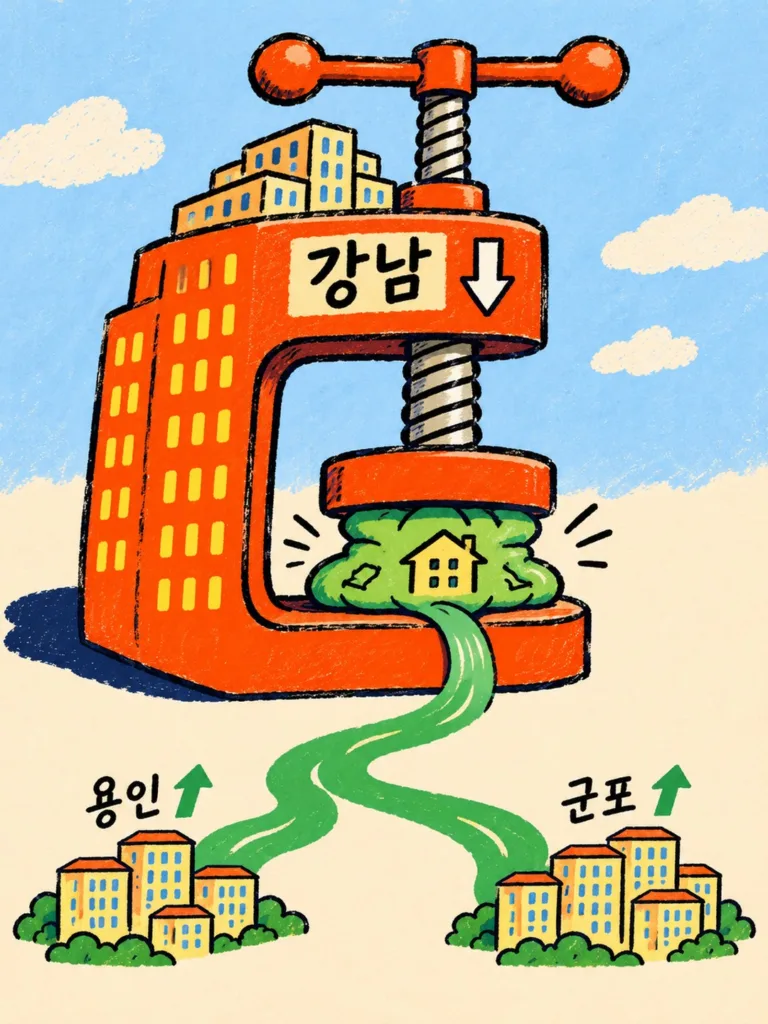
In the Korea Real Estate Board's weekly data as of Nov. 2, Seoul apartment prices rose 0.07% in a week, extending their run of gains to 91 weeks. Yet in the same week Gangnam fell 0.39% and Seocho fell 0.37%, both down for the 13th week in a row. While those two high-priced districts have been sliding since August, Giheung in Yongin rose 0.60% and Gunpo rose 0.57%, both in Gyeonggi Province.
The common reading goes like this. Gangnam fell first, so it is a sign that home prices are turning, and other areas will soon follow.
But put the same week's numbers side by side and the picture changes. Gangnam and Seocho fell while Yongin and Gunpo rose. Rather than the whole market cooling, demand (the buyers and their money) is moving between areas. Tax, interest rate and loan burdens are blocking the most expensive homes first.
- Seoul is rising, so why are Gangnam and Seocho falling?
As of Nov. 2, Gangnam and Seocho have fallen 13 weeks in a row, and Songpa 9 weeks in a row. Seocho has followed Gangnam into a negative year-to-date return.
Even so, Seoul as a whole rose. The average for the 11 districts south of the Han River was -0.03%, essentially flat, because the big drops in Gangnam, Seocho and Songpa offset gains in the other districts (Youth Today). The 14 districts north of the river rose 0.19%, with Seodaemun (0.31%) and Seongbuk (0.30%) rising most. The Seoul average is rising, but inside it some neighborhoods are climbing while others are falling.
- The pricier the home, the sooner the money pressure grew
Experts quoted by Financial News (Nov. 5) say the Gangnam and Seocho declines began in August. The 8·3 tax overhaul plan was expected to raise tax bills, and a rise in the benchmark interest rate came on top. Taxes scale with a home's price and interest scales with the amount borrowed, so the same change hits expensive Gangnam and Seocho harder.
Lending conditions have also tightened sharply in recent weeks. In areas full of high-priced apartments, the burden of raising funds pushed buyers to wait rather than buy, while areas with many mid- and low-priced apartments kept drawing people buying their first home (Youth Today, analysis of the Nov. 2 data).
A grocery run makes it easier to see. When a card limit drops, people don't stop shopping. They put the pricey item back and swap in something that fits under the limit. But a home relies heavily on a loan, unlike groceries, so when the amount you can borrow shrinks, the neighborhoods you can afford change.
- In the same week, parts of Gyeonggi rose more than Seoul
Gyeonggi Province rose 0.20%. Giheung in Yongin (0.60%), Gunpo (0.57%) and Dongan in Anyang (0.55%) led the gains. That is more than 8 times the Seoul average of 0.07% (calculation: 0.60÷0.07≈8.6, 0.57÷0.07≈8.1).
These are where the demand for mid- and low-priced areas went in Gyeonggi. Youth Today, reading the same data, wrote that demand continued in mid- and low-priced areas and pointed out that in Gyeonggi it crowded into Giheung, Gunpo and Dongan. Gangnam dropped out while these areas rose.
- Not all of Gyeonggi rose
Demand flowed to large complexes in Mabuk-dong and Dongbaek-dong in Giheung, small and mid-sized apartments in Sanbon-dong and Geumjeong-dong in Gunpo, and big complexes in Hogye-dong and Gwanyang-dong in Dongan, Anyang. Across Gyeonggi, buying inquiries kept coming for first-generation new towns and areas next to Seoul, where hopes run high for better transit such as the GTX (the Seoul-area express rail) and for redevelopment (projects that rebuild aging neighborhoods). The source, however, does not name these as the reasons for the rise in Giheung or Gunpo specifically.
By contrast, Icheon (-0.18%) and Anseong (-0.14%) fell. With new move-in supply piling up or weak self-sufficiency (the pull a city has on its own, such as jobs, to keep people there), older apartments went unsold. Cheap does not mean rising; only places with demand behind them rose.
- The next thing that may change is regulation
One market expert who asked not to be named told Hankyung (Nov. 11): "Some parts of southern Gyeonggi are posting high gains even in unregulated areas." In the same article, experts warned of a balloon effect, in which demand shifts to southern Gyeonggi and nearby unregulated areas as Seoul's rise slows, and said more regulated-area designations or tougher loan rules could become reality.
The article also carried a cautious view on further rules. The advice in it was that there would be "a short-term effect," but "considering the long-term effect, one should be careful about additional regulation." That is because if the mood shifts with falling rates or a recovery in moving-season demand, the rules could end up stimulating demand instead. When regulation blocks one path for money, money finds another.
- BITPRESS Insight
Reading Gangnam's fall only as a sign that home prices are turning means seeing half the picture. In the same week, northern Seoul and parts of Yongin, Gunpo and Anyang rose more than the Seoul average. How much people can borrow and how much tax they must pay has redrawn where demand can go.
That changes the math for people without a home and for one-home owners looking to move up. There is no guarantee that a fall in an expensive area will carry over to the areas you can afford. Mid- and low-priced areas where demand has gathered could rise further, and that rise could bring new regulation.
When you read home-price news, look less at the Seoul average and more at whether homes in the price range you can afford, with your savings plus a loan, are rising or falling.
Sources
https://www.fnnews21.com/news/articleView.html?idxno=58856
https://www.fnnews.com/news/202611051431225335
https://www.hankyung.com/article/2026111080226
Glossary
Weekly apartment price report — A statistic in which the Korea Real Estate Board surveys price changes in sample apartments each week and publishes the rise or fall by region.
Balloon effect — Like a balloon that bulges elsewhere when you squeeze one side, when one area is regulated, demand moves to less-regulated areas.
Unregulated area — An area not covered by the regulated zones where the government sets stricter loan, tax and subscription rules to cool overheated prices.
First-generation new towns — The first large planned cities built around Seoul, seen as places where hopes for redevelopment (projects that rebuild aging neighborhoods) run high.
8·3 tax overhaul plan — A government tax overhaul plan that, after its announcement, was expected to raise tax burdens on homeowners.
BITPRESS articles are information to help your investment decisions, not a recommendation to buy or sell any stock or coin. Investment decisions and their results are your own responsibility.





