



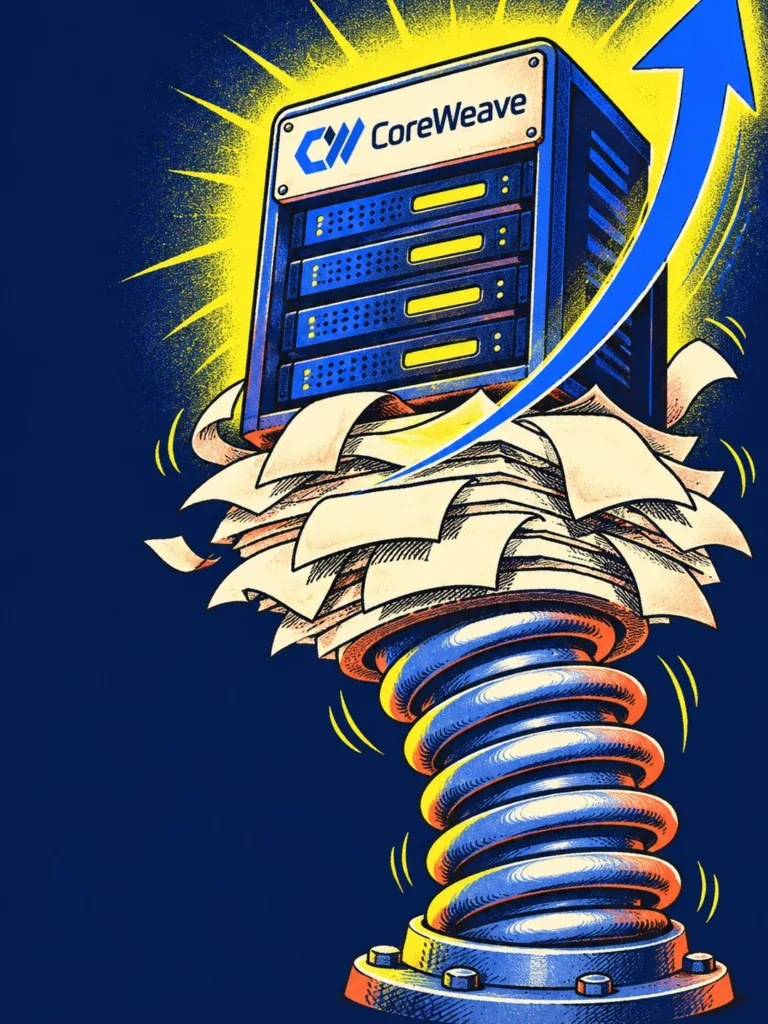
Shares of CoreWeave (a U.S. AI cloud company that rents out data centers packed with Nvidia AI chips to other companies) jumped 25.1% in a single day on Nov. 11 (local time). After the market closed the previous day, the company announced that third-quarter revenue was $3.66 billion, up 168% from a year earlier, and the Nasdaq-100 index (an index of 100 large non-financial companies listed on the Nasdaq) also rose 2.8% to close at 28,509.
The common reading goes like this. Customers willing to pay for AI data centers have been shown to be plentiful, so the pullback in AI stocks is over. But the real point lies elsewhere. What this report eased was the worry about demand, while the worry about debt, by the numbers, has actually grown.
- Which worry did CoreWeave's results ease?
Third-quarter revenue beat the market forecast of $3.54 billion by 3.4%. As of September 30, its backlog (revenue already under contract and still to be received) was about $132.5 billion, roughly 10 times the company's newly raised full-year revenue forecast of $13.0 billion to $13.3 billion.
Put simply, the line of customers waiting to rent AI chips is still long. On the news, the same day SMH (an ETF that bundles semiconductor companies) rose 6.3%, memory maker Micron rose 13.2%, and data center power company Bloom Energy rose 15.5%. Money flowed back toward chips, memory and power.
- So why is the debt worry not over?
In the same quarter, CoreWeave spent $9.441 billion on equipment and facilities. Cash coming in from operations was $1.975 billion, so it spent about 4.8 times what it took in. The shortfall has to be covered by borrowing or raising investment.
As a result, debt has grown fast. The company's borrowings rose from $21.373 billion at the end of last year to $46.873 billion on September 30, more than doubling in nine months. In the third quarter it also borrowed about $4.2 billion more through convertible bonds (bonds that can be swapped for shares under set conditions).
It resembles a restaurant with rising monthly sales that keeps expanding the shop to seat more diners. The difference is that CoreWeave signs multi-year contracts with its customers first and builds afterward.
- How much of its profit does interest eat up?
Third-quarter interest expense (net interest expense, meaning interest paid minus interest received) was $846 million, about 2.7 times the $310 million a year earlier. Operating profit for the same quarter was $207 million, so interest was more than 4 times operating profit. As a result, the net loss widened to $709 million from $110 million a year earlier.
If you treat operating profit, the money made from the core business, as a monthly salary and shrink both figures by the same ratio, it is like someone earning a salary of 2.07 million Korean won (the currency of South Korea) paying 8.46 million Korean won in loan interest every month. The company expects fourth-quarter interest expense of $1.05 billion to $1.15 billion. That means interest alone will top $1 billion in a single quarter.
- How does the company say it will handle the bigger debt?
CEO Michael Intrator said the company's growth is supported by multiple sources of funding, and that about $9 billion in customer prepayments and deposits is expected in the next three months alone. When customers pay in advance for what they will use, the company can borrow that much less.
The company said that at current interest rates it does not plan to issue unsecured bonds (bonds not backed by any collateral) in the parent company's name through 2027, and it sees the parent needing to raise less than $5 billion more to deliver on its contracts. Even so, its full-year capital spending forecast is $37 billion to $39 billion, about 3 times its full-year revenue forecast.
- What is the real test next quarter?
A contract turns into revenue only once the data center is delivered on time and the service is running. As of September 30, the power CoreWeave had contracted exceeded 4.6GW, but the power actually running was just over 1.7GW. That means only about 37% of contracted power is up and running.
The company expects running power, meaning power that is switched on and in use, to exceed 1.85GW by year-end. If that schedule slips, revenue arrives late while more than $1 billion in fourth-quarter interest still goes out. If the power comes on time, the added revenue starts to catch up with interest.
- BITPRESS Insight
This report answered the question of whether customers want to rent AI chips. But turning those contracts into revenue means first building data centers with borrowed money and switching on the power, and interest goes out every quarter in the meantime. The more demand is confirmed, the more there is to build and the more money there is to borrow.
So the shares of AI infrastructure companies depend less on sales announcements than on whether the facilities they build start running on time. Whether the debt worry is over is decided not by how many percent sales grew, but by whether operating profit has started to exceed interest.
Sources
https://investors.coreweave.com/news/news-details/2026/CoreWeave-Reports-Strong-Third-Quarter-2026-Results/default.aspx
https://www.tradingview.com/news/benzinga:03c5f231b094b:0-nasdaq-100-jumps-2-8-as-coreweave-nvidia-climb-stock-market-today/
https://cointelegraph.com/markets/coreweave-stock-surges-pre-market-q3-revenue
Glossary
Order backlog — The total revenue the company will receive in the future as it delivers services under contracts already signed with customers.
Capital expenditure — Money a company spends on long-lasting assets such as data centers, servers and equipment.
Convertible notes — Bonds that let a company borrow money and, under set conditions, repay it by handing over company shares instead.
Running power (GW) — The amount of power actually switched on at data centers and running AI chips; 1GW equals 1,000MW.
Customer prepayments — Money customers pay before using the service, which lets the company borrow that much less.
BITPRESS articles are information to help your investment decisions, not a recommendation to buy or sell any stock or coin. Investment decisions and their results are your own responsibility.





