



The unemployment rate fell to 2.0% in October. In the October 2026 jobs report released Nov. 11 by Korea's national statistics agency, the unemployment rate was 0.2 percentage points lower than a year earlier, the lowest for any October since records began in 1999. Central banks watch the unemployment rate when gauging the economy and setting the benchmark interest rate, so it ultimately connects to the interest on your own loan too.
The common reading is that the job market is very strong. But in the same report, the youth (ages 15 to 29) employment rate fell for a 30th straight month, to 42.9%. The key point lies elsewhere. The unemployment rate only measures people who are looking for work, so it falls even when more people stop looking.
- Whom does the unemployment rate count?
The unemployment rate is the share of unemployed people (those looking for work who haven't found it) within the labor force (people who are working or looking for work). Unlike the employment rate, which is the share of the whole population that works, the unemployment rate is measured only among people who are job hunting. So the two can move in different directions. In October, 29.179 million people were employed and 602,000 were unemployed. Dividing 602,000 by the sum of the two numbers gives about 2.0%.
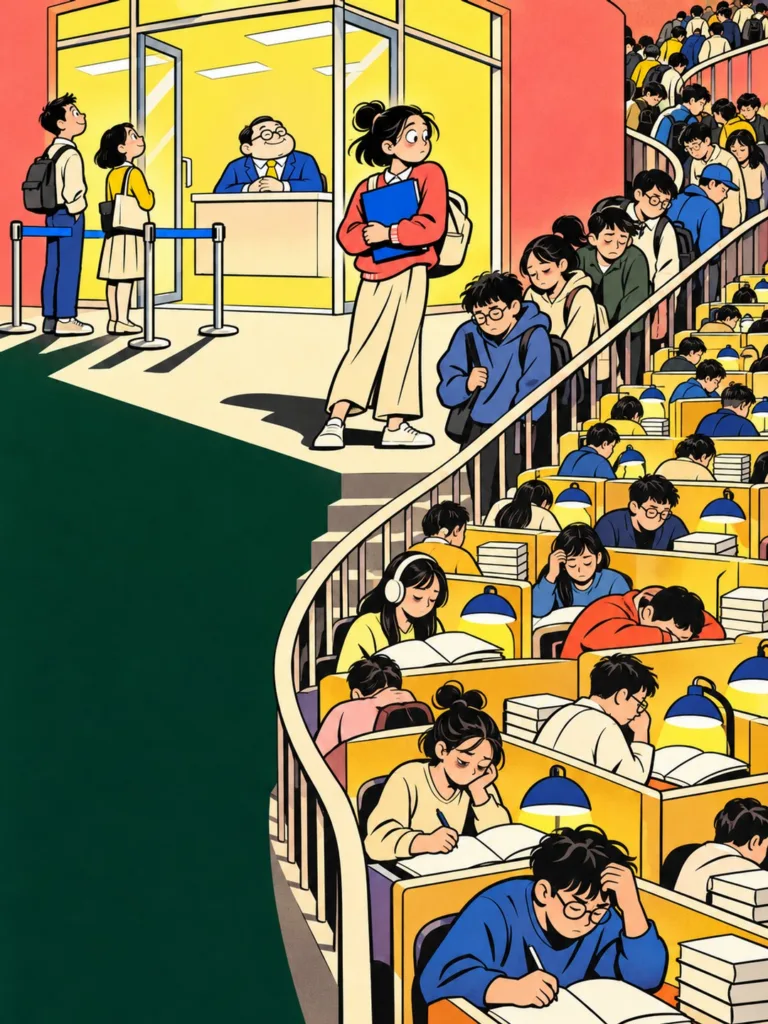
People who attend school or cram schools, prepare for exams or simply rest are classed as not in the labor force and drop out of the denominator of the calculation, which is the labor force. If 1 of 10 people looking for work hasn't found a job, the unemployment rate is 10%. But if that one person stops looking and starts studying, the remaining 9 are all employed, and the rate becomes 0%. Not a single job was added.
- In October, more people fell outside the unemployment rate
In October the number of people not in the labor force rose by 179,000 from a year earlier to 16.299 million. People preparing for jobs also rose by 21,000, to 619,000. As a result, the labor force participation rate (the share of people 15 and older who are in the labor force) fell 0.2 percentage point to 64.6%.
There are also numbers pointing the other way. The number of people who are "just resting" fell by 69,000 to 2.511 million, and discouraged workers (people who gave up looking for work) fell by 27,000 to 340,000. Put simply, fewer people were resting or giving up, but the total of people neither working nor looking rose, so the share of the population counted in the unemployment rate fell.
- Why did the youth numbers move the other way?
Youth employment fell by 196,000 from a year earlier to 3.325 million, a 48th straight monthly decline. Over the same period the youth population fell by 141,000. Because employment fell by more than the population, the employment rate, the share of young people who work, fell 1.7 percentage points to 42.9%. That is the lowest for any October since 2020.
Yet the youth unemployment rate actually fell 0.1 percentage point to 5.2%. This seems to reflect the youth participation rate falling 1.9 points to 45.2% that month. As fewer young people looked for work, the share of those who didn't find it appears to have shrunk too.
Bin Hyeon-jun of the statistics agency's social statistics bureau explained that the employment rate is falling because employment is dropping by more than the population. He also said employers' preference for experienced hires and the spread of rolling recruitment (hiring whenever needed instead of in set annual rounds) are weighing on youth employment.
- Where did jobs grow, and where did they shrink?
By industry, health care and social welfare added the most, up 249,000. By age, employment among people 65 and older rose by 255,000, exceeding the overall gain of 139,000. By contrast, employment among people in their 20s fell by 203,000.
Accommodation and food services employment fell by 137,000, the biggest drop since February 2021. The agency says young people make up a large share of workers in this industry. Bin said a consumer coupon program in the second half of last year had boosted jobs in the sector, so this year's drop looks bigger because of a base effect, on top of weak business conditions. When a neighborhood restaurant has fewer customers and hires fewer part-timers, jobs that young people were looking for disappear too.
- The employment rate also rises when its denominator shrinks
The denominator moves the employment rate in the same way. The employment rate for ages 15 to 64, the basis for comparison with the Organisation for Economic Co-operation and Development (OECD), rose 0.3 percentage point to 70.4%, the highest for any October since records began in 1989. But the employment rate is the share of the population that is employed, so it can rise even without job growth if the population shrinks faster. That is why this number alone does not prove jobs grew.
Think of a class's average test score. If the class average rises because a low scorer transferred out, nobody studied harder. The difference is that for employment, what shrinks the denominator is not a transfer but a falling population.
- BITPRESS Insight
The youth employment rate has fallen for 30 months because working young people are disappearing faster than the youth population. Looking only at the 2.0% unemployment rate suggests solid employment, but reading the same month's numbers in order gives a different picture. Fewer people were looking for work, youth jobs shrank faster than the population, and the new jobs were concentrated in care work and people 65 and older.
So employment indicators should be read together, in this order: unemployment rate, participation rate, employment rate, number employed. If the participation rate fell in a month when unemployment fell, the rate may have dropped because fewer people were looking for jobs, not because jobs grew.
Sources
https://www.fnnews.com/news/202611111037248063
Glossary
Economically active population — People who are employed plus people who are unemployed, meaning they are looking for work but have not found it.
Economically inactive population — People who neither work nor look for work because of school, job preparation, housework, age and the like; they are left out of the unemployment rate.
Labor force participation rate — The share of the population 15 and older that is in the labor force.
Employment rate — The share of an age group's total population that is actually employed.
Base effect — When last year's comparison figure was unusually high or low, so that this year's change looks bigger than it really is.
BITPRESS articles are information to help your investment decisions, not a recommendation to buy or sell any stock or coin. Investment decisions and their results are your own responsibility.





