



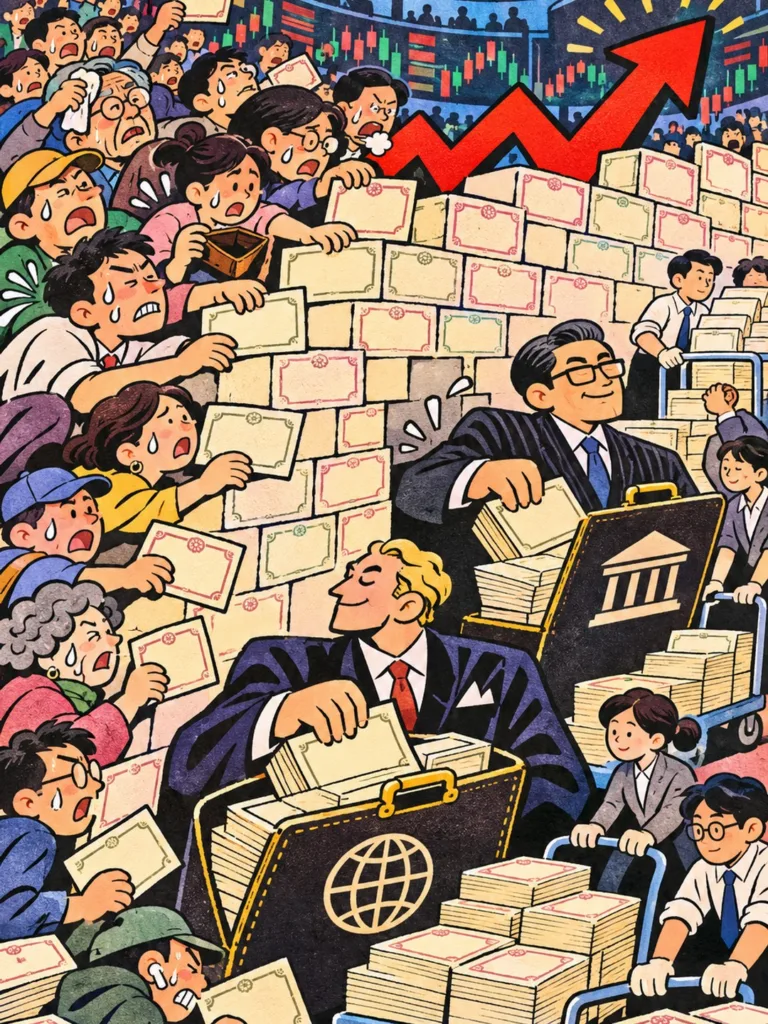
On Nov. 10, KOSPI closed up 220.28 points (4.39%) at 5,239.13. The rally was strong enough that a buy sidecar (a brake that briefly pauses automatic buy orders when futures prices jump) kicked in around 9:06 a.m. Yet on that day individual investors alone net sold about 1.3 trillion won of shares on KOSPI.
The common reading is that individuals were cashing in on the rebound. Press analysis points elsewhere. Individuals who got stuck at the second-quarter high keep putting shares up for sale (shares offered on the market) whenever KOSPI bounces, and that supply holds back the index's gains.
- On a 4% up day, who bought and who sold?
By one business daily's count, institutions net bought 473.5 billion won of KOSPI shares, foreigners 398.2 billion won and other corporations 489.0 billion won. "Other corporations" means ordinary companies that are neither institutions nor foreigners, and it includes firms buying back their own shares. Individuals, by contrast, net sold about 1.3 trillion won. The figures differ slightly by outlet, but every count shows the same thing: the three groups bought almost exactly what individuals sold.
The trends diverged too. Foreigners turned net buyers for the first time in eight trading days, and KOSPI rebounded for the first time in four trading days after three straight declines. Individuals kept net selling for a second day.
- Why did individuals sell into the rebound?
Being "stuck" means holding shares that have fallen below what you paid, so selling would lock in a loss. Press reports say individuals stuck at the second-quarter high keep dumping shares whenever KOSPI rebounds. For someone sitting on losses, a rebound can be a chance to cut the loss and get out.
Think of a secondhand sale. You paid 1 million won for an item, its price fell to 800,000 won, then climbed back to 950,000 won. More people stop waiting and say, "That's good enough." Stocks differ in one way: many people bought at similar prices, so each time the market rebounds, shares come up for sale all at once near the same level.
So this selling may not be the profit-taking of people who made money. Of course, not every individual investor sold at a loss.
- How much did individuals' selling hold the index back?
KOSPI opened already up 4.55% at 5,247.22 and briefly hit 5,300.92. But it closed at 5,239.13, 61.79 points below the intraday high, and the day's gain ended at 4.39%, below the opening gain.
Press analysis said the gain was limited as individuals unloaded large amounts of shares. Kang Jin-hyuk, a senior researcher at Shinhan Investment Corp., said caution ahead of the U.S. October consumer price index (CPI) and the earnings of CoreWeave (a U.S. AI data center company), both due that day, also trimmed the gain somewhat. In effect, individuals' selling and nerves about U.S. data pressed down on the index together.
At a price level where shares for sale pile up, there are more sellers than buyers, so the price struggles to climb further. It is a bit like cars slowing down at a toll gate. The difference is that a toll gate is always there, while a crowded price level thins out once the stuck holders have sold.
- What drove the rebound?
It started in the United States. On the 9th (U.S. time), the Philadelphia Semiconductor Index rose 6.9%, AMD jumped 13.3% and Broadcom 8.8%. International oil prices also fell below $87 a barrel on hopes of progress in U.S.-Iran talks.
As a result, Samsung Electronics closed up 4.74% at 198,900 won and SK hynix up 6.69% at 1,212,000 won. Kang said, "A sense that stocks were oversold after the recent plunge and a return of risk appetite in U.S. markets led to bargain buying of Korean chip stocks."
Put simply, outside good news sent chip stocks out front, and foreigners and institutions were the ones who took in the shares individuals put up for sale.
- This time, foreigners and institutions absorbed the selling
Foreigners, institutions and other corporations bought almost exactly what individuals sold that day. Foreigners, who had been selling for eight trading days, also turned to net buying. When shares from holders stuck at the high pass into other hands like this, there is less left to pour out at the next rebound.
Still, one day of buying and selling is not enough to say the trend has changed.
- BITPRESS Insight
Individuals selling on a rebound day is not only a bad sign. While stuck holders keep selling into each rebound, resistance grows as the index climbs. But if foreigners and institutions take over those shares, less will come up for sale at the next rebound.
The structure matters for individual investors too. If you buy on the first day of a rebound, you may be the one buying the shares that stuck holders are dumping. And if you are stuck yourself, you can decide knowing that others in the same position tend to sell on the same day.
This rebound was not stopped by individuals' selling. Foreigners and institutions took in what individuals sold, and the index closed up more than 4%. To judge a rebound's strength, look at how many percent the index rose and also at who took in the individuals' shares.
Sources
https://news.bizwatch.co.kr/article/market/2026/11/10/0040
https://www.fnnews.com/news/202611101614063289
https://view.asiae.co.kr/article/2026111015344411634
https://imnews.imbc.com/news/2026/econo/article/6864597_36932.html
Glossary
Net selling — Sales minus purchases is positive, meaning more was sold than bought.
Stuck (underwater) — Holding shares that have fallen below the price you paid, so selling would lock in a loss.
Listing — Shares put on the market for sale; when many people bought at the same price level, a lot comes up for sale near it at once.
Other corporations — Ordinary companies that are neither institutions nor foreigners; it includes firms buying back their own shares.
Buy sidecar — A brake that briefly pauses automatic buy orders when futures prices surge, to cool the market.
BITPRESS articles are information to help your investment decisions, not a recommendation to buy or sell any stock or coin. Investment decisions and their results are your own responsibility.





