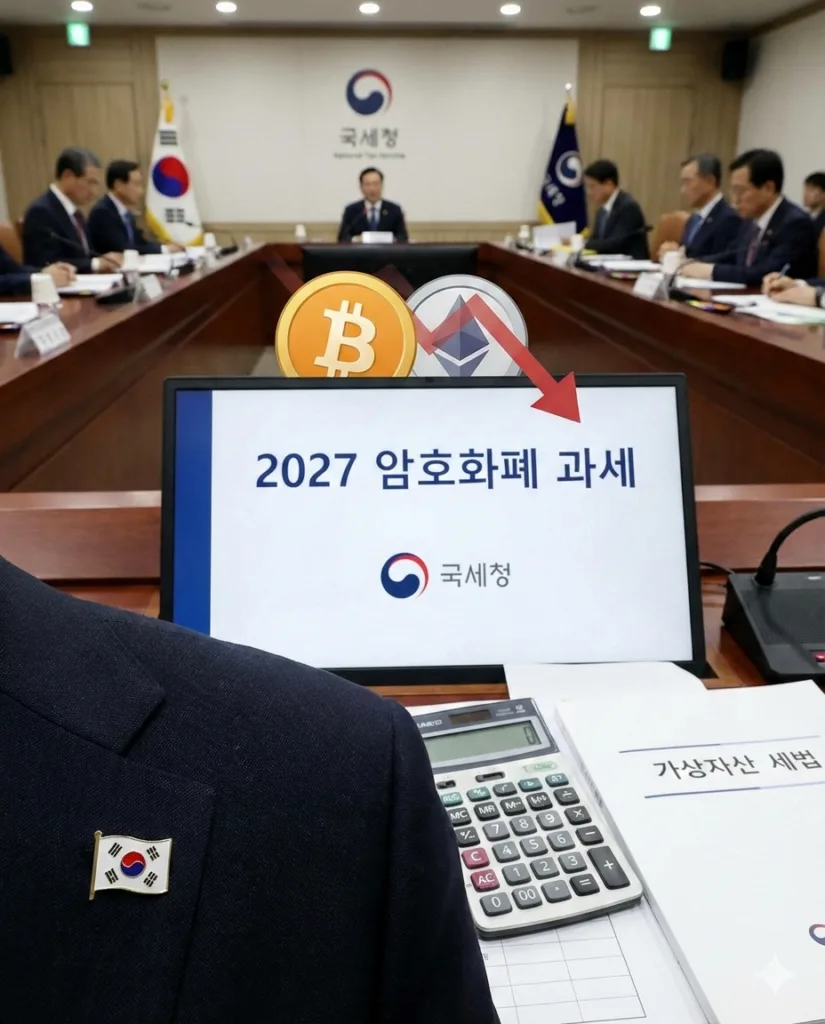
The last crossroads left by the "two-year delay"
At the end of 2024, the National Assembly agreed to push back the tax on virtual assets by another two years, to 2027. But now that 2026 has begun, the attention of 8 million active investors and 16 million account holders is turning back to "taxes." The government's principle that "where there is income, there is tax" and investors' argument that "taxation without preparation is plunder" are gearing up to clash amid the huge political storm of the June 2026 local elections.
1. Who holds the key to taxation? (The driving forces)
Virtual asset taxation in South Korea is currently a tug-of-war among three camps.
- The designer (Ministry of Economy and Finance): Pushes for taxation to secure revenue and tax fairness. In particular, through the CARF¹which goes live in 2026, it says it has completed the "technical preparation" to track even overseas transactions.
- The enforcer (National Tax Service): Is building the computer network to collect data from exchanges and collect the tax.
- The decision-makers (politicians): Are the most sensitive to votes. After the repeal of the financial investment income tax, both the ruling and opposition parties are torn between the fairness debate over "is it right to tax only crypto?" and the votes of up to 16 million potential investors.
2. What are other countries doing? (Global benchmarks)
Major economies are choosing "investment-friendly taxation" over "collection at all costs."
- United States: Treats crypto as property and taxes capital gains, but lowers the rate for holdings of more than a year to encourage long-term investing.
- Germany: Exempts holdings of more than a year from tax altogether to encourage real-world use.
- Japan: Kept a high tax rate of up to 55%, but amid worries about a shrinking market, talks on separate taxation and a rate cut have recently gained momentum.
- Problems with Korea's approach: Many critics say the current Korean plan is less favorable to investors than those abroad, since classifying gains as "other income" means losses cannot be carried forward.
3. Timing and pricing: watch "Dec. 31, 2026"
If taxation goes ahead as scheduled, the most important date is Dec. 31, 2026.
- Reference point: A 22% tax applies to gains arising on or after Jan. 1, 2027.
- Deemed acquisition cost² calculation: To protect investors' past gains, the acquisition price used for tax purposes is set at whichever of the following is greater.$$\text{Acquisition cost} = \max(\text{actual purchase price}, \text{market price on Dec. 31, 2026})$$So gains up to the end of 2026 are effectively tax-free.
4. The 2026 local elections: the "smoking gun" that will decide where taxation goes
This June's local elections are the most powerful variable in deciding whether the tax delay debate reignites.
- The firepower of votes: The 8 million active investors make up about 20% of all voters. Their influence is decisive, especially in the battleground Seoul metropolitan area and among Millennials and Gen Z.
- Political deals: To win the elections, the ruling and opposition parties are very likely to campaign on "raising the deduction limit from KRW 2.5 million to KRW 50 million" or "another two-year delay." With the financial investment income tax already repealed, forcing through a crypto tax could look like "political suicide."
5. What would it take for the tax to be cancelled or delayed again?
Beyond simple opposition, the tax could be halted again if any of the following happens.
- Scenario 1: Gaps in the IT system exposed. The National Tax Service's data collection system fails to fully capture data from overseas exchanges or personal wallets (such as MetaMask), proving that it is "a structure where only honest taxpayers lose out."
- Scenario 2: A fairness backlash over the repeal of the financial investment income tax. The financial investment income tax was repealed to boost the stock market, yet a constitutional complaint or a large-scale tax resistance movement arises against taxing only crypto, a relatively risky asset.
- Scenario 3: A shift in the global regulatory paradigm. If major economies such as the United States expand tax exemptions or introduce bold incentives in a race for crypto dominance, taxation could be postponed indefinitely on the grounds of preventing capital flight from Korea.
💡 BITPRESS Insight: "The essence of taxation is not the timing but the 'method'"
The focus of the debate must shift from "when to collect" to **"how to collect fairly."** Unless **"loss carryforward deductions"** and **"a realistic deduction limit"** that 8 million investors can accept come first, the 2026 local elections will be a repeat of history, producing yet another "political delay."
Before drawing the sword of taxation, the government should first check the completeness of the "Basic Act on Virtual Assets"that would protect investors and nurture the market. Investors should keep in mind that the end-2026 market price will become their tax reference point, and it is time to plan an exit strategy in line with political changes.
[Glossary]
- CARF (Crypto-Asset Reporting Framework): Automatic exchange of information on crypto assets. An international standard for sharing crypto transaction records between countries to prevent tax evasion.
- Deemed acquisition cost: A rule that treats the price just before taxation takes effect as the acquisition price, even if it is not the price you actually paid.
- Loss carryforward deduction: A rule that reduces tax by deducting this year's losses from next year's gains. (Not included in the current virtual asset plan.)
[Statistics check and corrections]
- 8 million: A figure based on the Korea Financial Intelligence Unit (KoFIU) statistics on "active users" (those who traded at least once in six months).
- 16 million: Either the combined "total number of accounts" registered at major Korean exchanges, or a figure that includes dormant accounts.
- How the article uses them: When politicians calculate votes, they cite the 16 million "potential stakeholders", while policy practice uses the 8 million "actual taxpayers"as the baseline. The article weaves in the political meaning of the gap between these two numbers.