Why ‘big exchanges’ decide who survives a crisis
The most dangerous risk in crypto investing is not simply a price crash, but “a situation where it looks like you can sell, yet your order does not actually get filled.”
This risk is not about individual coins; it is determined by an exchange’s whole structure: liquidity(trading volume and order book depth), system stability, and the financial strength of its major shareholder .
- When 24-hour trading volume is large enough, bid-ask gaps widen less even in a crash, and the risk of slippage (the gap between the price you want and the price you actually get) goes down.
- The more monthly active users (MAU) an exchange has, the more densely buy and sell orders stack up, raising the odds that “someone is there to take the other side when I dump.”
- The more stable the governance and the deeper the pockets of the major shareholder, the better the chances of keeping systems running, paying compensation and staying in operation when a hack, a mass withdrawal or a regulatory issue hits.
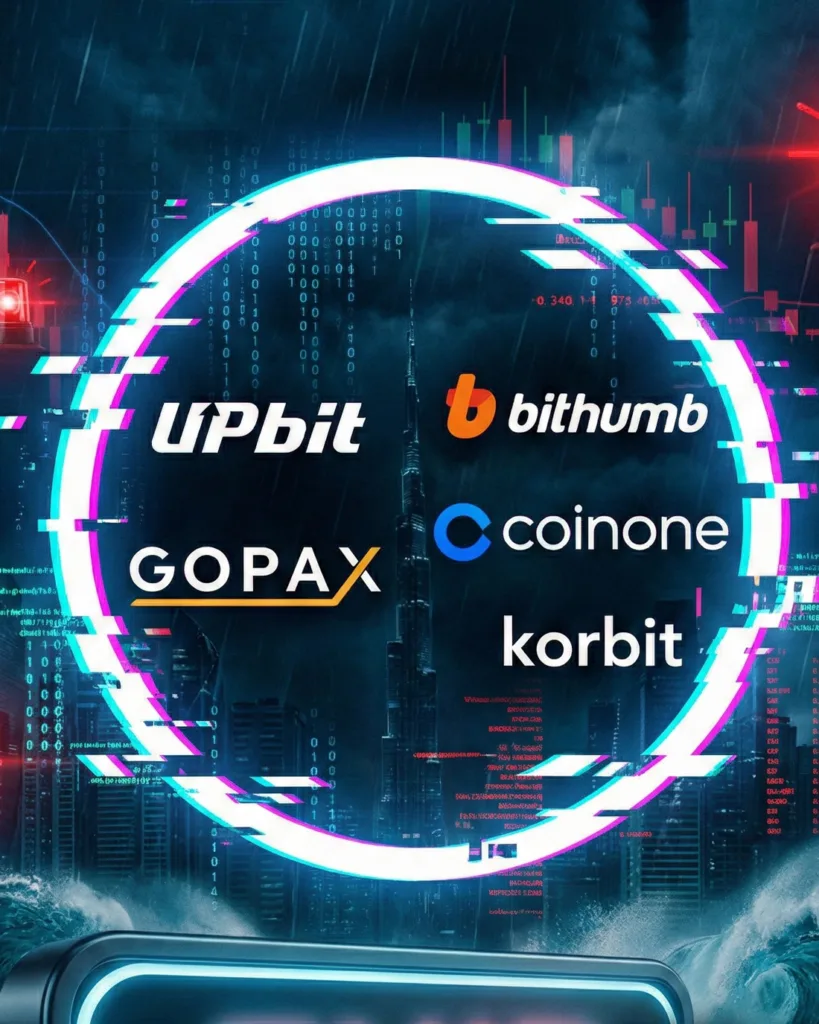
Below, based on the size and governance of Korea’s ‘top 5 won-based exchanges’ (Upbit, Bithumb, Coinone, Korbit and GOPAX) as of early 2026, we look at whether you can “really sell” in a crisis.
1. Upbit: No. 1, combining trading volume, users and Naver’s financial capital
Upbit still has the largest trading volume among Korea’s won-based exchanges and remains a major exchange ranked near the top globally as well.
- 24-hour trading value: As of late January 2026, crypto data providers show it ranking No. 1 in Korea with trading value in the billions of dollars (trillions of won).
- Market share: By domestic spot trading volume, Upbit and Bithumb together account for more than 90% of the total, with Upbit estimated to hold more than half.
- Accounts and users: Cumulative accounts are estimated in the millions, and outside reports say Upbit accounts make up the overwhelming majority of all domestic accounts (more than 16 million).
The biggest change in governance is its move into Naver’s financial group.
- In November 2025, Naver Financial’s board approved a share swap to make Dunamu (Upbit’s operator) a wholly owned subsidiary, with an exchange ratio of “1 Dunamu share : 2.54 Naver Financial shares.”
- The deal still needs review by the Fair Trade Commission and financial regulators, but if completed, Upbit will sit under a Big Tech financial platform combined with Naver’s finance and payments ecosystem.
In short, Upbit combines
- the capacity to fill orders, backed by overwhelming trading volume,
- , a deep pool of active traders,
- and, through Naver Financial, large-scale tech and financial capital
so in a crisis its “chances of filling orders” and “ability to keep systems running and handle withdrawals” are relatively high.
2. Bithumb: top-tier volume, but its governance history is a risk factor
Bithumb is Korea’s No. 2 spot exchange and still ranks near the top of global exchange rankings.
- 24-hour trading value: It swings between hundreds of millions and billions of dollars. Smaller than Upbit, but clearly an exchange with ‘large liquidity’ in Korea.
- Market share: One of the two giants that, together with Upbit, account for around 90% of Korea’s spot market volume, with an estimated share of around 30% at times.
- Estimated accounts: Cumulative accounts are said to be in the millions, but the exchange does not disclose them, so the ‘exact current number of users’ cannot be confirmed (insufficient information).
That said, Bithumb has a history of recurring governance issues, with changes in its major shareholder and takeover attempts mentioned several times over the years.
- Negotiations over a change of major shareholder and sale rumors have surfaced frequently, but the latest finalized and disclosed ownership structure is only partly public (details such as stake percentages and acquisition prices are insufficient).
- This history does not in itself mean ‘operational instability’ now, but it could become a variable in decision-making speed and capacity to inject additional capital when new regulations or market shocks hit.
On liquidity alone, Bithumb still falls into the “easy to sell on” category, but it is an exchange where governance risk should be checked separately from a medium- to long-term perspective.
3. Coinone: mid-level liquidity and ‘relatively quiet’ governance
Coinone is smaller than Upbit and Bithumb, but it is a won-based exchange with liquidity in Korea’s top three.
- 24-hour trading value: It sits mid-table in global rankings, with major data sites showing trading volume in the range of tens of millions to hundreds of millions of dollars.
- Market share: Kaiko Research explains that among Korea’s top five exchanges, Upbit and Bithumb account for more than 90% of total volume, while Coinone, Korbit and GOPAX split “the remaining 10% or less.”
There is relatively little public information on its governance and investment history.
- It has grown around its founder and CEO Cha Myung-hoon. There are reports that it attracted outside investment, but official public data showing specific stakes and investment amounts are limited (insufficient information).
In terms of liquidity, it is reasonable to see Coinone as “mid-tier: orders may fill more slowly than on the big exchanges, but with lower risk than small ones.”
Especially if you trade mainly major coins rather than small altcoins, the real-world risk of orders not filling is largely reduced.
4. Korbit: Nexon affiliate + small-to-mid liquidity, takeover talks still in progress
Korbit is one of Korea’s first-generation exchanges, and so far its stake is held by NXC, Nexon’s holding company.
- According to a regulatory filing, in 2017 NXC acquired about 125,000 Korbit shares for KRW 91.25 billion, securing a 65.19% stake.
- Filings and reports later showed that Korbit’s book value had fallen sharply, and one analysis says that by 2020 NXC had written down more than 90% of the value of its stake relative to the purchase price.
Since late 2025, several media outlets have reported “takeover talks with a Mirae Asset affiliate,” but as of February 2026
- no regulatory approval or official filing has confirmed that the deal has closed (insufficient information on its progress).
In terms of liquidity, it ranks near the bottom of the top five.
- Korbit often ranks around 50th to 100th globally, and its 24-hour trading volume is far lower than Upbit, Bithumb or Coinone.
In conclusion, it is realistic to see Korbit as
- having “big-company capital from Nexon’s holding company,” but
- with “small actual trading volume and user base, and takeover talks reported but not yet completed”:
a mixed structure.
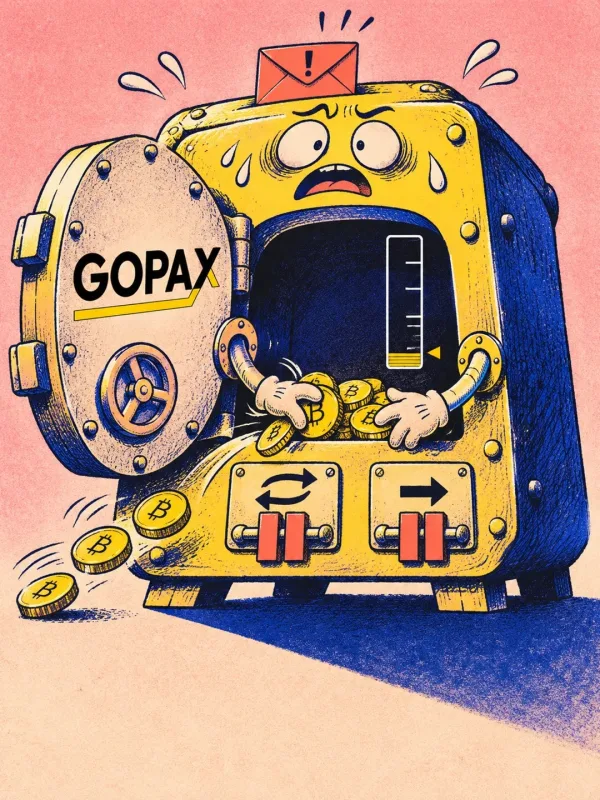
5. GOPAX: Binance is the largest shareholder, but liquidity is ‘the lowest of the five’
GOPAX has the smallest trading volume and user base of the five won-based exchanges.
- In February 2023, Binance acquired more than 67% of Streami, GOPAX’s operator, becoming its major shareholder, and then filed a report of executive changes with the Korea Financial Intelligence Unit (FIU).
- In October 2025, the FIU accepted that executive change report, legally settling Binance’s status as major shareholder, and GOPAX became an exchange with “Binance as major shareholder + an accepted domestic registration.”
But its liquidity is still small.
- On global data sites, GOPAX’s 24-hour trading volume is in the range of a few million to tens of millions of dollars, near the bottom of the top five.
- At this scale, trying to unload a sizable position all at once during a volatile market or a crash in a single coin can cause heavy slippage.
In short, GOPAX’s shareholder capital (Binance) is a plus, but on domestic won-market liquidityalone, it is closer to “last place.”
Key comparison of Korea’s top 5 exchanges as of 2026
None of the figures are “exact absolute values”; they are summarized only as approximate levels and rankingsthat can be cross-checked against outside data, reports and media as of early 2026.
‘Exit ability’ checkpoints to remember in practice
Putting together the data on Korea’s top five exchanges, the idea that “size equals the ability to exit” largely holds.
- The more members and active users,
- The larger the 24-hour trading volume,
- The stronger the governance and the major shareholder’s capital,
- the greater the ‘capacity to keep operating’ through shocks such as hacks, service outages or tighter regulation.
- Structures backed by large groups, such as Upbit (Naver Financial), Korbit (NXC) and GOPAX (Binance), can at least act as a safety net that greatly reduces the chance of an “exit scam.”
BITPRESS Insight: look at ‘where you can dump’ before ‘where you buy’
- Even for the same coin, your odds of getting out depend on “which exchange you hold it on.” On exchanges with high market share like Upbit and Bithumb, you are far more likely to be able to sell “within the time you want, at a price you can live with,” even in a crash in major coins.
- High leverage and special events on small exchanges can boost ‘returns in normal times,’ but in a crisis they can end up ‘blocking the exit.’ Even if you shop around for fees and promotions day to day, it is far more sensible to keep your main ‘exit base’ on one or two large exchanges.
- If you are a long-term investor, it is better to first picture “the worst-case scenario in which I have to liquidate this coin,” and then choose an exchange. For example, if you think in terms of “a market where the kimchi premium has widened to 20% and trading value is exploding,” it becomes much clearer which exchange can actually absorb your position.
In short, rather than where you can buy coins cheaply, checking first “whether the structure lets me get out on the spot when I am forced to cut losses or take profits” is the real edge for investors who survive Korea’s crypto market in 2026.