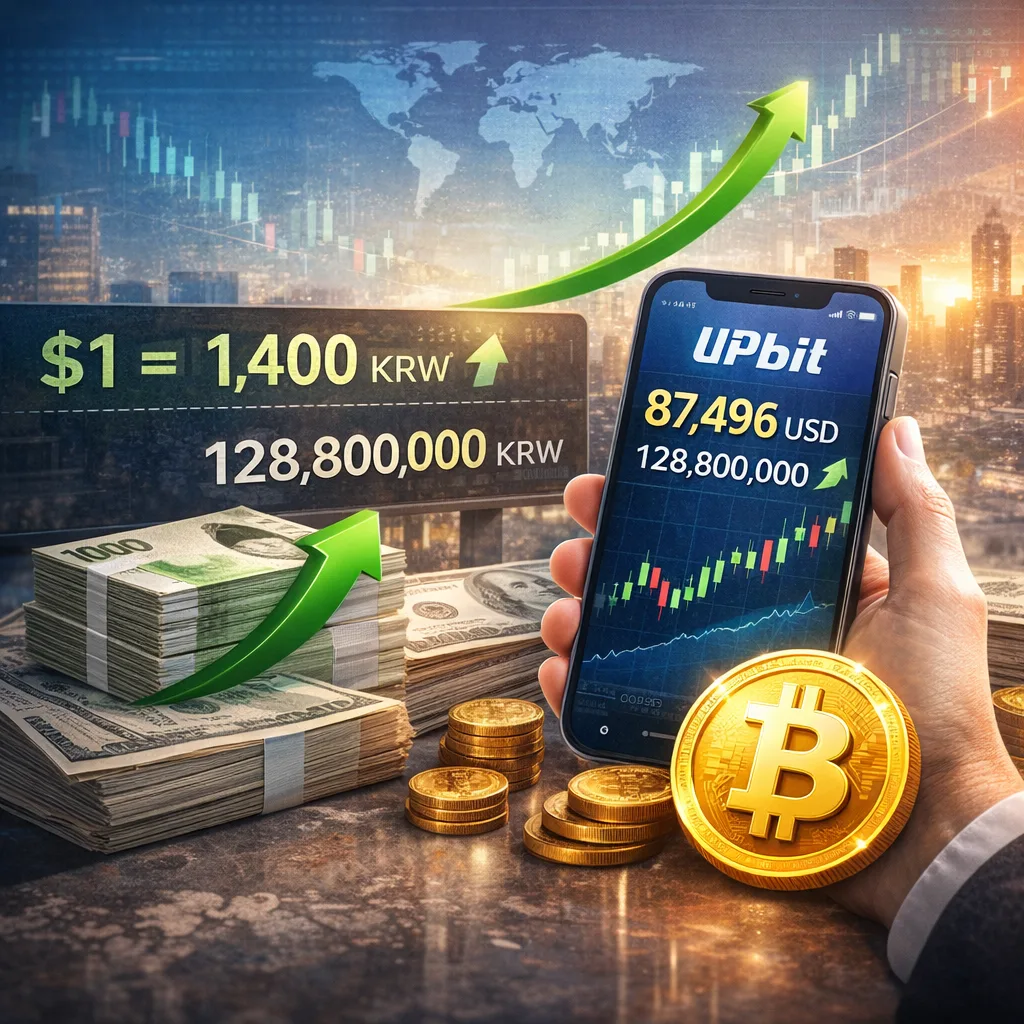
Bitcoin investor A opens the Upbit app the moment he wakes up. Yesterday he clearly saw news that Bitcoin was moving sideways around $87,000, yet the won price on the Korean exchange is slightly higher than it was yesterday.
“Huh? I woke up and my money multiplied? They say the overseas price hasn't changed, so why?”
The key to this mystery is **‘the won/dollar exchange rate’**. Here is a very simple explanation of why the number in your wallet changes when the exchange rate rises, even if the coin price stays put.
1. Bitcoin is the ‘global common language,’ the won is ‘Korean’
Bitcoin is like gold: it holds the same value anywhere in the world. But its global benchmark price is usually set in **US dollars ($)**.
Suppose Bitcoin is $87,496 as of today. If the won/dollar exchange rate is KRW 1,400then in Korean money it comes to about KRW 122.49 million. But what if Bitcoin's price stays put and only the exchange rate KRW 1,463jumps to that level? Bitcoin's price instantly KRW 128 millionbecomes.
You were just sitting still, but as the won lost value, the price of Bitcoin, a ‘dollar-based asset’ you hold, became relatively more expensive.
2. ‘Real profit’ or ‘optical illusion’?
A price rise caused by the exchange rate feels good, but there is something you need to separate coolly.
- Real performance (asset appreciation): Bitcoin itself rising from $87,000 to $90,000. (Every investor in the world smiles together.)
- Exchange-rate buff (currency depreciation): Bitcoin stays the same, but the won loses value. (Only Korean investors see their numbers go up.)
If you later sell your coins and convert back into won, this ‘exchange-rate buff’ is indeed a profit. But if you shop overseas or manage assets in dollars, keep in mind that your actual purchasing power may not have changed much.
3. Korea's special seasoning: the ‘kimchi premium’
Add the **‘kimchi premium’**, a phenomenon unique to the Korean market, and the calculator gets even busier. When Korean demand surges on top of the exchange rate, Upbit prices end up well above overseas prices.
Today's investing basics in brief
- Upbit price = (overseas dollar price × won/dollar exchange rate) + kimchi premium
- Even when Bitcoin moves sideways, a rising exchange rate increases your won-denominated assets.
- Conversely, if the exchange rate plunges, your won returns can shrink even when coins rise.
💡 A word from BITPRESS
In the end, for Korean investors the exchange rate is like **‘a second coin chart’**. Don't just watch the Bitcoin chart; pay attention to exchange-rate news every morning, too. It's the first step to becoming a smart investor who isn't fooled by the magic of numbers.