Oil leaving the Middle East averaged more than 24 million barrels a day in the week through Oct. 18. That is more than the 23.3 million barrels a day before the war began on Feb. 28, and it holds even without Iranian exports, which US officials say have been cut off completely by a naval blockade. Yet on the afternoon of Oct. 21, Brent crude (the benchmark for global oil prices) was $108.86 a barrel.
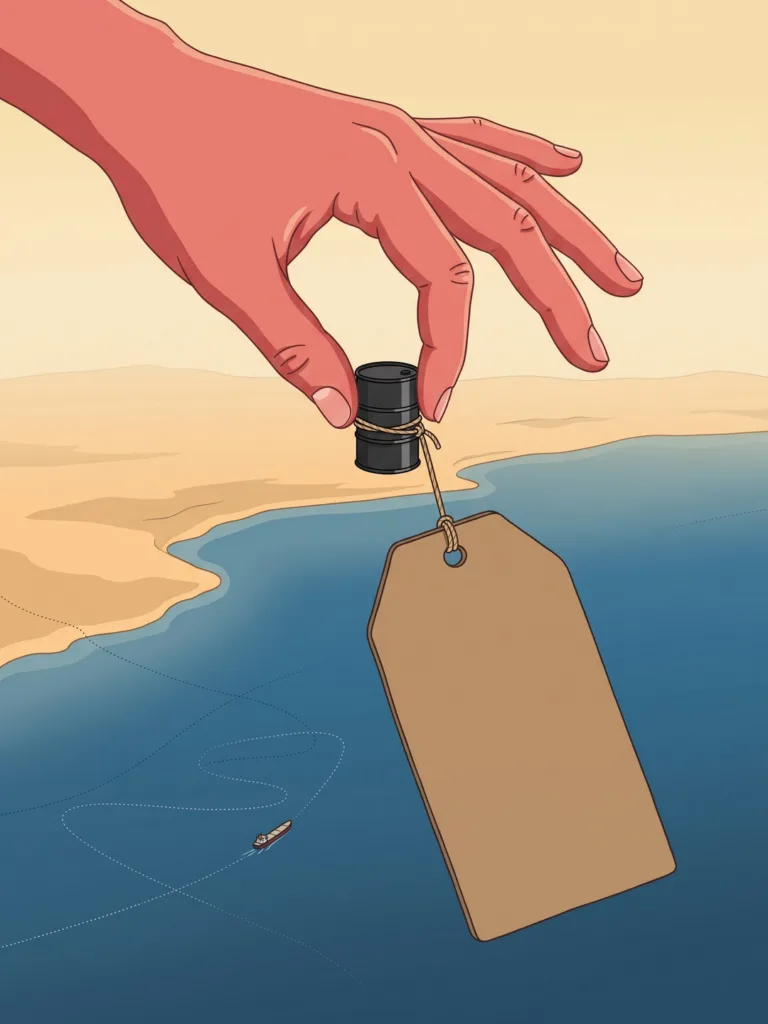
The common reading is "oil is flowing again, so prices will fall soon." But the real point lies elsewhere. The price of oil depends not only on how much there is, but also on the cost of carrying it across dangerous seas and on the refining capacity that turns it into fuels like diesel. The volume is back, but this "delivery cost" is not.
- How did exports get back above prewar levels?
When the US and Israel struck Iran on Feb. 28, Iran tried to close the Strait of Hormuz (a narrow waterway at the mouth of the Persian Gulf, through which about a fifth of the world's oil and LNG (liquefied natural gas) passed before the war). Oil now passing through the strait, including cargo transferred in the Gulf of Oman, is about 14 million barrels a day, or 82% of prewar.
Other routes made up the shortfall. In September about 40% of Middle East crude excluding Iran avoided the strait through detours such as Saudi Arabia's east-west pipeline. Before the war it was 17%. Put simply, the front door is still only partly open, so more is going out through a widened side door.
- Why is the detour so expensive?
Crude that does cross the strait no longer makes the trip in one go. Shuttle tankers load oil inside the Gulf and carry it across the strait, then it is transferred off the UAE and Oman to other ships bound for faraway ports. The US military protects ships along the Omani coast. More than 70% of the crude that crossed the strait in August was moved this way. Iran keeps attacking passing ships, and at least 18 attacks on ships were recorded in the region in the past two weeks.
Danger turns into cost. One report said sailors were being offered bonuses of up to $25,000 for a one- to two-week round trip. The risk has pushed tanker prices up, making even ships that avoid the Middle East more expensive. In early October a supertanker heading from the US Gulf Coast to China was reported chartered for $76 million, about 10 times the cost of a similar voyage less than a year earlier. The ship carries about 2 million barrels of crude, so shipping adds roughly $38 a barrel on top of the price of the oil. A tanker going from the US to Korea was also booked for $77 million.
Next to the price of US crude (WTI) that day, $97.17, the $38 in shipping is about 39% of the oil's price. It is like a delivery fee that has grown 10 times larger while the price of the goods stays the same. Unlike a delivery fee, though, this one is not a fixed rate; it rises the more dangerous the sea route becomes.
- Why are refined fuels like diesel still short?
Even when crude comes back, what goes into cars and factories is refined products (fuels such as diesel and gasoline, made by processing crude at a refinery). In the seven days through Sept. 28, refined products passing through Hormuz averaged 677,000 barrels a day, less than a fifth of the prewar 3.6 million.
The refineries were hit too. Middle East refinery runs fell from 9.9 million barrels a day in February to 7.3 million in August. The causes were damage to plants and trouble exporting finished fuel, and the ship-tracking firm Kpler thought a return to prewar levels was unlikely before the second quarter of 2027.
It is like flour arriving again while the bakeries are not fully running. At the end of September, US diesel prices rose to near record highs. So even if crude gets cheaper, fuel prices like diesel may not follow right away.
- How much do those who make the risky trip earn?
There is big money at stake for those willing to carry the oil despite the risk. Kpler analyst Homayoun Falakshahi estimated that reselling Iraqi crude can earn $20 more a barrel than before the war, or about $40 million for a single supertanker's cargo.
Sellers care about shipping rates too. Reuters reported that Saudi Aramco (Saudi Arabia's state oil company) had considered offering some Asian buyers discounts to help cover the high shipping costs.
- The price on the screen is not the price you actually pay
IBTimes noted that even though exports are up, high regional tension and shipping rates driven up by danger are keeping oil prices high. Also, Brent's $108.86 is only the benchmark price shown on financial-market screens. Voyages this costly show that the price of actually buying and delivering physical oil can differ from that benchmark.
The benchmark itself has not come down either. An Oct. 1 report said Brent had recently traded around $100, and on Oct. 21 it was close to $109. Tension around the strait and fighting that has spread through the region are holding the price up, and a diplomatic breakthrough between the US and Iran is still far off.
- BITPRESS Insight
The number "exports passed prewar levels" does not mean the paths oil takes have returned to prewar. The front door (Hormuz) is only 82% open, and the rest is volume made up through the side door (pipelines). The trip across the strait comes with transfers between ships, sailor bonuses and the risk of attack, and shipping rates that rose along with regional tension are propping up oil prices. Refined fuels like diesel are recovering more slowly than crude because refineries are running below capacity, so fuel prices may lag even if crude gets cheaper.
So if you look only at production or export volumes in oil news, the judgment "prices must fall now" is easy to get wrong. Whether oil prices really fall is better judged by whether the cost of the ships that carry the oil and the supply of refined fuels like diesel are easing, rather than by the volume of oil.
Sources
https://www.ibtimes.com/more-oil-flowing-through-persian-gulf-before-war-prices-are-still-high-3808854
https://arabnews.com/middle-east/arab-gulf-oil-exports-surpass-pre-war-levels-despite-iranian-attacks-3007580
https://www.hellenicshippingnews.com/crude-oil-exports-through-the-strait-of-hormuz-hit-prewar-levels-but-fuel-shipments-remain-constrained/
https://www.ibtimes.co.uk/strait-hormuz-crude-flows-prewar-diesel-supplies-tight-1823015
Glossary
Brent crude — The crude oil used as the benchmark for global oil prices.
Strait of Hormuz — A narrow waterway linking the Persian Gulf to the open sea, through which about a fifth of the world's oil and LNG (liquefied natural gas) passed before the war.
Refined products — Fuels such as diesel and gasoline, made by processing crude at a refinery.
Shuttle tanker — A tanker that runs only a short stretch, carrying oil and then handing it over to another ship.
Supertanker — The largest class of oil tanker, able to carry about 2 million barrels of crude at once.
BITPRESS articles are information to help your investment decisions, not a recommendation to buy or sell any stock or coin. Investment decisions and their results are your own responsibility.