On Oct. 13-14 (U.S. time), the yield on 2032 bonds from CoreWeave (a cloud company that buys Nvidia chips in bulk and rents computing power to AI companies) rose to a record 14.5%. CoreWeave sold those bonds in June at 9.625%. A rising bond yield means the price of bonds already issued has fallen. On Oct. 15, bonds CoreWeave sold in April traded at about 79 cents on the dollar.
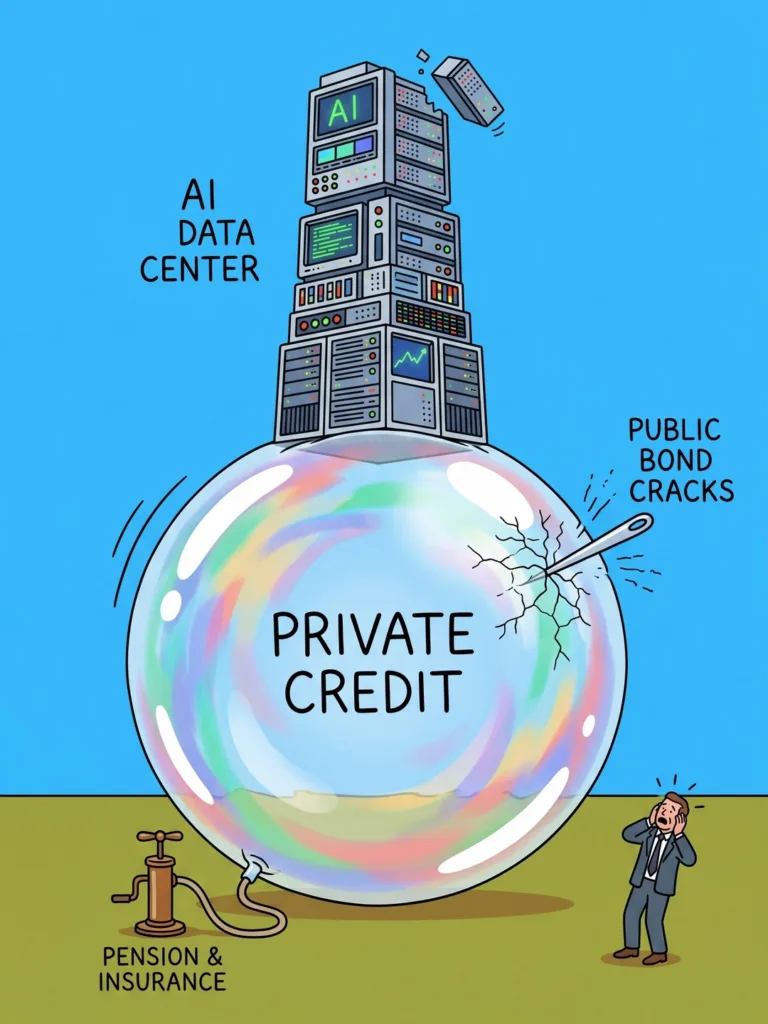
Many see this as a problem at one heavily indebted company. But the real story is elsewhere. The money building AI data centers increasingly relies on "private credit," which has no daily market price. When CoreWeave's bonds, which are priced every day, fell first, the market began to doubt all the debt lent to AI.
- What is private credit, and how much has gone into AI?
Private credit is money that fund managers such as private equity firms, rather than banks, lend directly to companies, using cash gathered from insurers, pension funds and others. Think of it as borrowing straight from a wealthy lender instead of going to a bank counter. The catch is that the money this lender manages includes other people's retirement savings, such as insurance premiums and pensions.
Private loans made directly to U.S. companies grew from $96 billion in 2010 to about $2.4 trillion in 2025. Loans to AI, big data and cloud companies top $200 billion (about 8% of the total). Counting only deals struck in 2025, more than a third were AI-related, up from 17% over the previous five years.
Single deals have grown too. In the second quarter of this year, a $35 billion vehicle led by Apollo and Blackstone was used to buy chips and lease them to Anthropic (the company behind the AI chatbot Claude), and the investment bank UBS called it the largest private credit deal on record.
- Why are bubble warnings coming now?
CoreWeave has about $50 billion in debt. The cost of insuring against it failing to pay (credit default swaps) rose on Oct. 15 to roughly 10% of the insured amount per year (about 1,000 basis points). That price implies a nearly 63% chance of default within five years, double the roughly 30% of a year earlier.
Investor Chamath Palihapitiya posted a chart of CoreWeave's bond yield and asked, "Is the AI buildout creating a private credit bubble?" Will Sommer of research firm Gartner said enterprise and consumer AI revenue "will be insufficient to support profitable returns on all planned AI capital expenditures." In May, the Financial Stability Board (an international body of major central banks and financial regulators) also warned that a sharp correction in asset values that have risen quickly could lead to "sizeable credit losses."
Put simply, the doubt over whether AI can earn enough to repay this debt showed up first as a price in corporate bonds, which are priced every day.
- Why does private credit reveal risk late?
Corporate bonds trade every day, so their prices change right away. Private loans rarely change hands, so they have no daily price. As CoreWeave's bonds fell, one market analyst pointed out that "those loans don't get repriced every day the way CoreWeave's bonds do."
Think of an apartment whose price is quoted every day versus a small building that rarely sells. If the building doesn't trade, its value on paper stays the same, but that doesn't mean it hasn't lost value. In fact, Project Jupiter, an $18 billion data center financing, later changed hands at 89 to 91 cents on the dollar.
If $10,000 worth of bonds trades at 79 cents, it is worth about $7,900 (a hypothetical calculation). In corporate bonds that $2,100 loss shows up in prices right away, but private loans to similar AI data centers have no daily price, so such losses may not show up in the numbers right away.
- Whose money is on the line?
According to a report citing an estimate from credit rating agency Moody's, about 20% of U.S. life insurers' bond holdings are linked to private and illiquid (hard-to-sell) bonds.
In May, the European Central Bank published a stress scenario in which, if returns on AI investment disappoint, euro-area pension funds could lose 5-6% of their assets and insurers about 4%. Applied simply to $100,000 in pension assets, that would be $5,000 to $6,000 (a hypothetical calculation).
Put simply, if the bubble bursts, the fund managers who made the loans take the first loss, but behind them are ordinary people who paid insurance premiums and pension contributions.
- Has this happened before?
Last year, when Tricolor, a U.S. subprime auto lender and dealer, and First Brands, an auto parts maker, collapsed, JPMorgan, Barclays, UBS and Jefferies reported losses or significant exposures. The Financial Stability Board cited the two cases while warning that banks are becoming more entangled with private credit.
The difference this time is concentration. Back then, the trouble was at two companies; now more than a third of private credit deals are concentrated in a single industry, AI. The Financial Stability Board said that if power shortages delay or cancel data center construction, losses could come faster.
- BITPRESS Insight
If you look at the AI downturn only through Nvidia's share price, the only risk you see is the number on your screen each day. But because the money building data centers increasingly relies on private loans with no daily price, losses could surface later than in stocks, and all at once.
So even people who own no AI stocks can't assume this downturn has nothing to do with them. If pension funds and insurers put money into private loans in search of higher interest, those losses could reach your returns later.
Whether this AI downturn affects you depends not on the stocks you own, but on how much "private credit" sits in your pension, insurance or high-yield bond fund.
Sources
https://www.marketscreener.com/news/coreweave-shares-bonds-slide-further-as-ai-debt-fears-mount-ce785dd3dd8cf522
https://finance.yahoo.com/markets/stocks/articles/elon-musk-says-yikes-coreweave-084136864.html
https://www.nakedcapitalism.com/2026/10/coreweave-stock-price-credit-market-nvidia-ai.html
https://investing.com/news/stock-market-news/coreweave-shares-bonds-slide-further-as-ai-debt-fears-mount-4951350
https://www.resultsense.com/news/2026-05-06-fsb-private-credit-ai-warning/
https://www.resultsense.com/news/2026-05-27-ecb-private-credit-ai-financial-system-risk/
https://www.insurancebusinessmag.com/us/news/technology/insurers-are-funding-ai-infrastructure–naic-wants-to-know-if-the-ratings-hold-up-578762.aspx
https://www.itiger.com/news/2581711097
https://www.itiger.com/hans/news/2577372294
Glossary
Private credit — Money that fund managers such as private equity firms, rather than banks, lend directly to companies using cash from insurers, pension funds and others; also called private lending.
Bond yield — The yearly return you earn if you buy a bond at today's price and hold it to maturity; it rises when the bond's price falls.
Credit default swap — Insurance against a borrower failing to repay; the higher its cost, the more default risk the market sees.
Financial Stability Board — An international body of major central banks and financial regulators that monitors risks to the global financial system.
Illiquid bond — A bond with few buyers, so it is hard to sell at a fair price when you want to.
BITPRESS articles are information to help your investment decisions, not a recommendation to buy or sell any stock or coin. Investment decisions and their results are your own responsibility.