On Oct. 15 the KOSPI fell 7.57% to close at 5,554.22, and during the session a circuit breaker (a mechanism that briefly halts trading when the index drops sharply) was triggered. The same day the U.S. 10-year Treasury yield fell 0.08 percentage point to 5.08%, and gold rose more than 1% to reclaim $4,150 an ounce (U.S. trading hours).
A falling Treasury yield means the price of existing Treasuries rose. Money appears to have flowed into bonds and gold. Bitcoin went the other way. Shortly before 4 a.m. U.S. Eastern time on Oct. 15 it slid to an intraday low of $79,694, dipping below $80,000 for the first time in a month. If bitcoin really were 'digital gold,' money should have poured into it like gold on a day like this.
But the real story is elsewhere. One line of analysis holds that whether bitcoin moves like gold depends less on the asset itself than on who holds it. Since spot ETFs (funds that hold bitcoin and trade like stocks in a brokerage account) brought institutional money in, bitcoin has more often moved together with stocks. That day, too, money left the ETFs, and trades made with borrowed money were forcibly closed.
- Where did the money leave, and where did it go?
On Oct. 15 markets split into two camps. Korean chip stocks dragged Asian markets lower, and copper futures fell nearly 1% more after a 1.6% drop the day before. Copper is used widely in factories and construction, which is why it is called a thermometer of the global economy.
Iliya Kalchev, an analyst at crypto lender Nexo, saw the move less as a crypto-specific story than as a broad exit from risk assets. He added that Treasuries and gold rallied on worries about growth and the financing of AI investment.
Suppose you had put KRW 10 million into each. A fund tracking the KOSPI would have lost about KRW 760,000 at the Oct. 15 close. Bitcoin, near its low on the morning of Oct. 15 U.S. time, was down 3.5% from 24 hours earlier, a loss of about KRW 350,000. Gold rose more than 1% that morning, a gain of more than KRW 100,000 (a hypothetical calculation at different times). Bitcoin regained some ground, climbing back above $82,000 at 1 p.m. U.S. Eastern, but that morning it stood with stocks, not with gold.
- Bitcoin held up on Oct. 13. Why did it fall with stocks on Oct. 15?
Two days earlier, on Oct. 13, when the KOSPI fell 5.46%, bitcoin slipped to just under $81,000 before recovering above $83,000. That day's bad news, such as worries about intensifying memory-chip competition, was a problem for chipmakers.
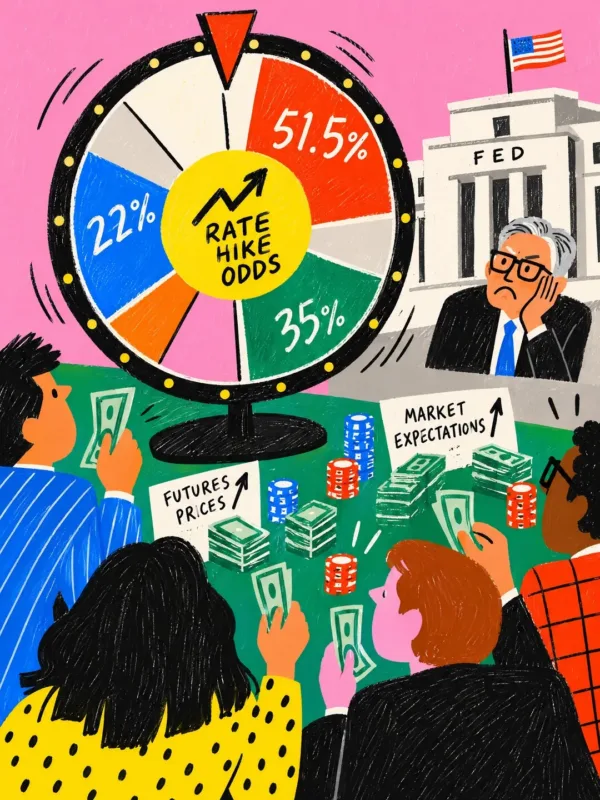
On Oct. 15, rate worries piled on top of the chip worries. After U.S. consumer prices released the day before came in hotter than expected, the odds of an October rate hike briefly approached 50% before falling back to 29%. On Oct. 14 the S&P 500, an index of 500 large U.S. companies, also fell 1.1%, its weakest session since July. The chip worries combined with rate fears appear to have shaken risk assets across the board.
Giuseppe Dellamotta, an analyst at InvestingLive, said conditions resemble stagflation (prices rising while the economy cools), a setting in which risk assets and the dollar generally underperform while gold outperforms. On Oct. 15, bitcoin landed on the risk-asset side of that divide, not on gold's.
- How did bitcoin ETFs and borrowed money move?
U.S. spot bitcoin ETFs saw $681 million in net outflows last week. This week, $175.6 million came in on Tuesday (Oct. 13) before about $260 million left on Wednesday (Oct. 14).
Trades made with borrowed money were closed out too. About $950 million of leveraged positions were closed over 24 hours, most of them long positions betting on rising prices. Think of a leveraged position as stock bought with an overdraft line. The difference is that the exchange closes it the moment the price touches a set level.
Put simply, money left the ETFs that day, and trades made with borrowed money were closed out as prices fell. That was the opposite of the money that headed for gold.
- Why didn't 'digital gold' serve as a safe haven?
Charles Archer, a senior market analyst at Crypto.com, wrote in January that bitcoin's tendency to move with tech stocks "has strengthened as institutional participation has grown and spot ETFs have integrated Bitcoin into traditional portfolio construction." A study published in December 2025 likewise found that after spot ETF approval, bitcoin's correlation with the S&P 500 rose sharply while its relationship with gold stayed near zero.
Archer saw the resemblance between bitcoin and tech stocks as superficial: both simply lean on the same appetite for risk and the same supply of money in markets. By that reading, on days when investors want less risk, the two tend to be sold together.
Think of a grocery cart. When money gets tight, you keep the rice and put back the snacks first. Right now bitcoin sits in the snack aisle. The difference: bitcoin's aisle isn't fixed, and it can shift depending on who is buying.
- BITPRESS Insight
Whether bitcoin moves like gold is not a fixed trait. Comparing Oct. 13 and Oct. 15, it can hold up against bad news confined to chips, yet fall with stocks on a day when rate and growth worries pile on.
That changes the math for anyone who has treated bitcoin as 'insurance' against falling stocks. Insurance should cover losses when stocks fall, but on the morning of Oct. 15 it added to them. Kalchev, too, wrote that the question now is whether spot demand returns.
Could you live with your bitcoin falling on the same day your stocks drop sharply? If not, that money isn't insurance; it's a risk asset on the same side as stocks.
Sources
https://www.coindesk.com/daybook-us/2026/10/15/bitcoin-copper-stocks-yields-all-fall-gold-rises
https://www.coindesk.com/business/2026/10/15/live-updates-bitcoin-back-under-usd81-000-as-ai-selloff-worsens
https://news.bitcoin.com/market-updates/bitcoin-price-rebounds-above-82k-after-brief-dip-below-80k/
https://cointelegraph.com/markets/bitcoin-etf-outflow-btc-below-82k
https://nexo.com/blog/markets-today-october-15
https://www.etoday.co.kr/news/view/2636289
https://www.coindesk.com/markets/2026/10/13/bitcoin-rebounds-above-usd83-000-as-it-decouples-from-tumbling-korean-stocks-and-nasdaq-futures
https://www.seoul.co.kr/news/economy/securities/2026/10/13/20261013500225
https://crypto.com/us/market-updates/bitcoin-in-2026-a-gold-like-hedge-tech-follower-or-something-else
https://arxiv.org/abs/2512.12815
Glossary
Circuit breaker — A safeguard that briefly halts stock trading on the exchange when the index drops sharply in a short time.
Spot Bitcoin ETF — A fund that buys and holds actual bitcoin and lets you trade its value like a stock in a brokerage account.
Leveraged position — A bet made bigger than your own money by adding borrowed funds. When the price hits a set level, the exchange closes it by force.
Stagflation — When prices keep rising while the economy slows down.
Government bond yields — The return you get by buying a government bond that is already on the market. It falls when bond prices rise and rises when bond prices fall.
KOSPI — The main index of the Korean stock market, tracking the combined value of the large companies listed on the Korea Exchange, such as Samsung Electronics and SK hynix.
BITPRESS articles are information to help your investment decisions, not a recommendation to buy or sell any stock or coin. Investment decisions and their results are your own responsibility.