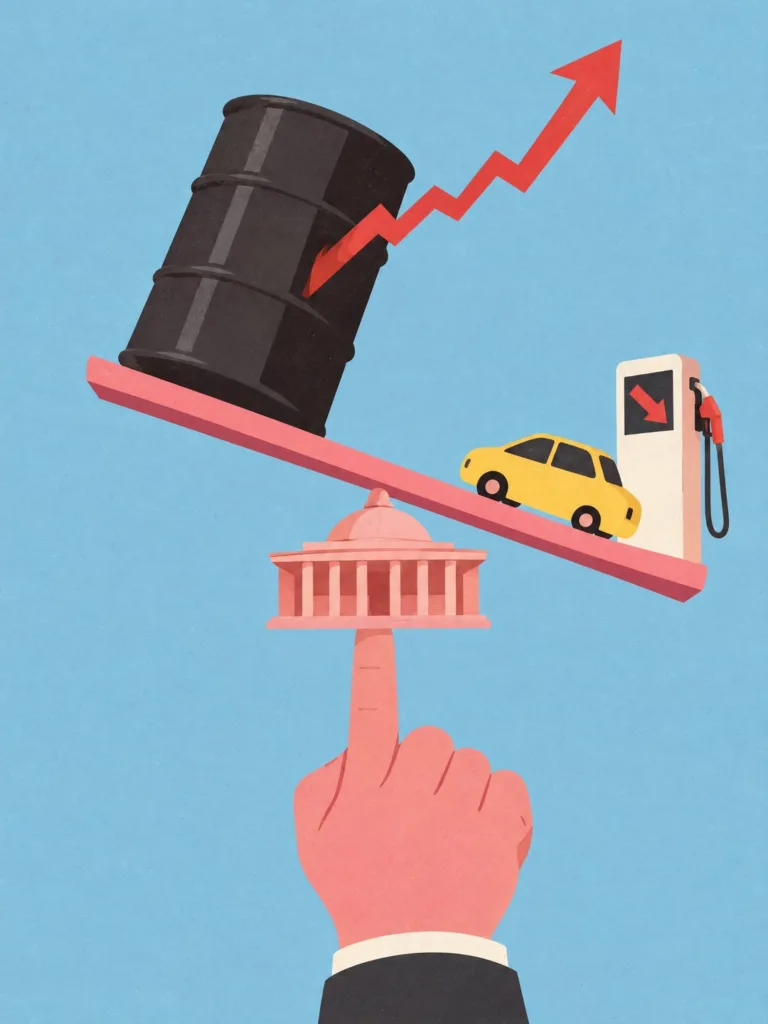
On Oct. 16, Brent crude (oil from the North Sea, one of the main benchmarks for world oil prices) rose 3.56% in a single day to $109.69 a barrel. Yet that same week, the national average pump price of gasoline (the pump price, below) was KRW 1,856.6 per liter, down KRW 0.9 from the week before. That is 22 weeks of declines in a row.
The common take is "fuel prices have settled down." But the key point is elsewhere. The government has put a price cap (a government-set ceiling) on the wholesale price that refiners (companies that import crude and turn it into gasoline and diesel to sell) charge gas stations, and that cap has stayed at KRW 1,784 per liter since late June. The refiners' loss from being unable to sell above the cap is to be covered afterward by the government out of a KRW 4.2 trillion contingency fund. But no source names the cause of the 22 weeks of declines.
- How far did oil rise, and how far did pump prices fall?
With Middle East tensions continuing, including Iran's attacks on ships in the Strait of Hormuz, Dubai crude (the price benchmark for most of the crude Korea imports) that week was $108.6 a barrel, up $0.5 from the week before.
Pump prices, by contrast, fell for a 22nd week: gasoline at KRW 1,856.6 and diesel at KRW 1,842.8. But this week's drops were small: KRW 0.9 for gasoline and KRW 0.5 for diesel. A driver filling a 50 L tank pays KRW 45 less than last week.
Put simply, oil is jumping while pump prices are slipping lower from nearly the same spot.
- Where is the price cap set, and at what level?
The cap applies not to the price gas stations charge consumers but to the wholesale price refiners charge gas stations. Refiners cannot supply at a price above it. The government says the aim of the system is to keep the surge in world oil prices caused by the war between the United States and Iran from passing straight into domestic fuel prices.
The first cap, which began March 13, was KRW 1,724 per liter for gasoline, and the 2nd through 6th were KRW 1,934. The 7th, on June 27, cut it by KRW 150 to KRW 1,784, and it has been held there four rounds in a row since. On Oct. 16, the Ministry of Industry and Trade also held the 11th cap, which applies for four weeks from 12 a.m. Oct. 17, at KRW 1,784 for gasoline, KRW 1,773 for diesel and KRW 1,380 for kerosene. It cited the burden on ordinary households' living costs.
Think of it as a limit not on the prices on a restaurant's menu but on what the restaurant pays its wholesaler for ingredients. In the second week of October, the pump price of gasoline was KRW 72.6 per liter above the cap.
- When do higher oil prices reach the pump?
Changes in world oil prices usually show up in pump prices after a lag of two to three weeks. The rise in oil this week has not yet passed through that lag. International gasoline prices that week actually fell $7.8 from the week before, to $138.5.
During the current four-week freeze under the 11th cap, the wholesale price cannot exceed the cap of KRW 1,784. So the rise in oil prices cannot pass straight into the wholesale price. However, the sources released this time do not separately explain exactly what is behind the 22 weeks of declines. Analysts say that if oil keeps rising it could affect domestic fuel prices, and that whether the declines continue is uncertain.
- Who pays the gap between the frozen price and the higher cost?
Refiners cannot sell above the cap, but in return they are to be compensated afterward by the government for the losses this causes. For that, the government has set aside KRW 4.2 trillion in a contingency fund (money held back from the national budget for unforeseen needs). It is like a restaurant selling to customers below the regular price and putting the difference on a tab with the district office. But how much the tab is worth has not yet been settled.
No compensation has been paid even once (as of a Sept. 16 report). The first payment has been delayed more than six months, and there are around 100 disputed points over what counts as cost alone. Because the contingency fund disappears if it is not spent within the year, the first settlement is expected only around year-end.
How much to pay is also in dispute (as of June 18). The refining industry asked to be compensated for the difference based on Singapore international petroleum product prices and estimated its losses at KRW 3 trillion to 4 trillion. The government did not accept that and chose a standard based on actual cost, built up from crude purchase price, shipping and labor. The industry figure is only an estimate and does not match the government's calculation.
- What happens to pump prices when the cap is lifted?
There is a scene worth looking at. On June 18, while keeping the 6th cap (KRW 1,934 for gasoline), the government explained: "Although international oil prices fell to the $70s, a premium remains, so the refiners' calculated price is somewhat higher than the cap."
The cap now is KRW 150 lower than then, and oil is above $100. The government has not said how big the gap is now between the refiners' calculated price and the cap. According to the government's June 18 explanation, it will decide whether to scrap the system by weighing the impact on livelihoods, the fiscal burden, and "the level of domestic oil prices after the system is lifted."
- BITPRESS Insight
The cause of the 22 weeks of declines is not confirmed, but the structure is. The refiners' wholesale price cannot exceed the cap of KRW 1,784, so the rise in oil prices cannot pass straight through, and this cap has been held four times since late June.
The part of the gap that arises because the wholesale price cannot rise with oil becomes the refiners' loss, which the government is to cover afterward from the contingency fund. For refiners' shareholders, the open question is how much of that compensation will be recognized on a cost basis.
When you see news that gas got cheaper, first separate whether it is because oil fell or because it is a price under the cap.
Sources
https://tradingeconomics.com/commodity/brent-crude-oil
https://www.m-economynews.com/news/article.html?no=71780
https://hankyung.com/article/2026101671917
https://www.seoul.co.kr/news/economy/2026/10/16/20261016500280
https://www.mt.co.kr/article/2026091615041534142
https://www.etoday.co.kr/news/view/2595037
Glossary
Price cap — A price ceiling the government sets on gasoline, diesel and kerosene. It applies to the wholesale price refiners charge gas stations, not the pump price consumers pay.
Refiner — A company that imports crude oil and turns it into petroleum products such as gasoline and diesel to sell.
Wholesale price — The price at which refiners hand petroleum products over to gas stations. It differs from what consumers pay at the pump.
Brent crude — Crude oil from the British North Sea, and one of the main benchmarks for measuring international oil prices.
Contingency fund — Money set aside in the national budget in advance to cover unexpected spending.
BITPRESS articles are information to help your investment decisions, not a recommendation to buy or sell any stock or coin. Investment decisions and their results are your own responsibility.