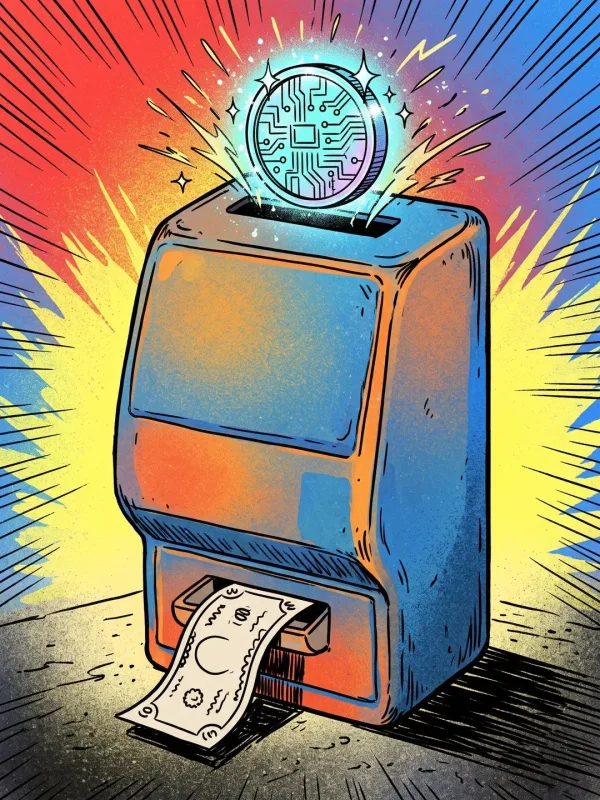

PayPal pays users who hold its dollar stablecoin, PYUSD, a 4% reward. Coinbase One members get 3.75% on USDC, and Kraken+ subscribers get up to 4.5% on USDG. A stablecoin is a coin pegged at $1 each. Put simply, it is not the company that issues the coin but the exchange or payment app that lets people buy and sell it that adds a payout that looks like deposit interest.
In this article, we call these payouts from exchanges and payment apps "exchange rewards."
On Oct. 21 (US time), the Office of the Comptroller of the Currency (OCC, the Treasury Department agency that supervises banks) issued the first final implementing rule under the stablecoin law, the GENIUS Act. The common reading is, "Stablecoin interest is banned, so exchange rewards are finished." But the real point lies elsewhere. What the law banned is interest an issuer pays for holding alone, and in the final rule the OCC dropped draft language that would have presumed some rewards from third parties tied to issuers, such as exchanges, to be illegal.
- What the law banned is 'interest an issuer pays for holding alone'
The GENIUS Act, which became law last year, bans issuers (the companies that create coins and redeem them for $1) from paying interest on stablecoins directly. The text defines the banned payment as money paid "solely in connection with the holding, use or retention" of the coin. Whether exchanges such as Coinbase, which are third parties, may pay rewards is something the law does not settle.
It is as if a manufacturer was barred from saying, "Just keep this product and we'll pay you," but nothing says whether the points a supermarket selling that product gives its members are barred too. Unlike supermarket points, though, an exchange reward is a percentage of the amount held, so it works much like deposit interest.
- The draft's 'presumption of illegality' is gone from the final rule
The OCC's draft rule presumed that some rewards paid by a third party were illegal when an issuer had a specific business relationship with that party. It was a 'rebuttable presumption,' meaning the third party was treated as breaking the law unless it could prove the reward was lawful. The final rule dropped this presumption.
So → rewards are not treated as illegal in advance → each set of facts is judged case by case. An OCC official said, "If we see clear evasion, we can respond accordingly." The agency gave no examples of banned rewards.
- One word, 'solely,' left a path open
The OCC put weight on the word "solely" in the text. If a reward is paid at least partly for some other reason, it may fall outside the ban. A reward tied to conditions such as signing up as a member or using the coin for payments leaves room to argue it is not "solely" for holding (BITPRESS interpretation).
That is not a free pass. The OCC set no safe harbor for existing reward programs and said it would not presume that programs in place before the GENIUS Act comply with the law. Put simply, it will neither block nor approve in advance, but examine each one.
- Banks push back, fearing deposits will leave
Assuming the 4% reward is for one year, $10,000 in stablecoins held for a year would earn $400 (illustrative calculation, excluding taxes and conditions). If the same money sat in a bank deposit, the bank would lend it out. The banks' argument is that if deposits move to coins → banks have less to lend → local lending could shrink.
Rob Nichols, president of the American Bankers Association, criticized the rule for leaving crypto platforms a way to pay interest-like rewards, contrary to "Congress's clear intent to protect local lending." He also said it is wrong to respond only after deposit flight and economic harm have occurred. The Blockchain Association, a crypto industry group, welcomed dropping the presumption as closer to the text of the law.
Still, reports say US bank deposits have kept growing even as interest in stablecoins has risen. So far, the banks' worry looks more like a future risk than something visible in the numbers.
- Case-by-case review is a beginning, not an end
TD Cowen's Washington Research Group (managing director Jaret Seiberg), a US investment bank, said case-by-case review creates uncertainty and is negative for banks. TD Cowen warned that the ambiguity will remain until a court rules, and that if the winner of the 2028 presidential election picks a new OCC chief, what counts as evasion could change.
There is a variable in Congress too. The CLARITY Act, which could reopen the interest provision, failed to clear a Senate procedural vote last month. The OCC said that until such a law passes, it must enforce the GENIUS Act's interest ban as enacted. The rule is due to take effect on Jan. 18, 2027.
- BITPRESS Insight
What this rule changed is not the reward rate but the nature of the reward. Interest from issuers is blocked, and exchange rewards are left neither banned nor allowed but "under review." Even at the same 4%, who pays and what protects the money differ from bank deposit interest.
The US Federal Deposit Insurance Corporation (FDIC) insures deposits at member banks up to $250,000 per depositor, per bank, per account category, and its list of products it does not cover includes crypto assets. An exchange reward is money the exchange pays, and whether it complies with the law is something the OCC will weigh case by case from here on.
When a coin reward rate looks like deposit interest, look first not at the number but at who pays the money and what protects it.
Sources
https://www.coindesk.com/policy/2026/10/21/occ-s-final-rule-to-start-fresh-in-weighing-stablecoin-rewards-against-genius-act-ban
https://www.theblock.co/news/regulation/2026-10-21-american-bankers-association-accuses-occ-undermining-congress-stablecoin-rewards-rule-421629
https://www.theblock.co/news/regulation/2026-10-21-occ-final-rule-implementing-trump-signed-genius-act-421470
https://www.fdic.gov/resources/deposit-insurance/understanding-deposit-insurance
Glossary
Stablecoin — A coin built to hold a steady value of $1 per coin.
GENIUS Act — The US stablecoin law enacted last year, covering reserve and redemption standards and a ban on issuer interest.
Office of the Comptroller of the Currency (OCC) — The agency under the US Treasury that supervises banks; it was the first to finalize a rule implementing the GENIUS Act.
Rebuttable presumption — A way of judging in which a regulator first treats something as illegal, and the judgment is reversed if the party proves otherwise.
Deposit insurance — A system that guarantees depositors get back up to a set amount even if a bank fails; in the US it is run by the Federal Deposit Insurance Corporation (FDIC).
BITPRESS articles are information to help your investment decisions, not a recommendation to buy or sell any stock or coin. Investment decisions and their results are your own responsibility.