On Aug. 26, 2022, the S&P 500, the benchmark US stock index, fell 3.4% in a single day. What came out that day was not jobs or inflation data but a speech by Fed Chair Jerome Powell (the Fed is the US central bank). Powell said the labor market was "particularly strong but clearly out of balance," and the market took that as a signal that rates would stay high for longer.
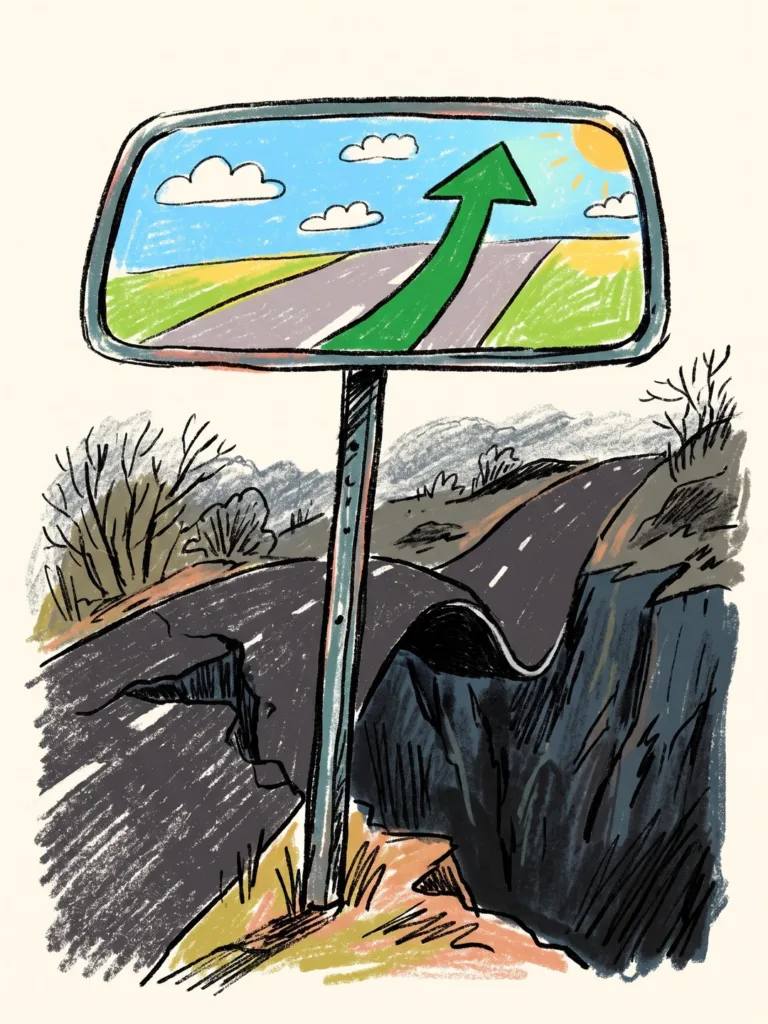
On days like this, people often say, "the economy is fine, so stocks will rise soon." But the real point lies elsewhere. Jobs and inflation statistics are last month's report card, while a stock price is today's value on the money a company will earn later. If the two disagree, something has changed on the side of expectations, not the report card.
- Why can a good report card not protect stock prices?
Jobs statistics measure how many jobs were added last month, and inflation statistics measure how much grocery-basket prices rose. A stock price, by contrast, takes the profit a company will earn later, cuts it down by the interest and risk of waiting, and converts it into a value today.
Think of a used car. A record of trouble-free driving last month matters less than how many more years it can be driven. The difference is that for a stock, expectations about that "future" change every day, and the price is reset every day.
So even when the data look fine, if expectations about the future change, the price moves first. Four things can change: the outlook for interest rates, the outlook for earnings, valuations that have already stretched, and crowded positioning.
- First, when the rate outlook rises, the value today of money to be received falls
The rate outlook is the expectation of where interest rates will settle. The higher the rate, the more money grows just sitting in a deposit today, so the value today of money to be received in a year shrinks. For a right to receive KRW 1.1 million in one year, the value today is about KRW 1.048 million at a 5% annual rate and KRW 1 million at 10%.
A 2004 Fed study (by former Fed Chair Ben Bernanke and Professor Kenneth Kuttner) estimated that an unexpected 0.25-percentage-point cut in the policy rate (the rate a central bank sets) would have lifted stock indexes about 1% (a hypothetical scenario). It found that the largest part of the stock reaction came from a change in the extra return investors demand for taking on risk.
Aug. 26, 2022 is an example in the opposite direction. Powell said high interest rates, slower growth and a cooling labor market would bring inflation down but "will bring some pain to households and businesses." Saying the labor market will cool while calling it strong for now reads as meaning there is little reason to rush to cut rates (BITPRESS interpretation). Put simply, what pulled stocks down was not the jobs numbers but the rate outlook.
- Second, when the earnings outlook shrinks, stocks fall even when the economy is fine
Jobs and inflation are averages for the whole economy, but a stock index swings heavily on the earnings outlook of a handful of giant companies. Shares of Nvidia, which sells AI chips, fell 17% in a day on Jan. 27, 2025, and nearly $600 billion in market value disappeared.
The trigger was the Chinese AI company DeepSeek releasing, free for the time being, AI services of the kind its rivals charge for. If AI can be given away free, expensive AI chips may not sell as well as expected, which is how the market's cut to Nvidia's earnings outlook reads. Nvidia praised DeepSeek and said inference (actually running AI) still needs a substantial number of Nvidia GPUs and high-performance networking equipment.
Say a company earns KRW 1,000 per share, and the market values it at 20 times earnings, or KRW 20,000. If next year's expected earnings fall to KRW 900, then even at the same 20 times, the price falls to KRW 18,000, down 10% (illustrative calculation).
- Third, a stock that has already run up falls when the multiple the market pays drops
The price-to-earnings ratio (P/E) is how many times earnings per share (company profit divided by the number of shares) the stock price is. With earnings of KRW 1,000 per share, if the market had been paying 25 times, or KRW 25,000, and decides to pay only 20 times, the price falls to KRW 20,000, down 20% (illustrative calculation). The company's earnings are unchanged.
The multiple also falls when the rate outlook rises or the outlook for earnings far in the future cools, but it can fall with both unchanged, on the worry alone that "it has run too far." Think of apartment asking prices. Even if nothing in the neighborhood has changed, once buyers say "not at that price," the deal price comes down. The difference is that with stocks, this change shows up in the price within a day.
- Fourth, money crowded on one side deepens the drop when it is sold all at once
When many investors hold the same stock → and someone starts selling → more people sell alongside and buyers dwindle → the price falls further. It is like a crowd all rushing out of a venue with a single exit: the door jams.
On Jan. 27, 2025, the DeepSeek shock spread across the AI industry, and the Nasdaq index also fell 3% that day. In general, the more money is piled into stocks with big weights in an index, the more easily the index shakes along with them when those stocks falter. What deepens the drop here is not the economic report card but the narrow exit.
- BITPRESS Insight
When data and stock prices diverge, waiting for a recovery because "the data are good" looks only at the report card and misses expectations. The order to check is the rate outlook, then the earnings outlook, then stretched valuations and crowded positioning.
If the rate or earnings outlook has changed, the value of money or the money to be earned has itself changed, so the reason for the drop is still in place. If it is stretched valuations or crowded positioning, the company's earnings are unchanged and only the price has been reset.
When the data are good but stocks fell, the rule is to ask first not what was good, but what expectation changed.
Sources
https://www.federalreserve.gov/pubs/feds/2004/200416/200416abs.html
https://www.federalreserve.gov/newsevents/speech/powell20220826a.htm
https://www.philstar.com/business/2022/08/29/2205773/hawk-jackson-hole
https://investmentnews.com/equities/nvidia-stock-slumps-17-amid-deepseek-shock-but-rival-shows-cracks/259082
Glossary
the Fed — The central bank of the United States; it sets the policy rate, which moves the cost of money in the US and around the world.
Benchmark rate — The rate set by a central bank; interest rates on deposits, loans and bonds move in line with it.
Price-to-earnings ratio (P/E) — How many times earnings per share the stock price is, showing how much the market pays for each unit of profit.
Market cap — The share price multiplied by the number of shares issued; the value the market puts on the whole company.
BITPRESS articles are information to help your investment decisions, not a recommendation to buy or sell any stock or coin. Investment decisions and their results are your own responsibility.