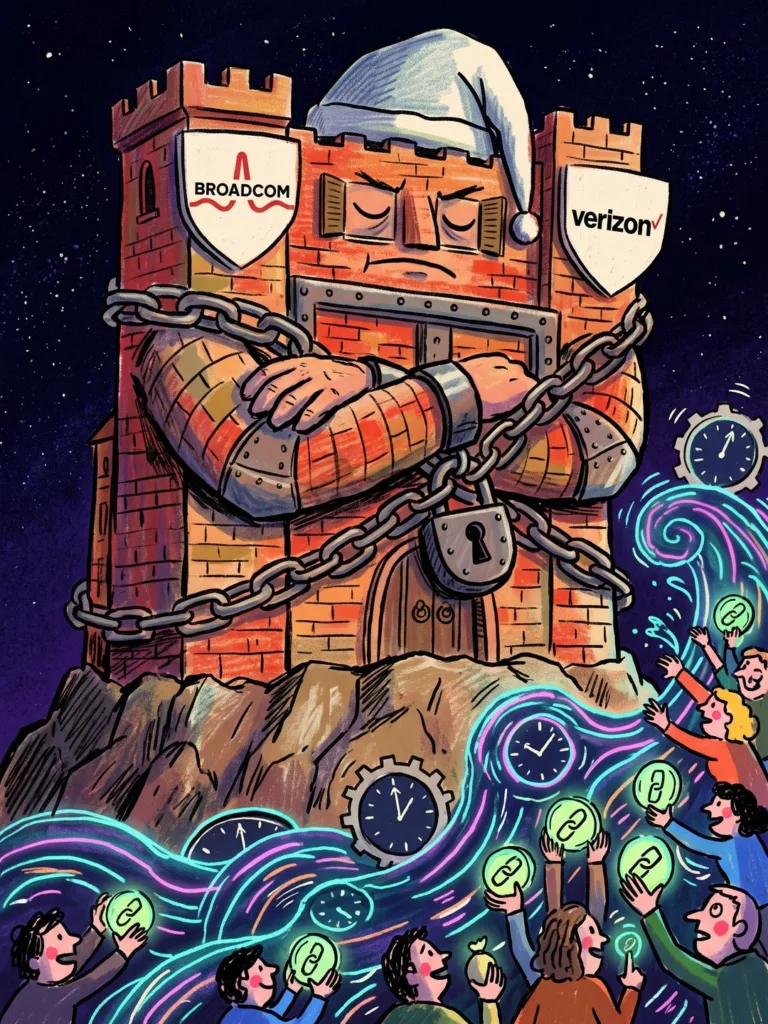
A plan to turn the stocks of 63 U.S.-listed companies into blockchain tokens and trade them around the clock has hit a snag: nine of those companies asked to have their shares left out. According to an Oct. 15 notice from OKXICE, a joint venture of crypto exchange OKX and ICE (Intercontinental Exchange), the parent company of the New York Stock Exchange, Broadcom, Verizon, UnitedHealth, CoreWeave and others objected.
At first glance, that seems odd. Trading day and night should bring in more buyers, and it doesn't look bad for share prices. It sounds like news that the door to U.S. stocks is opening for crypto investors.
But the real issue is elsewhere. Even without a company's consent, someone else can create tokens for its stock and price them separately from the official quote on U.S. markets. The nine companies that objected blocked this path in advance.
- How does OKXICE plan to sell U.S. stocks around the clock?
The basis is the ‘innovation exemption’ the U.S. Securities and Exchange Commission (SEC) issued on Sept. 17. It opened a five-year path for stock tokens to be bought and sold on a blockchain, without registering as a formal exchange, as long as conditions are met. OKXICE said it notified the SEC on Oct. 5 that it would use this exemption.
Here is how it works. A registered broker holds one real share for every token issued, then the token trades paired with a dollar-linked coin (stablecoin) such as Tether (USDT), and token holders must receive the same shareholder rights, such as dividends and voting rights.
What changes is how the price is set. Instead of matching the price buyers want with the price sellers want, an automated trading program called a ‘liquidity pool’ sets the price from the ratio of tokens to coins held inside the pool. It is like a fruit shop that raises the price when apples run low. The difference is that this shop doesn't look at prices at the market next door. It only looks at its own shelves.
- How can a company pull its stock out?
To list a stock token made by someone other than the company itself, an exchange must notify the company first and wait 30 days. If the company objects within that time, the token cannot be traded. By Oct. 15, nine companies had objected.
Cerebras (an AI chip company) objected first, and eight more were added in the Oct. 15 notice. The notice did not give a reason for the objections.
- What reason did Nasdaq give?
Nasdaq, the U.S. exchange operator, said it would exclude its own stocks from being traded as tokens under this rule. A Nasdaq spokesperson told The Wall Street Journal that the company does not want its shares traded at venues that don't show the best bid and offer in real time or don't report to the consolidated quote.
U.S. stock trades from many exchanges are pooled and shown as a single quote (the consolidated quote). Investors look there for the best current buying and selling prices (the best bid and offer) before placing an order. But a stock-token exchange does not have to follow this market rule (Regulation NMS), and it only has to publish its trade records separately within 10 minutes.
Put simply, another stall appears outside the official price board, one that never shows up on it, and sets a price on the company's stock.
- Why does a separately set price weigh on the real share price?
The SEC also noted this concern in its order. It said companies may worry that a token's price could drift away from, or hurt, the share price on U.S. markets, and that it is hard to keep the shareholder register when tokens move around on a blockchain.
Steven Wink, co-head of the fintech group at the U.S. law firm Latham & Watkins, said, “Low token trading volume could put pressure on the share price and send the wrong signal to the whole market.” Dan Gibbons of the same firm said companies don't want to do something unfamiliar with nothing to gain.
Suppose, for example, that on a weekend when U.S. markets are closed, a token's price drops sharply in a thinly traded pool. That price won't appear on the official quote board, but investors could read it as a signal before the market opens on Monday.
- There are safeguards, but the rule itself is temporary
To reduce such gaps, the SEC capped trading volume. For large stocks in the S&P 500 and Russell 1000, token trading volume cannot exceed 0.25% of the real stock's average daily volume for the previous month. For a stock that trades an average of 10 million shares a day, token trading would be limited to about 25,000 shares a day.
The problem is that this safeguard is not a permanent rule. The exemption is set to end on Sept. 17, 2031, and even before that, the SEC can change its terms if needed. A TD Securities report named this temporary nature as the biggest obstacle and said a future commission could reverse course. It also judged that interest is low outside a few companies close to crypto.
From a company's point of view, this can be read to mean that the rules of the market where its share price sits could change within five years. By objecting, it can avoid that uncertainty, at least on this exchange.
- BITPRESS Insight
News about stock tokens reads like “buying U.S. stocks with crypto,” but what you actually buy is not the stock itself but a certificate tied to the stock. The OKXICE notice also said the token price set by the pool can differ from the real stock. These objections also showed that the issuing company can cut that tie.
The reach of a company's objection is also narrow. The U.S. law firm Davis Polk pointed out that an objection cannot stop tokenization elsewhere, and that the SEC order has no effect on overseas trading. TD Securities said overseas platforms can keep selling synthetic products that simply track share prices without such conditions. The SEC exemption excluded these synthetic products.
So when you see a U.S. stock token on a crypto exchange, look first at who sets its price and where, rather than at the company name. Whether one real share is held for each token, whether the price is tied to the U.S. market share price, and whether the rules the product relies on can change at any time are what measure the distance from the real share price.
Sources
https://www.coindesk.com/business/2026/10/18/sec-tokenized-stock-framework-faces-issuer-pushback-as-broadcom-verizon-object-to-okx-ice-listing
https://www.sec.gov/files/rules/exorders/2026/34-106402.pdf
https://decrypt.co/380032/okx-and-nyse-owner-ice-plan-24-7-tokenized-stock-trading-under-sec-exemption
https://www.cooley.com/news/insight/2026/2026-09-22-permission-to-innovate-sec-carves-out-path-for-on-chain-stock-trading
https://www.mayerbrown.com/en/insights/publications/2026/09/sec-innovation-exemption
https://www.digitaltoday.co.kr/en/view/115322/coreweave-broadcom-reject-okxice-request-to-allow-tokenised-trading-of-their-shares
https://coinalertnews.com/news/2026/10/16/coreweave-broadcom-reject-okxice-shares
Glossary
Stock token — A certificate issued on a blockchain for real shares that a broker holds in custody. It can be bought and sold like a coin.
Liquidity pool — A trading program that, instead of matching orders between people, automatically sets prices from the ratio of the two assets held in the pool.
Consolidated tape — The official quote that pools stock trades and bid and offer prices from many U.S. exchanges and shows them in real time.
Innovation exemption — A temporary exception under which, for five years from Sept. 17, 2026, the SEC lets stock tokens trade without registering as a formal exchange if conditions are met.
Synthetic product — A product built to track a share price without holding the real stock in custody. It was left out of the SEC innovation exemption.
BITPRESS articles are information to help your investment decisions, not a recommendation to buy or sell any stock or coin. Investment decisions and their results are your own responsibility.