The S&P 1500 Aerospace & Defense index (29 U.S. defense stocks) fell nearly 19% from its early-August high through Oct. 14. Big weapons makers such as Lockheed Martin and Northrop Grumman also dropped by double digits over the same period. This happened while wars continue in Ukraine and Iran.
Common sense says this makes no sense. The usual thinking is that a longer war means more weapons purchases, so defense stocks should rise.
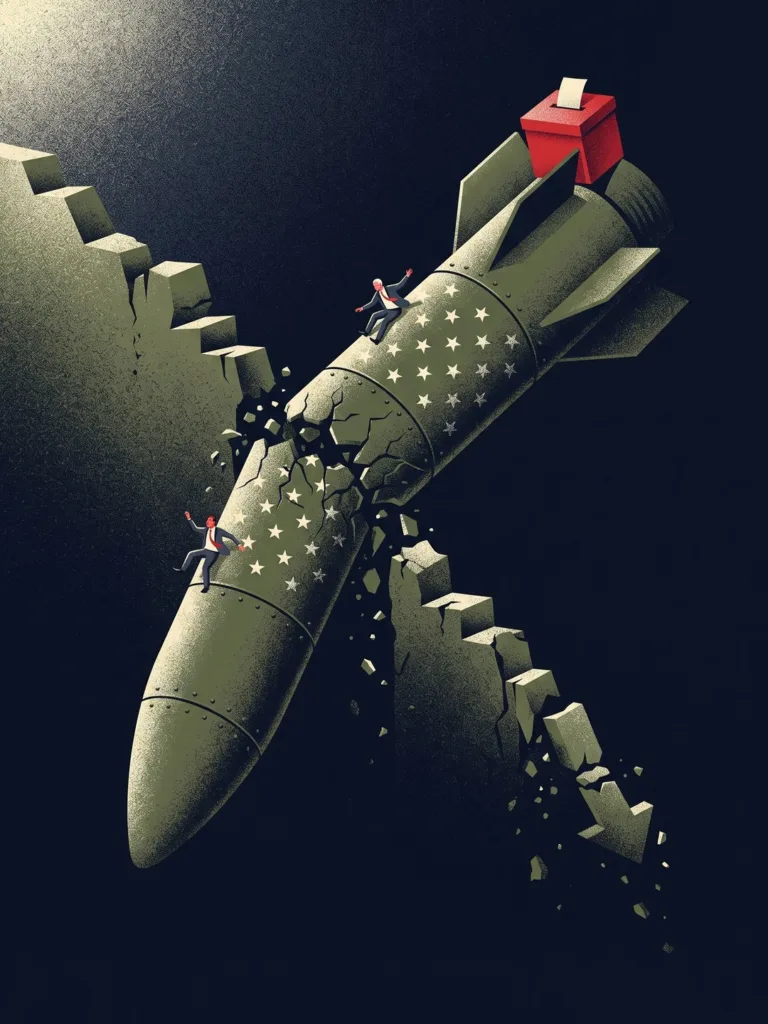
But the key point lies elsewhere. A defense company's money comes not from the battlefield but from the defense budget that the U.S. Congress passes, and control of that Congress could change in the November midterm elections (elections held midway through a presidential term to choose members of Congress). The reason Bloomberg and the Financial Times (FT) gave for the drop was also this election, not the war.
- Defense company sales come from the budget, not the war
Lockheed Martin (the largest U.S. defense company, maker of the F-35 fighter jet and missiles) said in its annual report that 72% of its 2025 sales of $75 billion came from the U.S. government. The Department of Defense alone accounts for 63%. The 28% from foreign customers also includes weapons sold through the U.S. government.
The company wrote that funding for government programs depends on the president's budget request, Congress's annual budget approval process and other factors. Even if the war creates a need for more weapons, it does not become revenue unless Congress hands over the money.
Think of a cram school. Even if more students want to attend, the school's sales do not grow if the parents paying the tuition close their wallets. The difference is that the defense budget's wallet is held not by one parent but by the majority party in Congress.
- Trump's $500 billion increase is now tied to the election
In early January, President Trump proposed making the 2027 defense budget $1.5 trillion instead of $1 trillion. That is a 50% jump at once, or about $500 billion more in spending. For defense companies, it was a reason to expect growing sales over the next several years.
The FT reported on Oct. 19 that U.S. defense stocks plunged as investors bet on a big Democratic win in the midterms, and that bipartisan support for a higher defense budget weakened, putting this increase in jeopardy. Bloomberg also cited, as a reason for the selling, worries that if Democrats win, they would scrutinize defense spending and the ties between some defense companies and the Trump administration more closely.
- After a 60%+ run in two years, the stocks reacted first when expectations wobbled
This index rose more than 60% over the two years of 2024 to 2025. Over the same period, the S&P 500 rose 44% and the Nasdaq-100 rose 50%. Money poured in on expectations that the U.S., Europe and others would raise defense spending.
Mark Malek, chief investment officer at Siebert Financial, said the rise came from multiple expansion, meaning share prices rose faster than earnings. However, he believes that given changes in demand and technology the rise was justified, and that things will settle down again once the midterms are over. Put simply, share prices already held big expectations for future budget increases, so when those expectations wobbled, prices moved first.
If you had put KRW 10 million into a product that moves exactly like this index at the August high, it would be worth about KRW 8.1 million on Oct. 14 (a hypothetical calculation). Not every drop is about budget worries. Bloomberg reported that jet engine maker GE Aerospace also fell 19% on concerns that higher fuel costs could reduce air travel.
- Wall Street split over the same election
Barclays initiated coverage of Northrop Grumman (maker of bombers and missile defense equipment) with a rating equivalent to a sell. Its reasoning is that the defense budget has grown for several years and a presidential election follows the midterms, so there is more room for defense spending to shrink than to grow. It gave only a hold rating even to Lockheed Martin, which has strong missile demand.
The other side also buys based on the budget, not the war. Jay Hatfield, CEO of Infrastructure Capital, expects a big Republican loss in November but bought Lockheed Martin in mid-September. He judges the drop to be overdone because Democrats will also support funding for defensive missiles. Vertical Research also upgraded Lockheed Martin to buy, saying both parties back missile funding. Integrity Asset Management bought more of Huntington Ingalls, a naval shipbuilder, saying it is a sector under less budget pressure.
- BITPRESS Insight
Defense stocks are less ‘stocks that rise when war breaks out’ and more ‘stocks that rise when budgets grow.’ The index fell nearly 19% even as the Iran war continues because of the signal that control of Congress, which holds the purse strings, could change. Even the dip buyers based their case not on the war but on ‘budget items Democrats would also support.’
So even among defense stocks, the outlook can split. Companies that sell weapons whose budgets are not easily cut, such as the missiles and ships both parties want, and companies that were counting on the new increase may react differently to the election result.
When you look at defense stocks or ETFs (funds that bundle many stocks and trade like a single share), look first not at the war in the news but at whether the weapons the company sells are items both parties will fund in the next Congress.
Sources
https://www.bloomberg.com/news/articles/2026-10-15/defense-stock-rout-lures-dip-buyers-looking-past-election-risk
https://www.spokesman.com/stories/2026/oct/15/defense-stock-rout-lures-dip-buyers-looking-past-u/
https://www.ft.com/content/e73d0106-486b-4382-8ecc-5c96ac44fdff
https://www.sec.gov/Archives/edgar/data/936468/000162828026004195/lmt-20251231.htm
https://www.foxnews.com/politics/trump-calls-1-5t-defense-budget-build-dream-military
https://biztoc.com/x/20c047807b985624
Glossary
Midterm elections — An election held midway through the four-year U.S. presidential term, in which all of the House and part of the Senate are chosen anew.
S&P 1500 Aerospace & Defense index — An index that groups 29 weapons, aircraft and engine companies out of 1,500 large-, mid- and small-cap U.S. stocks to show how their share prices move.
Multiple expansion — When share prices rise faster than company earnings, so the price paid for each won of earnings gets more expensive.
Sell-equivalent rating — An investment opinion, such as ‘underweight,’ that a brokerage issues to say investors should cut back on a stock.
ETF — A fund that holds many stocks in one basket and is bought and sold on an exchange like a stock.
BITPRESS articles are information to help your investment decisions, not a recommendation to buy or sell any stock or coin. Investment decisions and their results are your own responsibility.