
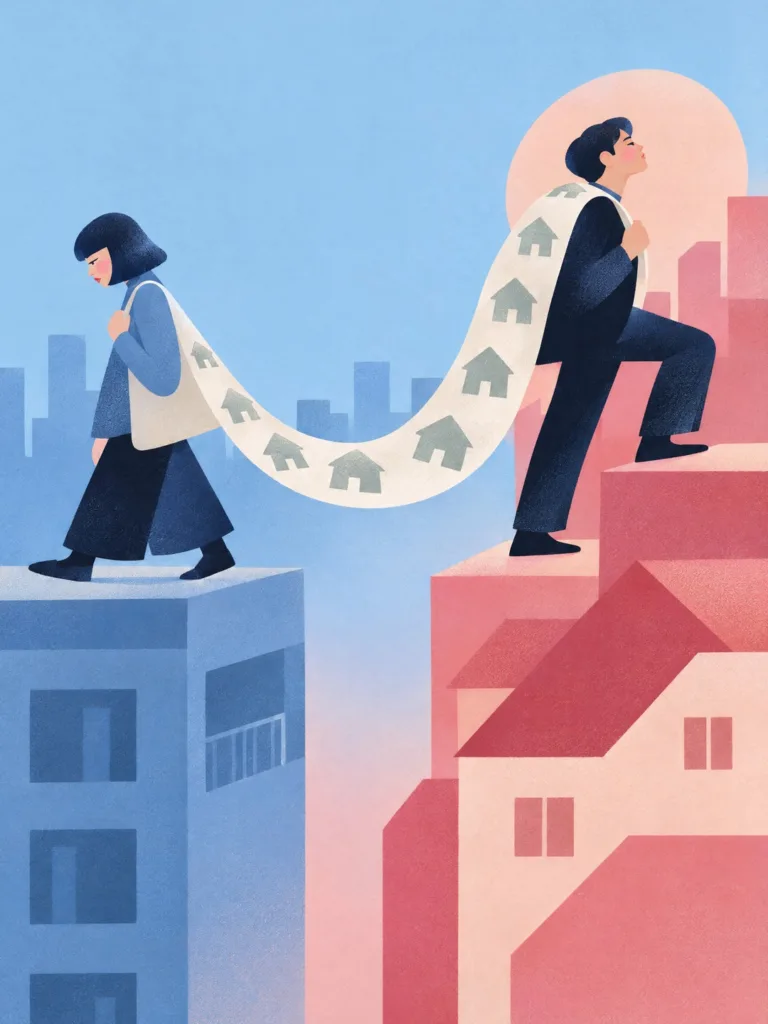
Bank mortgage lending rose KRW 2.9 trillion in September from August, bringing the balance to KRW 955.5 trillion. Over the same month, jeonse (Korea's lump-sum deposit lease) loans fell KRW 900 billion. Jeonse loans have been falling for more than a year, since last September (down KRW 200 billion).
Total bank household loans also grew by just KRW 600 billion in September. That is KRW 2.9 trillion less than in August (KRW 3.5 trillion). On the numbers alone, it looks as if lending rules are working and housing debt is under control.
But the key point lies elsewhere. The debt that fell is the debt of people renting a home. The debt of people buying one is still growing.
- The mortgage figures include jeonse loans
The mortgage total the Bank of Korea reports also includes housing-related loans such as jeonse loans. So the KRW 2.9 trillion rise in September means mortgages grew that much even after KRW 900 billion in jeonse loans dropped out.
The Bank of Korea said smaller jeonse and group loans (loans that residents of a new apartment complex take out together) held growth down, but individual mortgages are still growing fairly steadily. Of the KRW 2.9 trillion increase in September, individual mortgages made up about KRW 1.6 trillion.
Think of a grocery cart. If you take out one item and the receipt total still goes up, you must have added more of something else. But unlike groceries, a loan is debt you repay over decades.
- Jeonse loans fell, but not because jeonse prices dropped
Jeonse prices are actually rising. According to the KB Housing Market Review, jeonse prices for Seoul homes rose 0.68% in August from July, and 0.53% in the Seoul metropolitan area. Even so, the jeonse loan balance fell for 12 straight months through August as lending rules tightened, to KRW 162.1 trillion.
Tenants who found it harder to borrow moved to monthly rent. Monthly rent made up 68.3% of all jeonse and monthly rent deals from January to July this year. KB saw steady demand for monthly rent and half-jeonse leases (a deposit plus monthly rent), driven by jeonse loan rules and rate increases.
In short, the number of people looking to rent a home has not fallen. What is changing is how they pay: a deposit funded by debt is giving way to monthly rent.
- What grew is individual mortgages taken out to buy a home
An individual mortgage is a loan a home buyer takes out with that home as collateral. Lee Seung-yeop, a deputy general manager in the Bank of Korea's Financial Markets Department, said prices fell and some sales dropped in the three Gangnam-area districts and Yongsan after the government's Aug. 13 real estate measures. But he added, “Prices keep rising in other parts of Seoul and some parts of Gyeonggi Province, so individual mortgages are on an expanding trend.”
In other words, the rules first dampened buying in the priciest neighborhoods, but loans to buy homes keep going out in other neighborhoods where prices are rising. Mortgages grew KRW 4.1 trillion in August. KB pointed to more home sales in the Seoul area in May and to final-payment loans tied to a larger supply of move-in homes in July and August. The smaller increase in September reflected slower jeonse deals and fewer move-ins.
- Slower household loan growth also reflected less stock investing
What pulled September household loan growth down to KRW 600 billion was other loans, such as credit loans. Other loans fell KRW 2.3 trillion, to a balance of KRW 242.6 trillion. The Bank of Korea said individual investors were net sellers of about KRW 12.4 trillion in stocks in September. It added that seasonal factors also played a part: quarter-end clean-ups of bad loans, and loan repayments made with Chuseok (Korean harvest festival) bonuses.
Think of an overdraft account: people used the money from selling stocks to pay down their overdrafts first. But a mortgage is not debt that can be paid off in a month like an overdraft.
In short, household loans grew less because other loans dropped as stock investing fell, among other factors. It is not a sign that borrowing to buy homes has stopped.
- Why does the Bank of Korea say it is hard to judge what comes next?
The Bank of Korea said it is still hard to judge how home price trends will affect household loans. That is because prices are falling in the three Gangnam-area districts and Yongsan but rising in other parts of Seoul and some parts of Gyeonggi. Bank household loans grew by more than KRW 7 trillion in June alone, and growth has slowed for three straight months. Even so, loans have still risen for six months in a row.
Loan rates are not low either. The July mortgage rate was 4.48%, up 0.12 percentage points from June. KB said the rise in the benchmark rate in August pushed mortgage rates to their highest in two years and eight months. Assume a KRW 300 million loan at this rate, repaid over 30 years in equal monthly installments of principal and interest. The monthly payment would be about KRW 1.516 million. Even with that burden, loans to buy homes are increasing.
- BITPRESS Insight
In the September loan figures, housing debt did not shrink. It moved. Jeonse loan rules and rate increases pushed tenants into monthly rent, so debt on the renting side fell for over a year. In areas where home prices are rising, though, debt on the buying side kept growing through individual mortgages. The two trends are mixed in one statistic, so the mortgage increase alone understates how much buying-side debt grew.
That is why reading slower household loan growth as a sign of steadier home prices can be a mistake. What cut September's increase was debt tied to stock investing and jeonse loans. Individual mortgages grew with rising home prices in other parts of Seoul and some parts of Gyeonggi.
In BITPRESS's view, with loan news you should look first at which kind of loan grew, not at the total. If individual mortgages are growing even as jeonse loans fall, demand to buy homes is still alive.
Sources
https://www.etoday.co.kr/news/view/2636086
https://www.mt.co.kr/economy/2026/10/15/2026101511071427350
https://biz.sbs.co.kr/amp/article/20000340091
https://kbthink.com/realestate/insights/research/260916-7.html
https://kbthink.com/realestate/insights/research/260916-4.html
https://kbthink.com/realestate/insights/research/260916-5.html
Glossary
Mortgage — A loan taken out with a home as collateral. In Bank of Korea statistics, it also counts housing-related loans such as jeonse loans.
Individual mortgage — A mortgage a home buyer takes out from a bank separately, as distinct from group loans taken out collectively.
Group loan — A loan that people who bought into a new apartment complex take out together to pay interim and final installments.
Jeonse loan — A loan a tenant takes out to raise the deposit for a jeonse, Korea's lump-sum deposit lease.
Other loans — Household loans not secured by a home, such as credit loans and overdraft accounts.
BITPRESS articles are information to help your investment decisions, not a recommendation to buy or sell any stock or coin. Investment decisions and their results are your own responsibility.