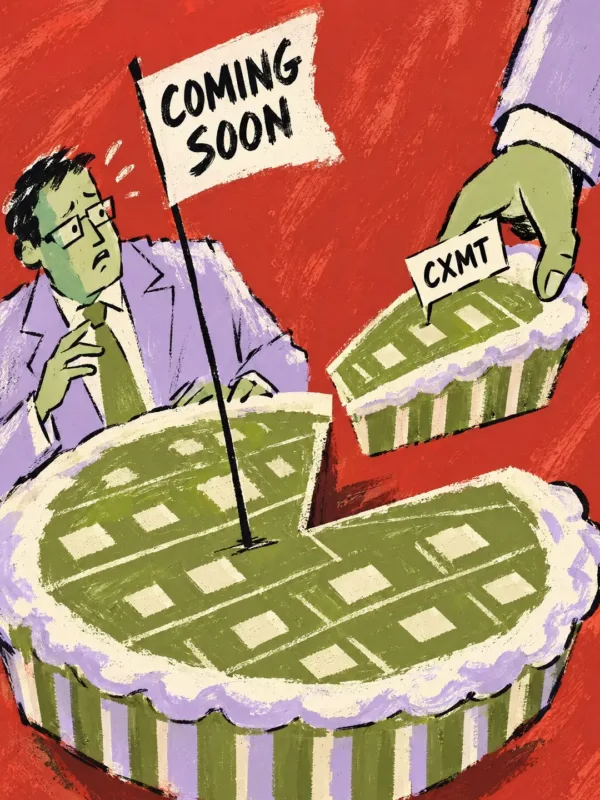
At 8:15 a.m. on Oct. 15, in trading before the main session opened (premarket), SK hynix was trading 7.47% below the previous close. Hours earlier, at a pre-IPO investor meeting held by U.S. AI company Anthropic, an AI chatbot maker founded by former OpenAI executives, word came out that its third-quarter revenue had grown 45% in a single quarter to $16.8 billion.
The usual reading is that chip stocks fell together on a U.S. inflation shock. If an AI company's revenue jumps, that should be good news for memory makers, so Anthropic looks beside the point.
But the real story is elsewhere. The market looked less at how much Anthropic's revenue grew than at whether it earns enough to pay for chips as expected. That money becomes data center chip orders, and the memory attached to those chips becomes SK hynix's earnings.
- What did Anthropic disclose?
Anthropic held a pre-IPO investor meeting in San Francisco on Oct. 14 (local time). According to an investor who attended, third-quarter revenue was $16.8 billion, up 45% from $11.6 billion in the second quarter, and first-quarter revenue was $4.7 billion. In the third quarter it was profitable on an adjusted basis (a measure the company calculates itself, leaving out some costs).
$4.7 billion in Q1 → $11.6 billion in Q2 → $16.8 billion in Q3. That is more than 3.5 times in two quarters. Anthropic is preparing to go public, targeting a valuation of over $2 trillion, and the listing is likely to come after the November U.S. midterm elections.
- Why did 45% growth disappoint?
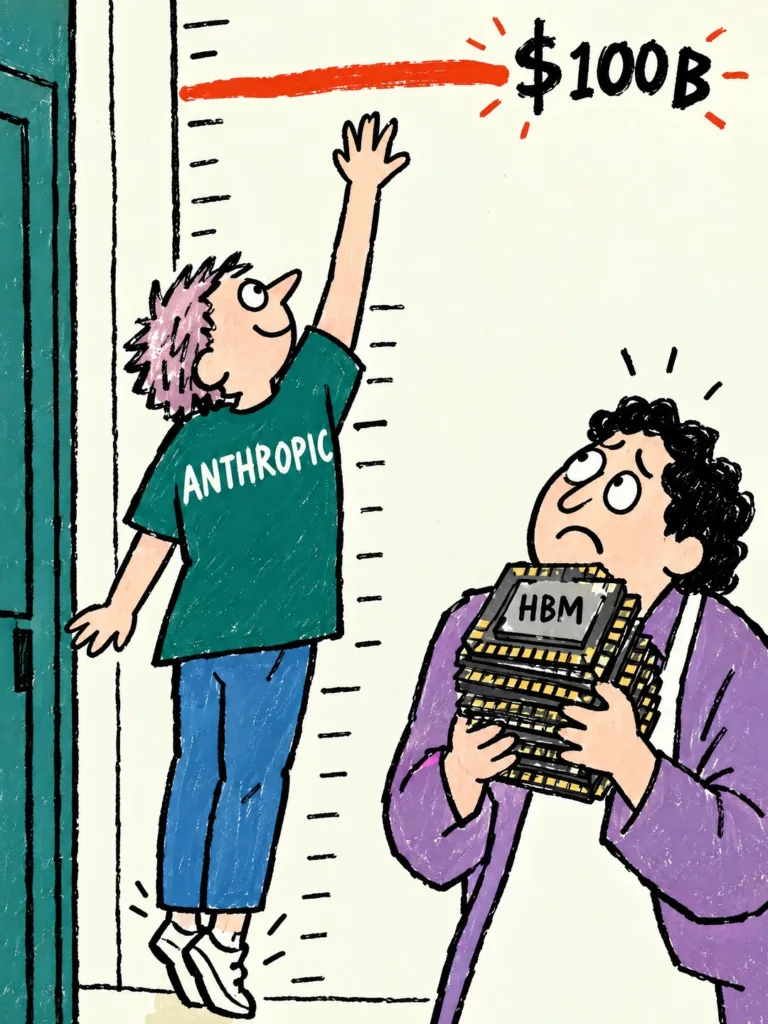
The market had expected Anthropic's annualized revenue (what a full year would bring in at the current pace) to reach $100 billion. Multiply third-quarter revenue of $16.8 billion by four and you get $67.2 billion. That is the average pace over three months, so the pace at the end of the quarter may be higher.
Kang Jae-gu, an analyst at Hana Securities, calculated that reaching $100 billion in annualized revenue by year-end would require growth of about 9% every month from late July to late December. By Hana Securities' calculation, reaching $100 billion by year-end would have required about $77.2 billion already in September, while the third-quarter average multiplied by four comes to $67.2 billion. He said growth is still high, but sustaining it and improving profitability will matter more to justify the company's valuation.
Put simply, the grades rose sharply but still fell short of the target score the market had set in advance. It is like someone who set a loan limit expecting a $100,000 salary and then got a big raise that still fell short of $100,000. The paycheck went up, but the bank still rechecks what they can repay. The difference is that Anthropic did turn a profit, at least on an adjusted basis.
- How does Anthropic's revenue become SK hynix's earnings?
Anthropic has committed at least $518 billion over the next 10 years to cloud services, computing and infrastructure. Google and Amazon are both investors in Anthropic and suppliers of the computing resources it rents.
What fills those data centers are AI chips such as Google's TPU (an AI chip Google built with Broadcom). Each TPU holds 6 to 8 HBM chips (high-performance memory made by stacking DRAM in layers right next to an AI chip). Korea Investment & Securities estimated that SK hynix supplied 56.6% of the HBM in Google's TPUs in 2025. Amazon also buys HBM from SK hynix and Samsung Electronics.
The money flows like this: Anthropic earns → it pays Google and Amazon for computing → Google and Amazon buy AI chips → the HBM on those chips becomes SK hynix revenue. Anthropic does not buy memory directly from SK hynix. But because the market reads along this chain, when Anthropic's revenue comes in below expectations, it marks down future orders all the way to the memory maker at the end of the chain.
- How much did the U.S. inflation shock add?
Anthropic was not the only cause. U.S. consumer prices for September, released on Oct. 14, rose 3.7% from a year earlier, above the 3.6% forecast and August's 3.4%. As the chance of a rate hike by the U.S. central bank (the Fed) grew, sentiment toward tech stocks weakened.
That day the Nasdaq fell 1.88% and the Philadelphia Semiconductor Index dropped 4.30%. SK hynix shares traded in the U.S. (ADR) also fell 6.06% in the regular session. Credit risk at AI data center company CoreWeave came into focus, and on top of that came a warning that Gartner, a global research firm, estimated AI infrastructure spending at about $7 trillion in 2026-2030 while AI revenue from data centers would be $3.6 trillion or less.
Anthropic's news came after the U.S. market closed. When its results were reported after the close, the SK hynix ADR fell another 3.66% in after-hours trading. Anthropic's results came on top of the inflation shock. When the Korean market opened, a sell-side sidecar (a mechanism that halts program selling for five minutes when futures prices plunge) was triggered on the KOSPI, and early in the session SK hynix was trading 8.95% lower.
- BITPRESS Insight
AI company earnings move memory stocks because the market reads that revenue as the budget for buying chips. The market had sized that budget large in advance and priced it into shares. So even when revenue grows 45%, if it falls short of the expected $100 billion pace, memory stocks react to "it fell short" rather than "it grew."
For people holding SK hynix or Samsung Electronics, this gap shows up as a single day's gain or loss. Anyone holding $10,000 of SK hynix would have seen the value of that holding fall by about $750 from the 7.47% premarket drop alone (hypothetical calculation).
Read AI company earnings news not by how much revenue grew, but by whether it came in above or below what the market expected. However big the growth rate, below expectations can be bad news for memory stocks.
Sources
https://www.investing.com/news/stock-market-news/anthropics-q3-revenue-surges-45-to-nearly-17-billion-4950208
https://www.opinionnews.co.kr/news/articleView.html?idxno=145676
https://www.opinionnews.co.kr/news/articleView.html?idxno=145684
https://www.newspim.com/news/view/20261015000116
https://biz.sbs.co.kr/amp/article/20000275475
https://www.ajunews.com/view/20251130160247763
Glossary
Premarket — A trading session on Nextrade, Korea's alternative exchange, held before the main market opens.
Annualized revenue run rate — A full year's revenue calculated on the assumption that the current pace continues all year.
Adjusted profit — A profit on a measure the company calculates itself, leaving out some costs, which can differ from accounting profit.
HBM (high-bandwidth memory) — High-performance memory that stacks DRAM in layers and sits right next to an AI chip to move data quickly.
ADR — A certificate that lets a foreign company's shares be bought and sold on the U.S. market.
BITPRESS articles are information to help your investment decisions, not a recommendation to buy or sell any stock or coin. Investment decisions and their results are your own responsibility.