The Financial Accounting Standards Board (FASB), the private body that sets U.S. accounting standards, issued a proposal on Aug. 18 with examples showing when a qualifying stablecoin (a coin issued to track a currency such as the U.S. dollar) can be recorded on a company's books as a cash equivalent. The market for dollar stablecoins has passed $300 billion (about KRW 400 trillion).
Cointelegraph reported on an analysis saying the proposal could remove a major barrier to corporate stablecoin use. That makes it easy to read the news as saying any dollar coin pegged at $1 will be treated as cash in a company's treasury.
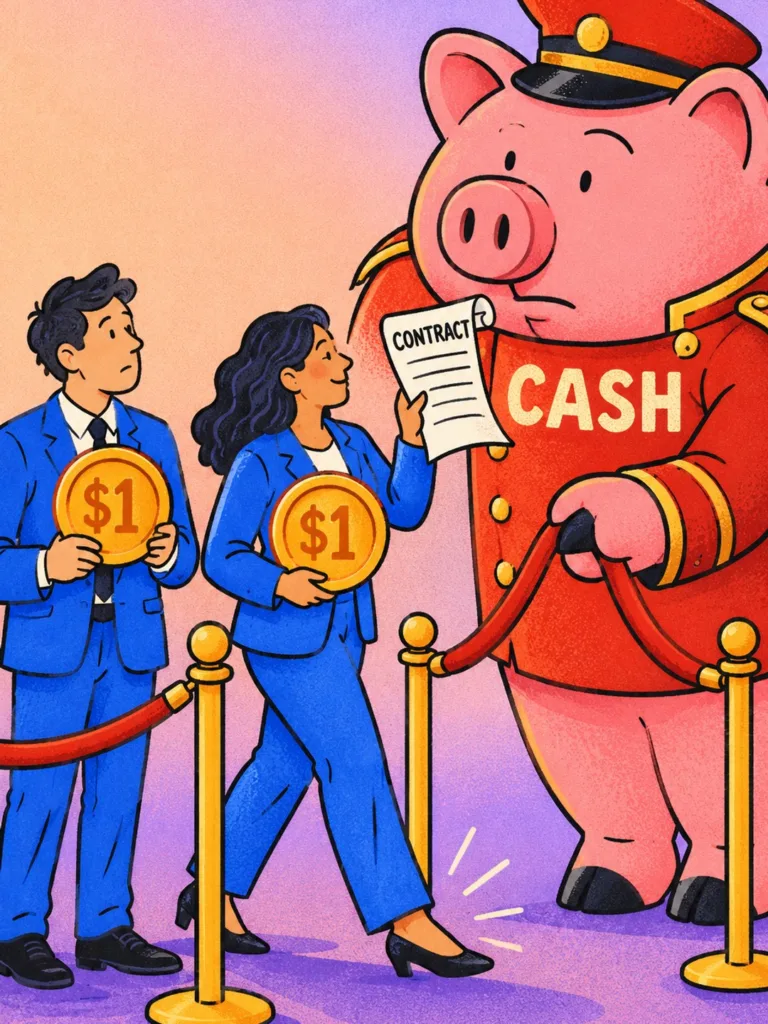
But the real point lies elsewhere. The proposal looks at the contract, not the coin. Even with the same coin, a company that has no right to redeem it directly with the issuer for dollars, and can only get dollars by selling it in the market, would find it hard to count as a cash equivalent.
- What does the proposal change?
A cash equivalent is a short-term asset that can be turned into a known amount of cash right away and barely changes in value. U.S. Treasury bills with an original maturity of three months or less and money market funds (funds that invest in short-term debt) are typical examples. The FASB proposal does not change this definition; it adds examples for judging whether a stablecoin meets it.
According to Cointelegraph, under current practice even coins fully backed by dollars may not count toward a company's reported cash reserves. That affects liquidity ratios (how much ready money a company has against debts coming due soon) and loan covenants (financial conditions a borrower must meet). Think of it this way: the balance in your bank account counts as cash, but gift cards in a drawer do not.
- What conditions must a stablecoin meet?
The proposal sets out three conditions, as summarized by the accounting firm Deloitte. First, the holder must have a contractual right to exchange the coin for cash from the issuer whenever it chooses, without significant fees. Second, the holder must be able to redeem directly with the issuer, without going through an intermediary such as an exchange or a market maker (a firm that always posts prices to buy and sell).
Third, the issuer must keep reserves at least equal to the coins in circulation (one-to-one or more), held separately in short-term, highly liquid assets. An example in which reserves consisted of crypto assets and gold did not qualify. The three conditions are weighed together, not one by one.
- Why can the same coin get different answers?
Here is the proposal's example. A company holds 100 units of a $1 stablecoin and expects to be able to sell them in the market for about $1 each. Even so, without a contract to redeem directly with the issuer, they are not cash equivalents.
The reason is the intermediary. Redeeming through an exchange adds that firm's credit risk, and the FASB described this as a "chain of contractual relationships" that makes conversion to cash less certain. Deloitte noted that many issuers offer direct redemption only to a small number of exchanges and market makers. So different companies can reach different conclusions about the same coin.
To use an analogy, it is the difference between a gift card the department store has agreed to cash out at its counter and one you have to sell secondhand to get money. Under the proposal's example, a company holding $1 million (about KRW 1.3 billion) of the same dollar coin would find it hard to record it as a cash equivalent without a direct redemption contract. Even a company with such a contract must meet the other conditions too.
- How has Coinbase already recorded it?
According to a report from Tempo, a blockchain backed by payments company Stripe, U.S. crypto exchange Coinbase classified USDC (the dollar coin issued by Circle) and other payment stablecoins as cash equivalents in its 2025 annual report. The basis was its redemption arrangement with Circle.
Tempo said, "Your contract with the issuer is what qualifies, and the token alone doesn't get you there," adding that buying USDC through an exchange would not necessarily let a company classify it as a cash equivalent.
- Where does the money move?
Cointelegraph said the proposal could let companies use stablecoins for payments and settlements without accounting complications. U.S. accounting firm CBIZ said issuers may face more pressure to demonstrate the quality and liquidity of their reserves.
The GENIUS Act, passed in July 2025 as the first comprehensive U.S. federal framework for payment stablecoins, puts reserve and redemption obligations on issuers. The FASB proposal deals with the books of companies that hold those coins. The proposal is not final. Comments are open until Nov. 19, and no effective date has been set. Even when the conditions are met, a company can choose whether to present the coins as cash equivalents.
- BITPRESS Insight
This proposal is better read as a standard that sorts $1 coins into grades than as a simple "win for stablecoins." Being able to sell for $1 is not the same as having the right to get $1 back.
So companies that use dollar coins, and investors following stablecoin news, gain a way to tell them apart. If the proposal is finalized, whether an issuer gives companies a direct redemption contract, and what its reserves are made of, will decide whether its coin gets cash treatment on a company's books.
Dollar coins make more sense when you sort them not by "is it pegged to $1?" but by "who is obliged to pay the $1 back, and to whom?"
Sources
https://cointelegraph.com/news/fasb-stablecoin-accounting-rules-corporate-adoption
https://dart.deloitte.com/USDART/home/publications/deloitte/heads-up/2026/fasb-proposes-enhancements-disclosures-cash-equivalents-clarifications-evaluation-certain-digital-as
https://www.cpapracticeadvisor.com/2026/08/18/fasb-proposal-could-shape-how-stablecoins-are-classified-as-cash-equivalents/188734/
https://www.ecb.europa.eu/stats/eurofxref/eurofxref-hist-90d.xml
Glossary
Cash equivalent — Short-term assets that can be turned into a known amount of cash right away and barely change in value; companies report them together with cash.
Stablecoin — A coin issued to track the value of a currency such as $1, with the issuer holding reserves to match.
Redemption right — The right to hand a coin back to the issuer and receive its value in dollars.
Reserves — Assets such as cash and Treasury bills that an issuer holds so it can pay out dollars when coins are redeemed.
Market maker — A firm that always posts prices to buy and sell so that trading does not dry up.
BITPRESS articles are information to help your investment decisions, not a recommendation to buy or sell any stock or coin. Investment decisions and their results are your own responsibility.