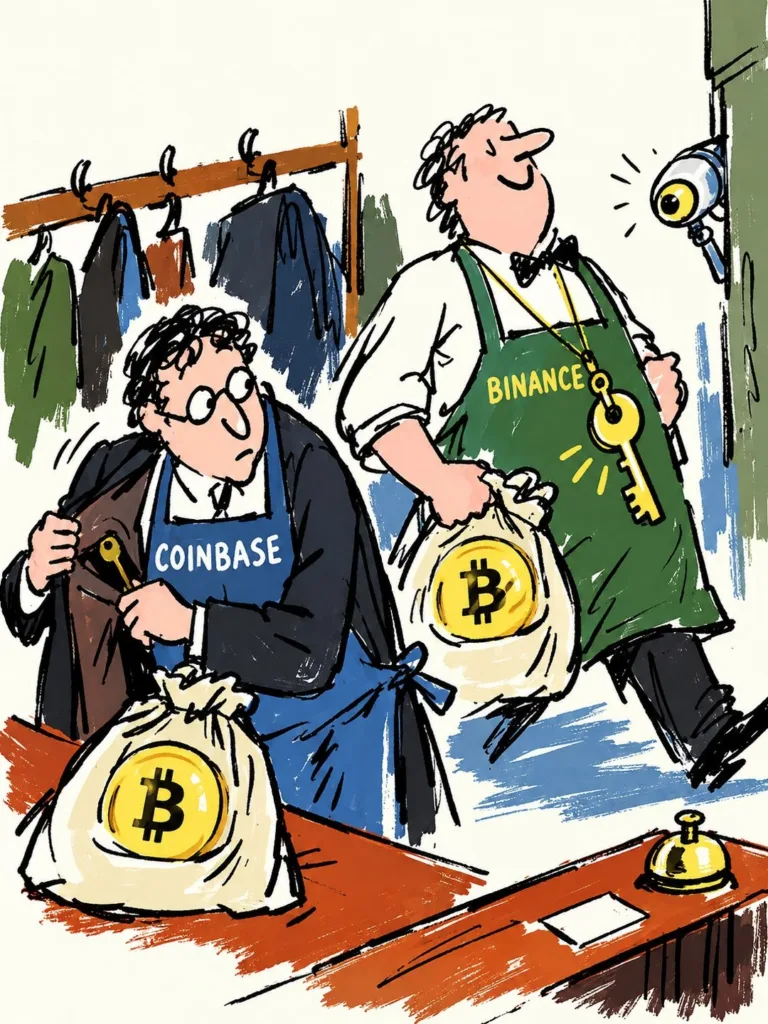
Data from blockchain analytics firm Glassnode, reported Oct. 8, show that 83% of the bitcoin held by Binance, the world's largest crypto exchange, sits at addresses whose “public key” is already exposed. At Coinbase, a US-listed exchange, the figure is 10%. A day earlier, Ethereum Foundation researcher Justin Drake warned that AI could find a shortcut to cracking crypto wallet security and called for preparing a “bunker mode.”
Some in the industry push back that this is overblown fear, and no such attack has ever been confirmed. But the real story lies elsewhere: two exchanges, one first in trading volume and the other first in an influence ranking, store the same bitcoin in very different ways.
- Where do the two companies rank in the world?
According to CoinDesk Data, Binance ranked first in global spot trading (buying and selling coins outright, on the spot) in April, with a 24.2% market share. It traded $255 billion (about KRW 345 trillion) that month. Coinbase ranked third with $48 billion and a 4.64% share.
Influence tells a different story. In the exchange-and-custodian category of the Fortune Crypto 100 (a ranking of the most influential crypto companies), published in June by the US business magazine Fortune, Coinbase ranked first and Binance second. Put simply, Binance is the shop with the most customers, while Coinbase came out ahead in the industry's assessment of influence.
- How much money do the two companies make?
As a US-listed company, Coinbase reports results every quarter. Revenue in the second quarter (April-June) was $1.22 billion (about KRW 1.65 trillion), down 19% from a year earlier, and its net loss was $360 million (about KRW 486 billion). A year earlier it had net income of $1.43 billion. It has now posted losses for three straight quarters, starting with the fourth quarter of last year.
Transaction fees brought in $599 million, and subscription and services revenue, such as stablecoin income, brought in $555 million, or 48% of net revenue. It is like a household with rental income on top of a paycheck: even when customers trade less, money from the assets it holds covers nearly half. But that income also rises and falls with coin prices and interest rates.
Binance is not listed and does not publish regular financial results. In August 2024, CEO Richard Teng said it had “been profitable since the fifth month of operation” and that there was no need to go public. The company says it handled $34 trillion in trading in 2025 and has 300 million registered users.
- What does an exposed public key mean?
A Bitcoin wallet has a secret number called a private key and a matching public key. The private key approves payments, and the network uses the public key to check that the approval is real. Working backward from a public key to the private key is a calculation that is practically impossible for today's computers.
Think of it as a lock and key. The public key is the lock and the private key is the key. Unlike a real lock, though, most Bitcoin addresses keep the lock hidden at first, and the public key is recorded on the blockchain the moment money is sent from that address.
Drake's worry is that AI finds a shortcut for that calculation. In the worst case, he said, it could come “in months, not years.” Quantum computers (next-generation computers) are seen as the same kind of risk. Either way, the starting point of an attack is a public key that is already exposed.
- Why did it split 83% vs. 10%?
A major way public keys get exposed is using one address many times. If an address receives money several times and then sends some of it, the public key is recorded, and the remaining balance sits behind an exposed lock. Glassnode's May report found that about 40% of the 4.12 million bitcoin exposed this way belongs to exchanges.
Think of package lockers: one side keeps using the same locker and shows its code every time it opens it, while the other moves to a new locker each time. But this is only an analogy guessed from the ratios; the companies have not disclosed how they run their wallets. In its May report, Glassnode said these figures reflect custody design choices and are not a risk ranking.
Here is a summary in one table.
| Item | Binance | Coinbase |
|---|---|---|
| Company | Not listed, no regular financial results | US-listed, quarterly results |
| Global spot trading rank (April) | 1st, 24.2% share | 3rd, 4.64% share |
| Fortune Crypto 100 (June) | 2nd | No. 1 |
| Earnings | Figures not disclosed; CEO: “profitable since the fifth month” (2024) | Q2 revenue $1.22 billion, net loss $360 million |
| Customer assets (company figures; dates and definitions differ) | $162.8 billion (end of 2025, company figure) | $246 billion (end of June 2026) |
| Share of held bitcoin with exposed public keys (Oct. 8) | 83% | 10% |
- So is it dangerous right now?
Nothing has been broken yet. CoinDesk reported that no attack that actually cracked crypto wallet keys has been confirmed. Yehuda Lindell, head of cryptography at Coinbase, pushed back, saying there is “no evidence whatsoever” that the assumptions behind wallet cryptography have weakened.
But the exposed share is growing. Exposed bitcoin has risen by 222,000 coins since May to more than 6 million, or 31.2% of circulating supply. Ethereum co-founder Vitalik Buterin said the risk is real, but warned against rushing, noting that he personally has lost more money in botched wallet migrations than in all hacks combined.
- BITPRESS Insight
The people whose decisions change with this news are those who keep bitcoin on an exchange. Until now, people picked exchanges by fees and trading volume. This data shows that even among the biggest exchanges, the way coins are stored can differ by more than eight times.
Across each company as a whole, a little over 8 of every 10 bitcoin Binance holds sit behind an exposed public key, versus 1 in 10 at Coinbase (Oct. 8 data, illustrative calculation). The difference is invisible today, but if a shortcut appears, this ratio is the share that could become an attack's starting point.
One rule of thumb: the exchange with the most trading is not necessarily the one exposing the fewest locks. Trading-volume rankings and storage practices should be judged separately.
Sources
https://www.coindesk.com/markets/2026/10/08/over-6-million-bitcoin-sit-behind-exposed-public-keys-as-ai-warnings-mount
https://www.coindesk.com/tech/2026/10/08/bitcoin-and-ether-holders-urged-to-prepare-bunker-mode-against-possible-ai-attacks
https://decrypt.co/368721/nearly-500b-bitcoin-exposed-future-quantum-computing-attacks-glassnode
https://crypto-economy.com/crypto-industry-splits-over-justin-drakes-ai-ecdsa-warning/
https://www.sec.gov/Archives/edgar/data/0001679788/000167978826000087/q226earningsdeck_sec.htm
https://cdn.prod.website-files.com/6704e1ce67bb87e211a44c06/6a1030d3a4ef35b03219ab25_Exchange%20Review%20April%202026%20(2).pdf
https://fortune.com/ranking/crypto/
https://www.coindesk.com/policy/2024/08/21/new-binance-ceo-sees-no-need-for-ipo-as-he-plots-100-year-strategy-for-crypto-exchange
https://m.thewire.in/article/ptiprnews/binances-2025-end-of-year-report-trust-liquidity-and-web3-discovery
https://finance.yahoo.com/news/binance-says-user-hits-300m-130112048.html
https://www.newspim.com/news/view/20260930001065
Glossary
Public key — A number that lets anyone check whether a wallet's payment approval is real; it works like a lock.
Private key — A secret number only the wallet owner knows; whoever has it can send that wallet's coins.
Address reuse — Receiving and sending money with the same Bitcoin address more than once; after the first send, that address's public key stays on the blockchain.
Subscription and services revenue — Money Coinbase earns outside trading fees, such as stablecoin income, interest and blockchain rewards.
Quantum computer — A next-generation computer expected to perform certain calculations far faster than today's computers.
BITPRESS articles are information to help your investment decisions, not a recommendation to buy or sell any stock or coin. Investment decisions and their results are your own responsibility.