On Oct. 7, gold in London fell below $4,100 an ounce (about 31 grams), the first time since Aug. 5. That is about 27% below its record of $5,595, set in January. Meanwhile, the US-Iran war has entered its eighth month, and Brent crude, the global oil benchmark, was up about 70% this year as of late September.
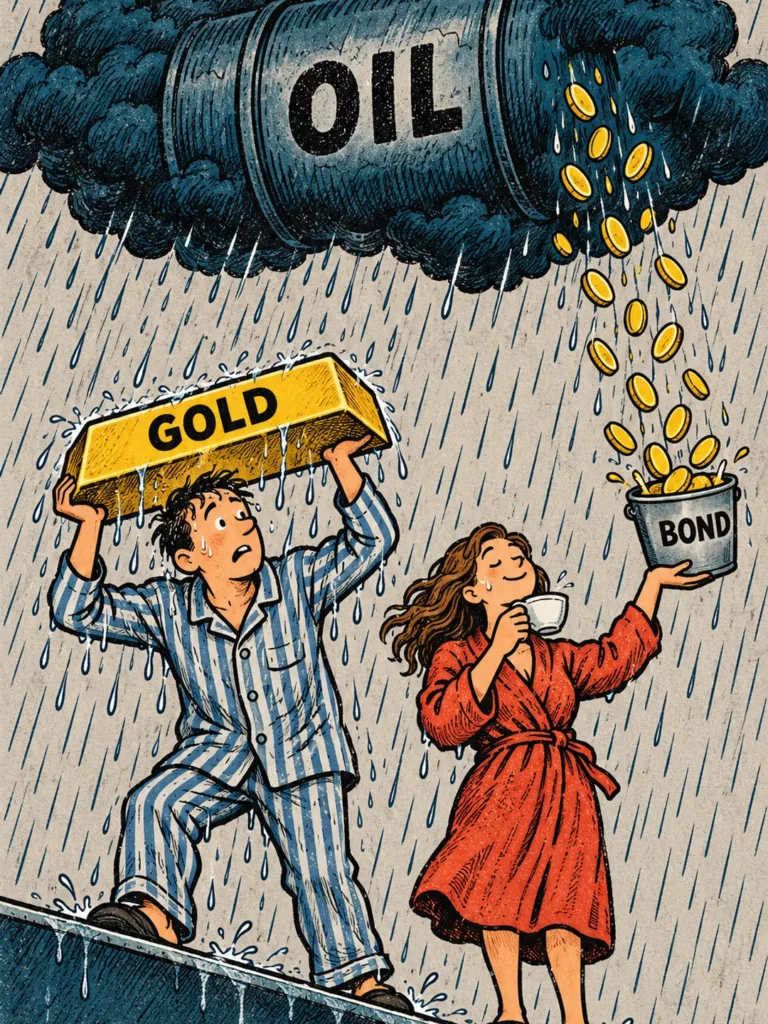
Conventional wisdom says gold, a safe haven, rises when war breaks out. But the likeliest reason market analysts point to is not the war itself, but the interest rates that rose after it. The path runs: oil prices → inflation → US rate hikes → a disadvantage for gold, which pays no interest.
- Did gold really rise when the war broke out?
Briefly, yes. On March 2, right after the weekend in which the US and Israel struck Iran, gold futures climbed as high as $5,400 an ounce. The record had come in January, before the war, but that day gold was back within about $200 (about 3.5%) of it. In other words, most of the decline so far has come after the war began.
JPMorgan, the US bank, said such crisis premiums "can be sharp but hard to sustain." The gains indeed did not last. In March, the war's first month, gold fell 14.5%. The same month, the S&P 500, America's benchmark stock index, fell 7.8% and US Treasuries fell 3.6%. Gold, which should fall less in a crisis, fell more than stocks.
- How did oil prices turn into higher interest rates?
March's slide came before the US raised rates. Amy Gower, a commodity strategist at US investment bank Morgan Stanley, said the conflict triggered "an energy supply shock that has reduced hopes for lower U.S. interest rates," so it was not surprising that gold struggled to work as a safe haven. Hopes for rate cuts faded first; the actual hike came in September.
A standoff over the Strait of Hormuz (a narrow oil shipping lane at the mouth of the Persian Gulf) kept energy prices high. On Oct. 7, Brent crude was about $102 a barrel.
The Federal Reserve, America's central bank, wrote in the minutes of its September meeting that geopolitical events pushed up prices for crude oil and fuel. The personal consumption expenditures (PCE) price index, the Fed's preferred inflation gauge, rose 3.8% from a year earlier in August, and core inflation, which excludes energy and food, was 3.4%. The Fed's target is 2%.
On Sept. 16, the Fed's 12 voting members unanimously raised the benchmark rate by 0.25 percentage point, to 3.75% to 4%. Most meeting participants saw another increase by year-end as likely appropriate. On Oct. 7, the 10-year US Treasury yield rose as high as 5.36%. The 30-year yield hit 5.72%, its highest since June 2002. Put simply, the interest you earn by lending to the US government has risen sharply.
- Why did gold, which pays no interest, lose out?
Gold pays no interest while you hold it. Put $10,000 in a 10-year US Treasury and you collect about $536 a year in interest alone; hold gold and you get $0 (ignoring bond price changes, an illustrative calculation). The higher rates go, the more interest you give up by holding gold.
It is like leaving a spare room empty when you could rent it out. The higher rents rise, the more the empty room costs you. The difference is that gold can make up for that loss if its price rises.
In May, Gower said, "Gold's sensitivity to monetary policy has taken over as the key price driver," adding that "gold prices reflect not just the impact of a particular event but, more importantly, the policy response that follows." She warned that gold could suffer if markets began to anticipate prolonged rate holds or even hikes.
- Were there days when gold followed that path?
Yes. On June 29, when renewed US-Iran tensions lifted crude prices, gold fell 1.7%. Conversely, on July 27, when a pause in strikes sent Brent down more than 8%, gold rose 0.5%. Khasay Hashimov, an Investing.com contributor, read this as peace headlines weakening the case for Fed rate hikes.
In May, Morgan Stanley Research forecast that gold could rise to $5,200 in the second half, assuming central banks and ETFs resumed buying and the Fed held rates for the rest of the year. The rate-hold assumption broke with the September hike, and on Oct. 7 gold was around $4,100. The forecast period isn't over, but so far gold has moved the opposite way.
- How much can public data explain?
Rates aren't the only reason. In the war's first month, Turkey's central bank sold 52 tons of gold, and gold exchange-traded funds (ETFs) sold about 90 of the 150 tons they had bought in January and February. On Oct. 7, the dollar was also near its strongest level of the year. A strong dollar makes gold more expensive in other currencies, which cuts demand.
We could not find public data splitting how much of the 27% came from rates, the dollar and the selling. Whether the Fed will actually raise rates again by year-end is not settled either; the Fed said future decisions would depend on incoming information. What public data confirms is the path analysts identified, and that there were days when gold moved along it.
- BITPRESS Insight
The people whose judgment this news should change are those who bought gold as crisis insurance. The likeliest reason gold fell in this war was not the war news itself but the US interest rates that rose after it. When oil fuels inflation, rates rise, and when rates rise, gold, which pays no interest, loses out.
$10,000 of gold bought at January's record would be worth about $7,330 now (an illustrative calculation). Even an asset bought as crisis insurance can lose value in the middle of a crisis.
When crisis news makes you think of gold, one question matters: is this a crisis that pushes inflation and interest rates up, or down?
Sources
https://finance.yahoo.com/markets/commodities/articles/gold-declines-hormuz-impasse-keeps-235920982.html
https://www.bullionvault.com/gold-news/gold-price-news/gold-silver-bond-yields-debt-100720261
https://www.federalreserve.gov/monetarypolicy/fomcminutes20260916.htm
https://www.investing.com/news/stock-market-news/gold-holds-near-nineweek-low-as-hormuz-tensions-raise-fed-hike-bets-4937808
http://www.kitco.com/news/article/2026-10-07/gold-silver-slide-yields-rise-fed-minutes-10-year-auction-kitco-am-report
https://www.morganstanley.com/insights/articles/gold-prices-safe-haven-status-reality-check-iran-conflict
https://finance.yahoo.com/news/gold-touches-5400-as-demand-for-safe-haven-asset-jumps-amid-iran-conflict-102241256.html
https://www.investing.com/analysis/why-war-hurt-gold-at-first–and-why-the-safehaven-trade-is-back-200684885
https://en.sedaily.com/finance/2026/10/06/gold-prices-tumble-26-percent-from-january-record-as-us
Glossary
Brent crude — Crude oil from the North Sea off Britain, used as the benchmark for global oil prices.
PCE inflation — An inflation gauge based on what Americans actually spend, and the one the Fed watches most closely.
Benchmark rate — The rate set by a central bank, which loan, deposit and bond rates tend to follow.
Treasury yield — The interest rate a government pays to borrow; when it rises, buyers of government bonds earn more.
Gold ETF — A fund that buys and stores gold and lets investors trade shares of it like a stock.
BITPRESS articles are information to help your investment decisions, not a recommendation to buy or sell any stock or coin. Investment decisions and their results are your own responsibility.