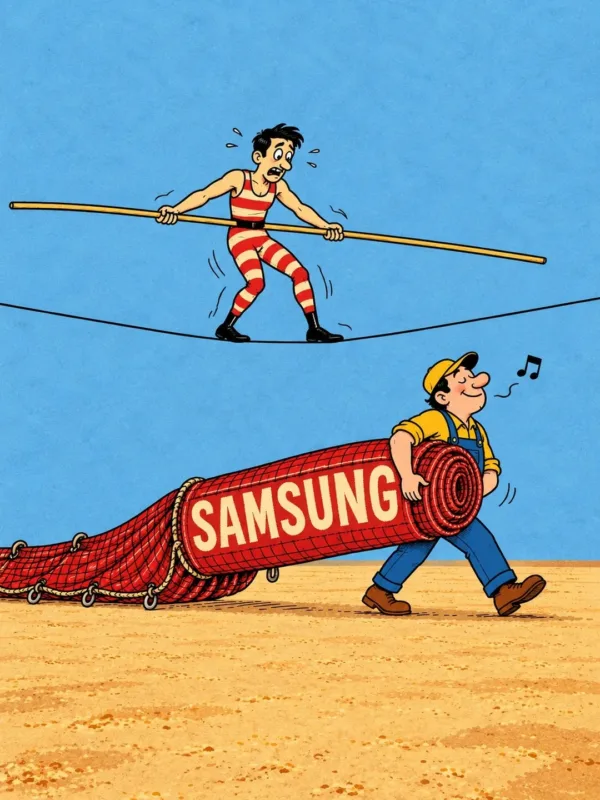

Broadcom (a US chip company that designs Google's AI chip, the TPU, together with Google) has agreed to lend Anthropic (the US company behind the AI chatbot Claude) up to $42 billion, or about KRW 57 trillion. The terms were reported on Oct. 1 from the prospectus (the official document in which a company tells investors about its business, finances and risks) that Anthropic prepared ahead of its stock market listing. Won figures are simple conversions at the Oct. 2 rate of KRW 1,350.6 per dollar.
The common reading is that the AI boom is still running hot. The same week, banks working for Broadcom also began raising $60 billion (about KRW 81 trillion) to fund chips for AI companies.
But the real point lies elsewhere. Anthropic has committed to renting $125.2 billion (about KRW 169 trillion) of TPU computing capacity over five years, and this loan ceiling is about a third of that. The seller of the chips is also putting up the buyer's money.
- Has the KRW 57 trillion already changed hands?
The $42 billion is not money already handed over but a ceiling Anthropic can draw on (a credit line). Think of it like an overdraft line on a bank account: the limit is open, but only what is actually drawn becomes debt. The difference is that this debt is a convertible note (debt that can be turned into shares on set terms), so if Anthropic does well, Broadcom could end up a shareholder.
The interest rate and the price at which the debt converts into shares have not been disclosed. Anthropic wrote in its prospectus that it does not expect the notes to be sold before its listing is complete.
The $60 billion is money several banks are raising together (a syndicate). It is split into $42 billion of senior debt, repaid first, and $18 billion of junior debt, repaid later, with US private equity firm Blackstone putting in $9 billion of the junior portion directly. The $42 billion senior piece was reported to be tied to Anthropic's funding for leasing Broadcom chips, but the exact flow of money has not been disclosed.
- Why would a chip company lend its customer money?
Start with the path of the money. Anthropic rents TPU computing capacity and pays rent for it. Broadcom also acts as the lessor (the party renting it out) for the capacity Anthropic leases. So if the money Broadcom lends is spent on rent, it can come back to Broadcom as revenue.
Broadcom CEO Hock Tan said on its Sept. 2, 2026 earnings call that he expects Anthropic to become Broadcom's largest custom AI chip customer (a chip designed to one customer's order) in 2027. US investing outlet 24/7 Wall St. named the loan's strongest rationale as turning expected orders into contracted demand.
Think of a carmaker whose finance arm lends buyers the money for a car. The difference is that car loans are spread across many buyers, while this is up to KRW 57 trillion to a single customer.
- Rival Nvidia went down this road first
Nvidia (a US chip company that competes with Broadcom in AI chips) has also been funding its customers. It has committed up to $100 billion to OpenAI (the maker of ChatGPT).
Seaport Research analyst Jay Goldberg said, "Nvidia is using its balance sheet on a massive scale, so Broadcom has to follow suit." It is like a shop matching the store next door once it starts offering interest-free installments. 24/7 Wall St. noted that matching a rival's financing protects market share but reveals little about loan underwriting standards.
- How big is KRW 57 trillion for Broadcom?
Broadcom held $24 billion in cash at the end of its fiscal third quarter (the third three-month period of the company's own accounting year). The loan ceiling is about 1.75 times that cash (BITPRESS calculation). It is like promising to lend more than you have in your wallet: if the full ceiling is drawn, outside funding is needed (BITPRESS view).
Free cash flow in the same quarter (cash earned from operations minus spending on equipment and facilities) was $13.7 billion, so the loan ceiling equals roughly three quarters' worth (BITPRESS calculation). Put simply, it would take close to nine months of the cash Broadcom has left over each quarter to fill it.
- What risks did Anthropic itself disclose?
Anthropic wrote in its prospectus that because Broadcom is both its chip supplier and its lender, there is a "potential conflict of interest" (when the interests of two roles held by one company clash). According to CNBC, the filing also says Broadcom's pricing and equipment supply decisions could hurt Anthropic's capacity expansion. It is as if the landlord were also the tenant's bank.
The bigger link is a breach of terms. If Anthropic misses a payment or breaks the contract's conditions, a large share of its lease obligations could come due at once, and at the same time its access to the $42 billion credit line could be cut off. The emergency funding channel would close just when money is needed most.
Broadcom carries risk too. If Anthropic stumbles, Broadcom could lose both the chip revenue and the money it lent. Broadcom has listed its reliance on a small number of large customers among its own risk factors.
- BITPRESS Insight
If you own Broadcom shares, part of its future revenue could come from money Broadcom itself lent. If Anthropic pays the rent with money it earns from its business, the loan is a tool that brought sales forward. If it pays only with borrowed money, loans that may never be repaid pile up behind that revenue (BITPRESS view).
Someone who pays a credit card bill from their salary and someone who covers it with a card loan pay the same amount this month, yet their situations are completely different. A chip company's revenue works the same way.
So when you hear that an AI chip company's revenue is growing, hold it up to one test: did the customers pay with money they earned, or with money they borrowed?
Sources
https://finance.yahoo.com/technology/ai/articles/broadcom-raises-60-billion-debt-113047288.html
https://dataconomy.com/2026/10/02/broadcom-anthropic-60-billion-usd-ai-chip-debt/
https://www.investing.com/news/stock-market-news/broadcom-starts-amassing-60-bln-to-fund-chips-for-anthropic-bloomberg-4928882
https://finance.yahoo.com/technology/article/broadcom-to-lend-anthropic-up-to-42-billion-to-lease-chips-in-latest-circular-investing-deal-121617505.html
https://finance.yahoo.com/markets/stocks/articles/broadcom-lending-one-biggest-customers-121237103.html
https://finance.yahoo.com/markets/stocks/articles/broadcom-stock-jumps-following-reported-124437812.html
https://finance.yahoo.com/technology/ai/articles/broadcom-42-billion-loan-anthropic-073843155.html
https://startupfortune.com/broadcom-agreed-to-lend-anthropic-up-to-42-billion-ahead-of-its-ipo/
https://www.news1.kr/finance/market-exr/6309176
Glossary
Convertible notes — Debt that the lender can turn into the borrower's shares at a set price, so the lender becomes a shareholder if the company does well.
Senior and junior debt — The order in which lenders get repaid if the borrower cannot pay; junior lenders are repaid later but earn more interest in return.
TPU — A chip Google built for AI computing, co-designed with Broadcom; Anthropic leases computing capacity on these chips.
Prospectus — The official document a company files before its stock market listing to tell investors about its business, finances and risks.
Free cash flow — The cash a company earns from operations minus what it spends on plants and equipment, an accounting figure that shows its room to repay or lend.
BITPRESS articles are information to help your investment decisions, not a recommendation to buy or sell any stock or coin. Investment decisions and their results are your own responsibility.