



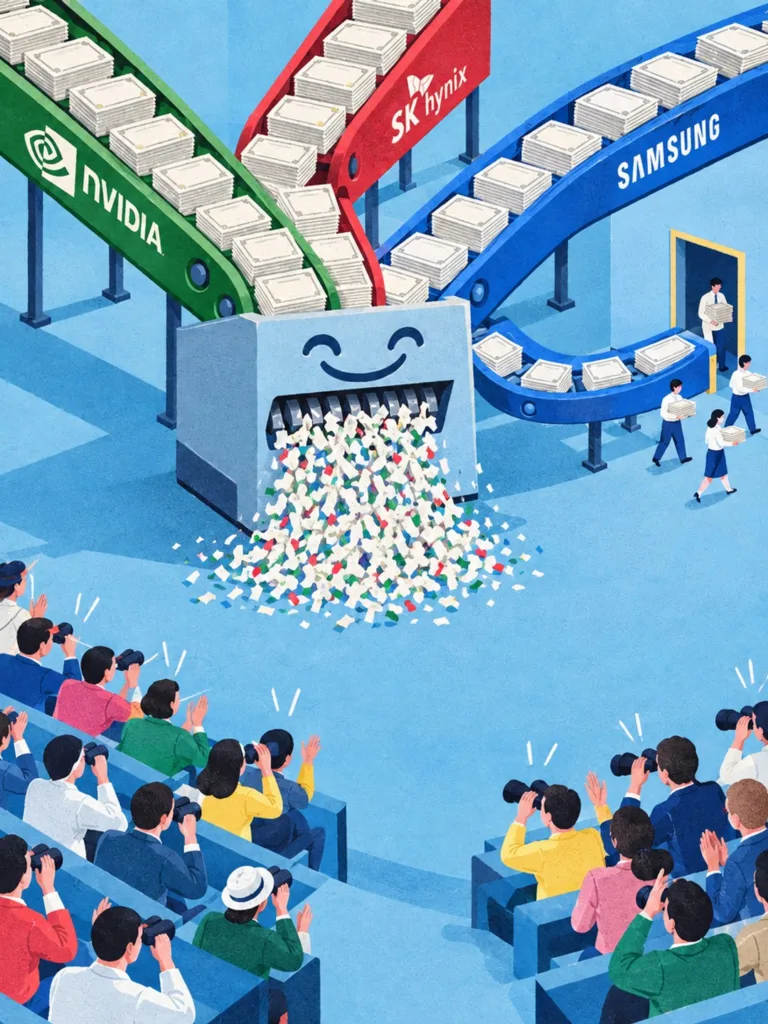
Nvidia (the top US maker of AI chips) raised its share buyback authorization by $150 billion (about 204 trillion won) on Sept. 28 (local time). That is more than the $110 billion Apple announced in May 2024, and it lifts Nvidia's remaining buyback authorization to $235 billion (about 320 trillion won).
Looking only at the numbers, it is easy to stop at "American companies think big." But what matters to shareholders is not the authorization. It is what share of profit actually gets spent, and whether the repurchased shares are eliminated (retired).
Apply the same yardstick to Samsung Electronics and SK hynix and the result is not what you might expect. On a planned basis SK hynix's ratio is bigger than Nvidia's, and the shares Samsung Electronics is buying this time go to employee compensation, not retirement.
- Nvidia wipes out its shares with $1 of every $3 it earns
In its annual report for the year ended January 2024, Nvidia said any shares it repurchases in the future will assume the status of "authorized and unissued" shares. In other words, it does not stack them in a vault; it erases them from the books, which in Korean terms is retirement. Its latest annual report (year ended Jan. 25, 2026) likewise shows issued and outstanding shares both at 24.304 billion, meaning no treasury shares are left.
The spending is steady, too. In the second quarter (Apr. 27-Jul. 26, 2026) it bought 94 million shares for $19.7 billion, while net income for the quarter was $59.69 billion. In the previous fiscal year (Jan. 27, 2025-Jan. 25, 2026) it spent $40.4 billion of its $120.07 billion net income on buybacks.
Put simply, not just for one quarter but all year long, Nvidia has been buying and eliminating its own shares with about a third of its profit.
- Actual spending is similar; on plan, SK hynix is bigger
The comparison is set as "buybacks over three months relative to the latest quarter's net income." The two Korean companies' buybacks started in late August on roughly three-month schedules, close to the length of one Nvidia quarter.
On Aug. 19, SK hynix announced it would buy KRW 40 trillion of its own stock (about 24.07 million shares, about 3.3% of shares outstanding) by an original deadline of Nov. 19 and retire all of it. It is the largest share retirement by a Korean listed company. On a planned basis that is about 43% of its Q2 net income of KRW 93.9226 trillion, above the roughly 33% Nvidia actually spent. Counting only the KRW 28.8388 trillion it had actually bought by Sept. 28, it is about 31%, similar to Nvidia.
On Aug. 21, Samsung Electronics decided to buy about KRW 15 trillion of its stock by an original deadline of Nov. 21. That is about 21% of its Q2 net income of KRW 71.6245 trillion. Note that SK hynix's net income was about KRW 33 trillion higher than its operating profit (KRW 60.5426 trillion); measured against operating profit, KRW 40 trillion is about 66%.
- Samsung's KRW 15 trillion is not for retirement
The real difference is what the shares are for. The shares Samsung Electronics is buying this time are for employee stock compensation. Since they are not retired, the total share count does not shrink.
Samsung Electronics does retire shares. On April 2 this year it retired about 86.95 million shares it had bought last February and July. But this buyback is not meant for retirement to begin with.
The shareholder return plan approved the same day is expected to total KRW 90-110 trillion this year. First, it plans a cash dividend of about KRW 30 trillion in the third quarter, with the exact amount to be set by the board in late October. Whether the rest is paid as dividends or used to buy back and retire shares will be decided by the board next January. As of an Aug. 25 report, SK hynix shares had risen 14% since the announcement, while Samsung Electronics had fallen more than 9%.
- Why can't Samsung simply retire its shares?
Ownership structure is in the way. Samsung Life Insurance, which owns 8.5% of Samsung Electronics, and Samsung Fire & Marine Insurance, which owns 1.5%, are subject to the "10% rule" of Korea's financial-industrial separation law (a finance affiliate needs Financial Services Commission approval to hold more than 10% of the voting shares of a company in the same group).
When Samsung Electronics retires shares, the total share count falls and the two insurers' stakes rise automatically, so analysts say they must sell the portion above 10%. In March this year the two companies sold Samsung Electronics shares in a block deal (a single large sale) to trim the excess.
SK hynix is the opposite. Its largest shareholder, SK Square, is a holding company that must keep at least 20% of SK hynix, and retiring shares raises that stake, which actually helps. The same retirement is a burden for one and a help for the other.
- When the buybacks end, the price support may weaken
The two companies' buybacks have been propping up their stock prices. By Sept. 28, Samsung Electronics had bought KRW 12.5288 trillion since Aug. 24 (89.7% of the planned share count) and SK hynix KRW 28.8388 trillion since Aug. 20 (68.76%). Over each buyback period, foreign and retail investors net sold KRW 39.3035 trillion of the two stocks.
Most of the buying by "other corporations" (companies other than individuals, foreigners and institutions) that absorbed those shares came from the buybacks (about 95.5% at Samsung Electronics, about 97.2% at SK hynix). Put simply, when sellers flooded in, the companies themselves took most of the shares.
At the current pace, analysts say Samsung Electronics could finish buying around Oct. 1 and SK hynix around mid-October. Unless new buybacks are announced, this steady buying may weaken after that.
- BITPRESS Insight
In buyback news, the amount is only half the information. You need the ratio to profit and whether the shares are retired to know whether each share you own gets a bigger slice.
Nvidia is a company that steadily spends a third of its profit on retirement. SK hynix plans to retire a larger ratio this time, but it will announce any further returns at its Q3 earnings after a board resolution, so its consistency is not yet proven. Samsung Electronics' KRW 15 trillion was buying that propped up the stock, but it was not money that reduces the share count.
So for Samsung Electronics shareholders, the expected payout of up to KRW 110 trillion is still only half a story. If only dividends grow, each share's slice stays the same; it grows only if retirement is added. Buying back shares without eliminating them does not enlarge shareholders' stake.
Sources
https://nvidianews.nvidia.com/news/nvidia-announces-a-150-billion-share-repurchase-authorization-increase
https://www.fnnews.com/news/202609291819311979
https://www.sec.gov/Archives/edgar/data/0001045810/000104581026000073/q2fy27pr.htm
https://www.sec.gov/Archives/edgar/data/0001045810/000104581026000075/nvda-20260726.htm
https://www.sec.gov/Archives/edgar/data/1045810/000104581026000021/nvda-20260125.htm
https://www.sec.gov/Archives/edgar/data/1045810/000104581024000029/nvda-20240128.htm
https://www.fnnews.com/news/202608191552137327
https://news.skhynix.co.kr/q2-2026-business-results/
https://www.jabon.co.kr/news/articleView.html?idxno=5408
https://www.inthenews.co.kr/news/article.html?no=89947
https://www.ytn.co.kr/_ln/0102_202608212146353812
https://www.newsis.com/view/NISX20260331_0003570527
https://www.investchosun.com/site/data/html_dir/2026/08/25/2026082580188.html
https://www.ajunews.com/view/20260929160059090
Glossary
Share retirement — When a company eliminates its own repurchased shares, cutting the total share count so each remaining share owns a bigger slice of the company.
Shareholder returns — A company handing profit back to shareholders through dividends or share buybacks and retirement.
The 10% rule (financial-industrial separation law) — A Korean rule that requires Financial Services Commission approval for a finance affiliate, such as an insurer, to hold more than 10% of the voting shares of a company in the same group.
Block deal — A trade in which a large block of shares is handed over in one go at a set price, usually after the market closes.
Other corporations — In Korean market flow data, ordinary companies that are not individuals, foreign investors or institutions; companies buying back their own stock are counted here.
BITPRESS articles are information to help your investment decisions, not a recommendation to buy or sell any stock or coin. Investment decisions and their results are your own responsibility.





