



Anthropic, the US AI company behind the Claude chatbot, posted a net loss of about $42 billion (about 57 trillion won) for 2025. The figure comes from a draft of its IPO prospectus that Reuters obtained and reported on Sept. 28 (local time). Yet according to Reuters, the company could be valued at more than $2 trillion (about 2,700 trillion won) if it lists. Won figures are converted at the Sept. 29 won-dollar rate of 1,356.7 won.
A 57 trillion won loss, paper losses included, next to a 2,700 trillion won price tag may prompt cries of a bubble. But break the loss down and about 81% of it is a paper loss that involved no cash going out, and that loss arose because the company's value went up. The cash problem is a separate matter: a bill to be paid over several years is written in the same document.
- Eight of every 10 won lost never left as cash
Of the $42 billion net loss, about $34 billion (about 46 trillion won) is a fair-value loss on convertible securities. Convertible securities are investments that give investors the right to swap their money for company shares later. As Anthropic's value rose, the estimated value of the shares it owes those investors rose too, and the increase was booked as a loss. That is about 81% of the net loss ($34 billion ÷ $42 billion, our calculation).
It is like borrowing to open a shop and promising, "I'll pay you back in equity later." The better the shop does, the more that promised stake is worth, and the bigger the debt looks on paper. But no cash left that year.
The loss from running the business itself, the operating loss (revenue minus operating costs such as payroll and computing), was reported at $8.06 billion (about 10.9 trillion won). That is up from $2.98 billion a year earlier. It is also not the same as the year's cash outflow.
- Revenue grew 12-fold in a year, and jumped quarter by quarter this year
Revenue in 2025 was about $4.6 billion, 12 times the prior year's roughly $386 million. According to reports on the draft, revenue in the second quarter of 2026 was $11.5 billion, more than double the first quarter's $4.73 billion. Quarterly and annual revenue cover different periods, but one quarter's revenue is about 2.5 times all of last year (our calculation).
According to reports, the company is expected to be in the black for a second straight quarter through Q2 this year (adjusted operating profit, a company measure that excludes one-off costs and similar items). The operating loss in section 1 is a 2025 result under accounting rules (GAAP), so the two numbers differ in basis and period.
What is cited as grounds for the valuation forecast is this pace of revenue growth (our interpretation). KB Securities calculated that at an assumed $2 trillion valuation, the price-to-sales ratio would be around 30 times the $65 billion annualized revenue run rate (a full year's revenue estimated from the latest pace). The $65 billion is an end-of-July figure Reuters reported citing a source. KB Securities added that AI-related companies such as Palantir already trade at 30 times confirmed revenue or more, but the revenue bases differ, so a direct comparison is difficult.
- $2 trillion is not a settled number yet
$2 trillion is a forecast reported by Reuters, not a fixed offering price. The most recent disclosed valuation is $965 billion (about 1,309 trillion won) from a May funding round, in which Anthropic raised $65 billion in new money.
The prospectus is also a draft that had not been made public as of Sept. 29. According to Reuters, Anthropic confidentially filed for a US listing in June. KB Securities, in its report, described this as a confidential S-1 filing (the prospectus that discloses a company's finances and risks). No official listing date has been confirmed so far. Reuters previously reported that the IPO (the first sale of shares to the general public) is likely to be pushed until after the Nov. 3 US midterm elections. The timing may change.
- The bill is just as big
Anthropic spent $7.33 billion on computing and infrastructure in 2025. That is about three times the prior year and more than half of its $12.65 billion in operating expenses. It has contractually committed about $518 billion (about 703 trillion won) to cloud, computing and infrastructure in the years ahead, and about 80% of that cannot be canceled.
Against that, cash as of Dec. 31, 2025 (including cash equivalents and short-term investments) was $20.28 billion. A multi-year commitment total and a point-in-time balance are different kinds of numbers, but the commitments are about 25 times end-2025 cash (our calculation). Even simply adding the $65 billion raised in May falls far short of the commitments (our calculation).
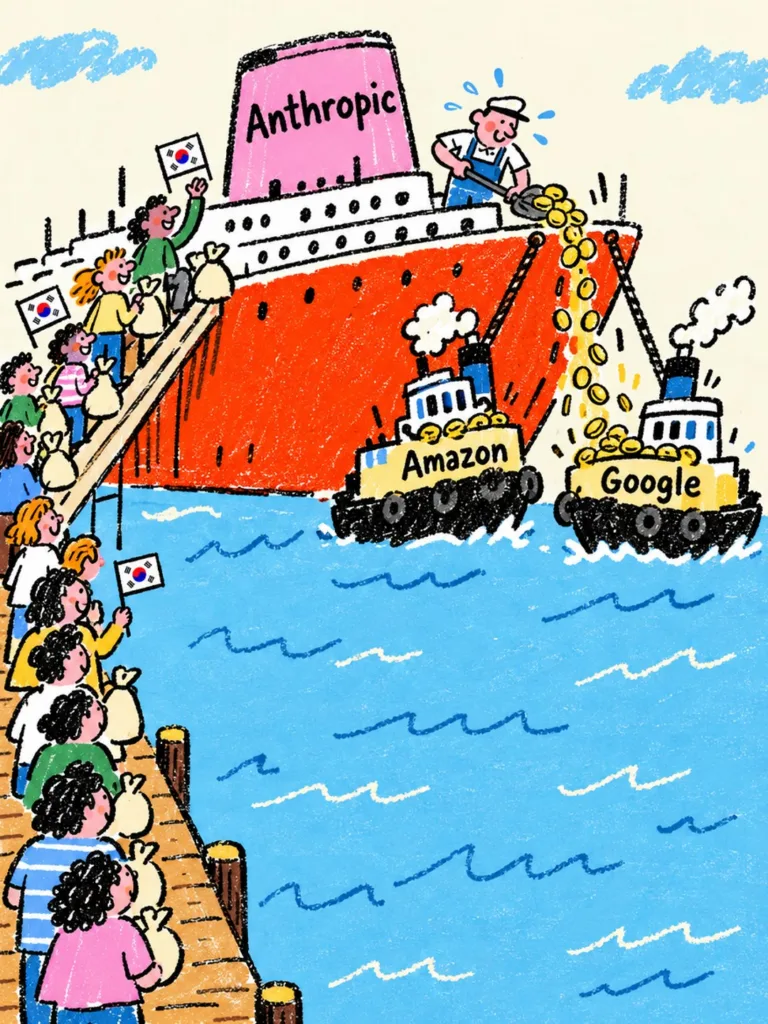
Customer concentration is another risk. The draft warned that about a quarter of last year's revenue came from two customers, and that many large customers have no long-term contracts and could cut or stop spending. According to AI Times, the two customers are Amazon and Google. According to Decrypt, Google accounts for at least $111 billion of the spending commitments and Amazon for $110 billion.
- Why it matters to Korean investors
In a Sept. 4 report, KB Securities analyst Kim Min-gyu said Korean investors' money is likely to flow into Anthropic regardless of how the IPO goes. His reason: Korean investors' direct bets on AI have been largely limited to memory chips, and now the company most exposed to AI demand is listing for the first time.
His evidence is SpaceX. According to the report as cited by Edaily, SpaceX took 97% (a KB Securities figure) of Korean investors' net purchases of US stocks in the month after it listed. The article does not say how that figure was compiled.
KB Securities said a successful listing could soak up flows strongly and give other AI themes a breather. A weak one could spread worries to upstream industries such as cloud and memory chips, but Korean chip stocks had already fallen sharply in July, so a crash below their previous lows is unlikely, it said. Put simply, a hit could give other stocks in the AI theme a pause in buying, while a flop could spread worries to memory chips and similar sectors. Korea's leading memory-chip stocks are Samsung Electronics and SK hynix.
- BITPRESS Insight
Anthropic's 57 trillion won loss is neither proof of a bubble nor a number to ignore. About 81% of it is a paper loss created by the rising valuation.
So read any IPO news about a loss-making AI company in three lines. If much of the net loss involved no cash, it is not as bad as the headline number. If quarterly revenue is growing from the previous quarter, the growth story is intact. If planned spending far exceeds cash, the company must rely on money yet to be earned or raised. On the reported draft, Anthropic gave good answers on the first two and a heavy one on the third.
For Korean investors, the direction of money matters more than the size of the loss. If KB Securities is right, Korean investors, whose direct ways into AI were largely limited to memory chips, gain a new option: the company most exposed to AI demand.
Sources
https://fortune.com/2026/09/29/anthropic-ipo-s-1-prospectus-income-statement/
https://www.aitimes.com/news/articleView.html?idxno=215749
https://decrypt.co/379605/anthropic-lost-42-billion-last-year-wants-ipo-2-trillion
https://finance.yahoo.com/technology/ai/articles/anthropic-ipo-prospectus-2025-revenue-120505564.html
https://investinglive.com/stock-market-update/anthropic-ipo-prospectus-shows-42-billion-2025-loss-and-518-billion-spending-plans/
https://dailycaller.com/2026/09/29/anthropic-ipo-prospectus-reveals-8-billion-operating-loss/
https://finance.yahoo.com/technology/ai/articles/anthropics-path-ai-startup-industry-235243135.html
https://edaily.co.kr/News/Read?mediaCodeNo=257&newsId=04152486645576840
https://www.mt.co.kr/economy/2026/09/29/2026092915322975023
Glossary
Fair-value loss on convertible securities — A loss booked with no cash spent, because investments that can later convert into company shares rose in estimated value.
Operating loss — The shortfall when operating costs such as salaries and computing exceed revenue — the loss from running the core business.
Prospectus (S-1) — The filing a company submits to the US Securities and Exchange Commission before listing, disclosing its finances and business risks to investors.
Initial public offering (IPO) — When a private company first sells its shares to the general public and lists on a stock exchange.
Annualized revenue run rate — A full year's revenue estimated by assuming the latest month's or quarter's pace continues all year.
BITPRESS articles are information to help your investment decisions, not a recommendation to buy or sell any stock or coin. Investment decisions and their results are your own responsibility.





