One Bitcoin was worth $83,759 on the morning of Oct. 7 (U.S. Eastern time). That is $37,630, or about 31%, lower than a year earlier. Over nearly the same stretch, September 2025 to September 2026, Zcash (ZEC) rose about 2,300%. In other words, KRW 1 million of it a year ago would now be worth about KRW 24 million (hypothetical calculation).
The common explanation is that a speculative frenzy hit a small coin. But the key lies elsewhere. It wasn't just the price that rose: payments using the coin's hiding feature also grew sharply. According to Grayscale's research team, as AI made it cheap to link wallet addresses to real people, demand appeared for a way around blockchain's weak spot, the fact that its records last forever.
- How is Zcash different from Bitcoin?
Zcash is a coin launched in 2016 based on Bitcoin's code. Its 21-million-coin supply cap and its mining-based way of securing the network are the same as Bitcoin's. The difference is that it offers the option to hide transactions.
With a "shielded" transaction, the network only checks that the payment isn't fake and isn't the same money spent twice, without revealing who sent how much to whom. When someone needs to prove something to a regulator or business partner, they can hand over a "viewing key" that shows only the information needed.
Think of it like keeping your bank history to yourself and handing over a copy of your statement only when you apply for a loan. The difference: a bank's records are guarded by the bank, while Zcash's records are hidden by cryptography.
- Why are "permanent records" a problem now?
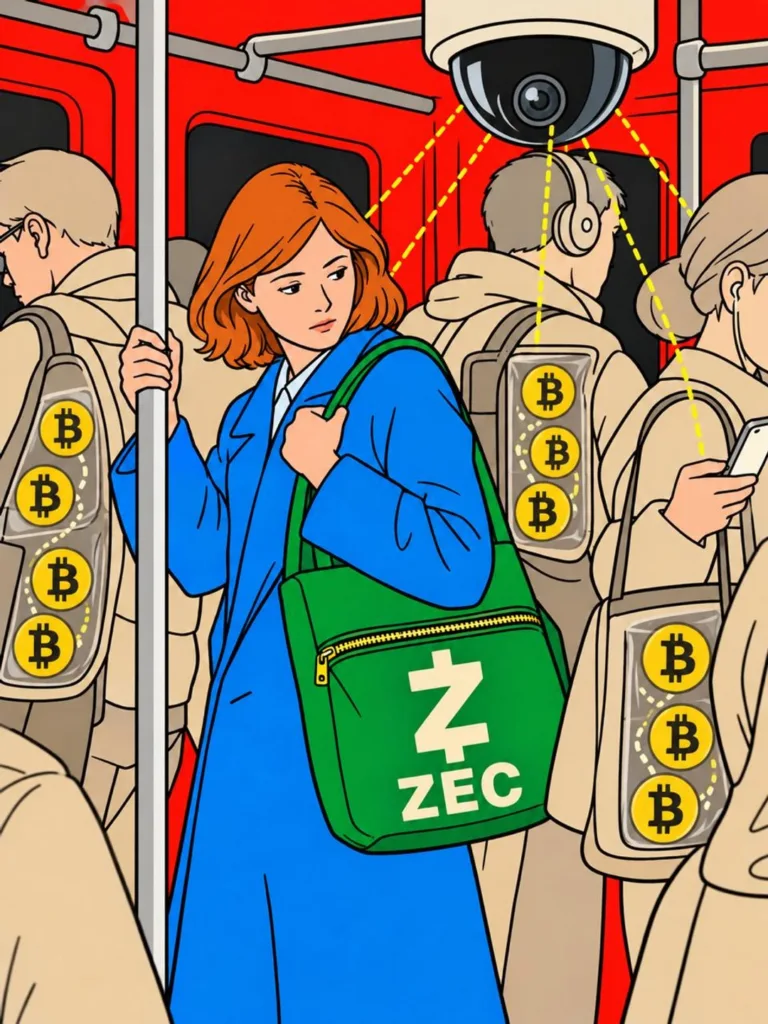
Every Bitcoin transaction is public forever. Wallet addresses carry no names, but anyone can see who sent how much and when. Until now that wasn't a big problem, because linking an address to a real person took court orders, exchange records or expensive tracking firms.
Grayscale, a U.S. crypto asset manager, says its research team sees that changing fast. AI can cheaply match wallets against exchange accounts, leaked data, social media and timing patterns. Because a blockchain can't be erased, even a 2019 transaction can be traced to its owner by software that only appeared in 2026.
Imagine every household's spending diary pinned to your apartment building's notice board, with no names. It used to be too much trouble to work out whose was whose, but now AI can quickly guess the unit number from when packages arrive and how much they cost. Note, though, that Grayscale, which produced this analysis, runs a Zcash ETF (a fund that trades on an exchange like a stock).
- Do the numbers show only a price rise?
By the Grayscale research team's count, about 4.9 million coins, roughly 29% of all Zcash mined so far, sit in the space for hidden payments (the shielded pool). Over the past two years, shielded transactions grew sharply, while ordinary public transactions stayed flat.
Put simply, it wasn't only the price that rose: payments using the hiding feature grew too. Figures such as how many people use it have not been released, though. Shielded transactions get harder to single out the more people use them.
- How did the money come in?
Grayscale's Zcash ETF (ticker ZCSH) began trading on NYSE Arca in the U.S. on Aug. 25. It gathered more than $1 billion in its first 30 trading days. An ETF like this uses the money it receives to buy and hold real Zcash. Grayscale's Krista Lynch said that puts it in the top 1% of ETFs launched over the past decade by money raised in the first month.
On top of that, a company of the Winklevoss twins, who founded the U.S. crypto exchange Gemini, filed a registration statement for a Zcash ETF on Oct. 6. It has not been approved yet. Its annual fee is 0.25%, one-tenth of Grayscale's (2.5% a year). On KRW 10 million invested for a year, Grayscale would take KRW 250,000 in fees and the Winklevoss ETF KRW 25,000 (hypothetical calculation).
- What changes for a coin that ETF money crowds into?
Once there is an ETF, even people who don't know how to set up a crypto wallet can buy the coin through a brokerage account. The door for money coming in gets wider. But money can leave through the same door, and having an ETF doesn't protect the price. Bitcoin has ETFs too, yet after hitting a record $126,198 on Oct. 6, 2025, its price on Oct. 7 was about 34% below that (calculated).
Regulation is also an open question. Hiding transactions is not illegal in itself, but it is not settled whether regulators used to seeing every transaction will accept a system that shows information only when needed. Global anti-money-laundering rules and the European Union's crypto regulation (MiCA) are moving toward more automatic reporting.
- BITPRESS Insight
The people whose judgment this news changes are investors who notice a coin only after it has soared. The same 2,300% means something different when only the price rose than when the number of people actually using the coin's feature grew too. For Zcash, the growth in shielded transactions and the 29% sitting in the shielded pool are offered as evidence of new demand.
Even when demand is real, though, the price moves on its own. A coin that, by Grayscale's count, drew more than $1 billion through an ETF in 30 trading days could see that money rush out through the same door when the mood changes.
When a coin's price jumps, asking first "did only the price rise, or did the number of users rise too?" is the line between a fad and new demand. And even if users grew, money crowded into one ETF can leave all at once through the same door.
Sources
https://www.coindesk.com/coindesk-indices/2026/10/07/crypto-long-and-short-zcash-and-the-case-for-privacy-in-the-age-of-ai
https://www.theblock.co/news/markets/2026-10-07-grayscale-crypto-etf-market-beyond-bitcoin-ether-417953
https://www.sec.gov/Archives/edgar/data/0002158471/000110465926113940/tm2626975-1_s1.htm
https://www.cryptometer.io/news/grayscale-launches-zcash-etf-on-nyse-arca-with-2-5-annual-sponsor-fee/
https://fortune.com/article/price-of-bitcoin-10-07-2026/
https://stocktwits.com/news-articles/markets/cryptocurrency/zec-soars-over-60-in-one-week-tyler-winklevoss-says-there-are-more-millionaires-in-the-world-than-whole-units-of-zcash/cZYkkAZRJ8i
Glossary
Privacy coin — A coin built so you can hide transaction details such as the sender, the recipient and the amount.
Shielded transaction — Zcash's way of making a payment in which the network only checks that it is valid, without revealing who sent how much to whom.
Viewing key — A key that lets you show only the needed part of your hidden transactions to a chosen party, without giving them the power to move your money.
ETF — A fund that trades on an exchange like a stock; buying a crypto ETF lets you invest in a coin's price through a brokerage account, with no crypto wallet.
MiCA — The European Union's rules for the crypto market, which also apply to firms handling coins like Zcash.
BITPRESS articles are information to help your investment decisions, not a recommendation to buy or sell any stock or coin. Investment decisions and their results are your own responsibility.